Kinetico vs SpringWell: is the twin-tank worth the premium?
For most homeowners on normal city power, SpringWell is the better value: a published price, a metered softener that quietly recharges overnight, and a system you can install yourself or hand to any plumber.
Choose Kinetico if you lose power often, live off-grid, or simply want a softener with no electronics, because its water-powered twin-tank runs with no power and always keeps soft water flowing.
Here’s the part most comparisons skip. Both brands soften water the same proven way, so the real decision is whether Kinetico’s clever twin-tank design is worth paying roughly double for.
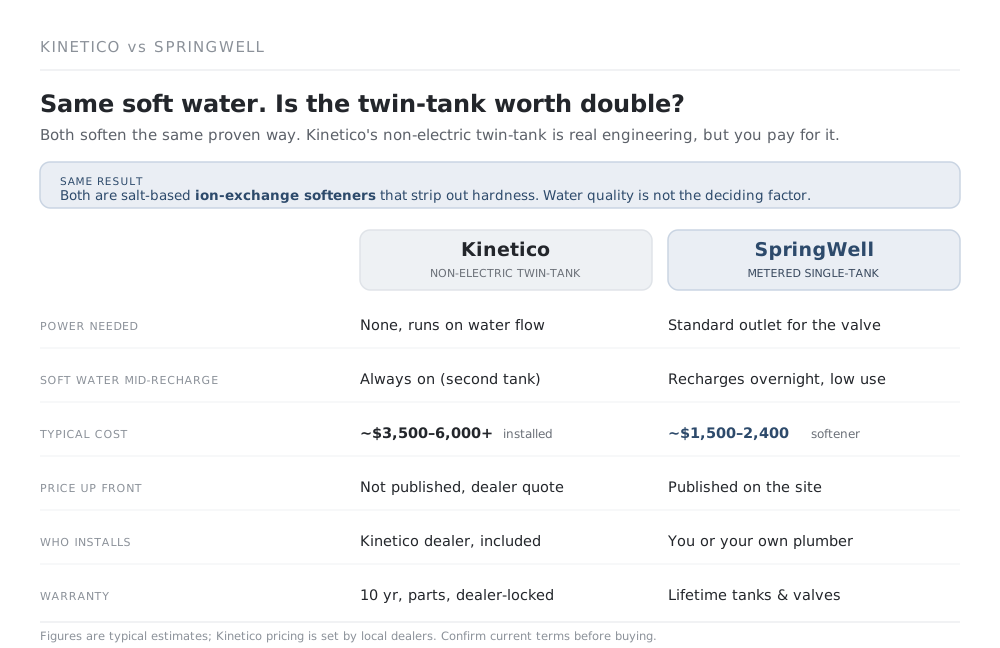
What actually differs is the tank, not the softening
Both companies sell salt-based ion exchange softeners, the standard technology that removes hardness minerals from your water.
Run either one and your spotty glasses, scaly showerheads, and crusty faucets go away.
So the water comes out the same. What differs is the machine that does it, and how much you pay for it.
Kinetico builds a non-electric, twin-tank system. Two resin tanks work in turn, and moving water, not power from the wall, drives the recharge. (Kinetico)
SpringWell builds a metered, single-tank system. One tank does the work, a meter tracks your water use, and it recharges on a schedule you rarely notice. (SpringWell)
Both are good machines. The rest of this page is about which one your home actually needs.
Kinetico vs SpringWell at a glance
| Kinetico | SpringWell | |
|---|---|---|
| Tank design | Non-electric twin-tank | Metered single-tank |
| Power needed | None (water-powered) | Standard outlet for the valve |
| Continuous soft water | Yes, even while recharging | Recharges overnight at low use |
| How you buy | Local dealer, in-home quote | Direct-to-consumer, online |
| Price shown up front | No (quoted after a home visit) | Yes (published on the site) |
| Typical cost | ~$3,500–$6,000+ installed (Premier) | ~$1,500–$2,400 for the SS softener |
| Who installs it | Kinetico dealer (included) | You, or a plumber you hire |
| Warranty | 10 years (Premier), dealer-installed | Lifetime tanks & valves |
| Parts & service | Kinetico-only, dealer service | Standard, direct support |
Sources: Kinetico, SpringWell.
How the non-electric twin-tank actually works
Give Kinetico credit: the design is genuinely smart.
Instead of a timer or a circuit board, water flow spins a small internal turbine that starts the recharge. There is nothing to plug in and no electronics to fail. (Kinetico)
Because there are two tanks, one is always softening while the other recharges. You never draw hard water, even in the middle of a recharge.
It also meters your actual water use and only recharges when the resin is nearly spent, so it doesn’t waste salt on a fixed timer. (Kinetico)
That’s real engineering, and for the right home it’s worth paying for. The question is whether yours is that home.
Does continuous soft water actually matter for you?
This is the benefit Kinetico’s whole premium rests on, so it’s worth being honest about.
A single-tank softener like SpringWell does go offline for about an hour while it recharges. To avoid that, it meters your use and recharges in the early morning, when almost no one is drawing water. (SpringWell)
So for a typical household, the “you might hit hard water mid-recharge” problem the twin-tank solves rarely happens in the first place.
The twin-tank’s continuous supply genuinely pays off in a few cases: a very large household drawing water around the clock, a home with unusual overnight demand, or a small business.
For most families on city water, though, an overnight-recharging single tank delivers soft water every waking hour just the same.
The non-electric part is a different story, and a real one. If you lose power regularly, live off-grid, or run your well on a generator, a softener that needs no power is a genuine advantage. On stable city power, it’s a feature you’ll never notice.
Price: a published number vs a dealer quote
The cost gap here is wide, and it’s the heart of the decision.
SpringWell publishes its salt-based softener online at roughly $1,500 to $2,400, depending on the grain size your home needs. (SpringWell)
Kinetico doesn’t publish prices at all. Every system is quoted after an in-home visit, and each dealer sets its own pricing in an exclusive territory.
In practice, a Kinetico Premier twin-tank commonly runs about $3,500 to $6,000 or more installed, with entry Signature units lower and filtration bundles climbing past $10,000.
That gap is often two to three times the price of a SpringWell for the same soft water.
Kinetico is also a dealer-quote brand, the same model Culligan uses, so you learn the real number only after a rep is in your home. Our Culligan vs SpringWell comparison breaks down that dealer-quote-versus-published-price gap in detail.
What the Kinetico premium actually buys you
Sticker shock aside, the fair question is what that extra $2,000 to $4,000 is buying. Here’s each Kinetico advantage against whether a typical city home will ever use it.
| Kinetico advantage | Real? | Who actually cashes it |
|---|---|---|
| Continuous soft water mid-regen | Yes | Round-the-clock or very large demand; most homes never notice |
| Non-electric operation | Yes | Off-grid, frequent outages, or you want no electronics |
| Salt savings | Partly | “Up to 70% less” is vs old timer softeners; a metered SpringWell is already efficient |
| 10-year warranty | Yes | Strong, but parts-only and dealer-locked (service-call fees) |
Look closely at the salt savings, because it’s the one that sounds like it pays for itself. It doesn’t.
Kinetico’s “up to 70% less salt” figure is measured against conventional timer-based softeners.
SpringWell’s SS is already a metered, demand-initiated softener, so it captures most of that same efficiency. The real salt difference between the two is small.
Even if Kinetico saved you $70 a year in salt, recovering a $2,500 price gap would take about 35 years. Salt efficiency never pays back the premium.
So the premium isn’t justified by running costs. It’s justified only by a specific situation: power outages, off-grid living, or continuous heavy demand. So weigh the buy against your real circumstances rather than the sales brochure.
Warranty: strong on paper, with a catch
Kinetico backs its top systems for a long time, but the fine print matters.
The Premier XP carries a 10-year warranty and the Signature Series a 5-year one, and both apply when a Kinetico specialist installs the unit. (Kinetico)
The catch is that Kinetico’s parts are made by Kinetico alone, so you’re tied to your local dealer for service, parts, and warranty work for the life of the system.
Owners report that this can mean a service-call fee even for a covered repair, hourly labor charges, and a minimum charge if you live far from a dealer. (ConsumerAffairs)
SpringWell takes the opposite approach. It gives a lifetime warranty on the tanks, valves, and heads, backs it with a 6-month money-back trial, and supports you directly rather than through a dealer. (SpringWell)
One honest caveat on SpringWell’s trial: owners report a restocking fee of around 25% on refused or uninstalled returns, plus you pay return shipping on the heavy tanks.
So Kinetico’s coverage is long but locks you to the dealer, while SpringWell’s is lifetime and self-served but costs you shipping and a fee if you send it back.
What about well water, iron, or a rotten-egg smell?
Kinetico markets its softeners for well water and even some iron, so this deserves a clear answer. (Kinetico)
A softener can handle a little dissolved, clear-water iron. But it is built to remove hardness, not iron, and pushing raw well water full of iron through it fouls the resin and shortens its life.
If your water is orange, leaves rust stains, or smells like rotten eggs, that’s oxidized iron or sulfur, and no softener alone will fix it.
For that water you need an iron and sulfur filter ahead of the softener. Our guide to the best iron filter for well water explains how to size that first stage.
Kinetico will quote that combination through its dealer, at a dealer price. SpringWell sells it as a single combined unit, an air-injection iron and sulfur filter paired with the softener, at a published price.
Check price at SpringWell(opens on SpringWell, external site)The case for each brand
Choose SpringWell if you want value on normal power
SpringWell is the better pick for most homeowners whose lights stay on.
You see the price before you buy, you get a lifetime warranty on the tanks and valves plus a 6-month money-back trial, and you keep the $2,000-plus a twin-tank premium would have cost. (SpringWell)
Its metered SS softener recharges overnight, so in daily use you get soft water just as continuously as a twin-tank owner does. (SpringWell)
The honest trade-off: you arrange your own install, and returning a heavy system under the guarantee costs shipping and a restocking fee.
If your power flickers often or you’re off-grid, Kinetico’s non-electric design is the better fit.
Check price at SpringWell(opens on SpringWell, external site)Choose Kinetico if power reliability or no electronics matters
Kinetico earns its premium when the situation calls for it.
If you lose power often, live off-grid, run a generator, or simply want a softener with no timers or circuit boards to fail, the water-powered twin-tank is genuinely the better machine. (Kinetico)
A very large household with round-the-clock water use also gets real value from the continuous, never-interrupted supply.
The honest trade-off: you won’t know the price until a dealer is in your home, it commonly costs two to three times a SpringWell, and its brand-only parts tie you to that dealer for service. (ConsumerAffairs)
If you’re on stable city power and want the lower cost, SpringWell makes more sense.
Which is right for you?
| Choose SpringWell if… | Choose Kinetico if… |
|---|---|
| Your power is stable city service | You lose power often or live off-grid |
| You want to see the price before you buy | You’re fine getting a quote after a home visit |
| You’ll install it yourself or hire a plumber | You want a dealer to install and service it |
| You want the lowest cost for soft water | You want no electronics and continuous supply at any cost |
| You want a lifetime tanks-and-valves warranty | You want a long dealer-backed warranty and local service |
Either way, you’ll end up with soft water. The difference is how much you pay, and whether you’re buying a feature your home will actually use.
Frequently asked questions
Is Kinetico or SpringWell better?
For most homeowners on stable city power, SpringWell is the better value: a published price of about $1,500 to $2,400 for a metered softener that recharges overnight, plus a lifetime warranty on the tanks and valves. Kinetico is the better choice if you lose power often, live off-grid, or want a softener with no electronics, because its water-powered twin-tank runs without power and never draws hard water during a recharge.
Do I really need a twin-tank softener for continuous soft water?
Usually not. A single-tank softener like SpringWell meters your water use and recharges in the early morning when no one is drawing water, so a typical household almost never hits hard water. A twin-tank’s non-stop supply mainly pays off for very large or round-the-clock demand, or when you want a softener that needs no power.
Why is Kinetico so expensive, and why won’t they publish a price?
Kinetico sells through local dealers who quote each system after an in-home visit, and each dealer sets its own pricing, so there’s no public price list. A Premier twin-tank commonly runs about $3,500 to $6,000 or more installed, often two to three times a comparable SpringWell, partly for the twin-tank hardware and partly for the dealer and install.
Which is better for well water with iron?
Neither softener alone is the answer. A softener removes hardness and can tolerate only a little dissolved iron; oxidized iron and a rotten-egg sulfur smell need an iron filter ahead of the softener. Kinetico sizes that combination through a dealer, while SpringWell sells it as a single combined filter-and-softener system at a published price.
Which has the better warranty, Kinetico or SpringWell?
Kinetico’s Premier XP carries a 10-year warranty and the Signature a 5-year one, but the parts are made only by Kinetico, so you rely on your dealer for service and may pay a service-call fee even under coverage. SpringWell gives a lifetime warranty on the tanks, valves, and heads plus a 6-month money-back trial, supported directly rather than through a dealer.
Does a non-electric softener really matter?
Only if your power isn’t reliable. Kinetico’s water-powered design keeps softening during an outage and has no electronics to fail, which is a real advantage off-grid or in an area with frequent outages. On stable city power, a standard metered softener does the same job, and the outlet it uses is not a meaningful downside.
Is SpringWell hard to install yourself?
No, SpringWell designs its systems for DIY, and the warranty holds whether you or a plumber installs it. The softener connects at your main water line, needs a nearby drain and a power outlet, and takes a handy homeowner a few hours. If you’d rather not, a local plumber can fit it for a few hundred dollars and you’re still well under a Kinetico quote.
Comparing the other dealer brand too? See our Culligan vs SpringWell breakdown of the dealer-quote model.
Not sure a softener is even what your water needs? Start with our water softener system guide, which explains what softening does and doesn’t fix.
Want the full field, not just these two? Our best water softener guide ranks the systems worth buying, for city and well water.
How we researched this
We built this comparison from Kinetico dealer cost data and product specs. We added SpringWell’s published prices and warranty terms, plus independent owner reviews of warranty service, pricing, and reliability.
We don’t install these two systems side by side ourselves yet, so we don’t claim first-hand testing, and every price, warranty term, and figure here is attributed to its source.
Kinetico pricing is set by local dealers and SpringWell updates its lineup, so treat every number as approximate and confirm the current price and warranty on the model before you buy.
When we name a merchant it’s SpringWell, and we may earn a commission if you buy through a link here, at no cost to you.