Best iron filter for well water: match the fix to your iron type
Rust-colored stains in your toilet, sink, or laundry, or a metallic taste, almost always mean iron in your well water.
The right filter depends on which of three iron problems you have: ferrous iron (clear at the tap, turns rusty as it sits), ferric iron (already red or orange when it comes out), or iron bacteria (a rusty slime and a swampy smell).
Run the quick test below, then match the fix.
A water softener only helps with the first one, and can make the other two worse.
The 5-minute test: which iron do you have?
Fill a clear glass straight from an unfiltered tap and watch it.
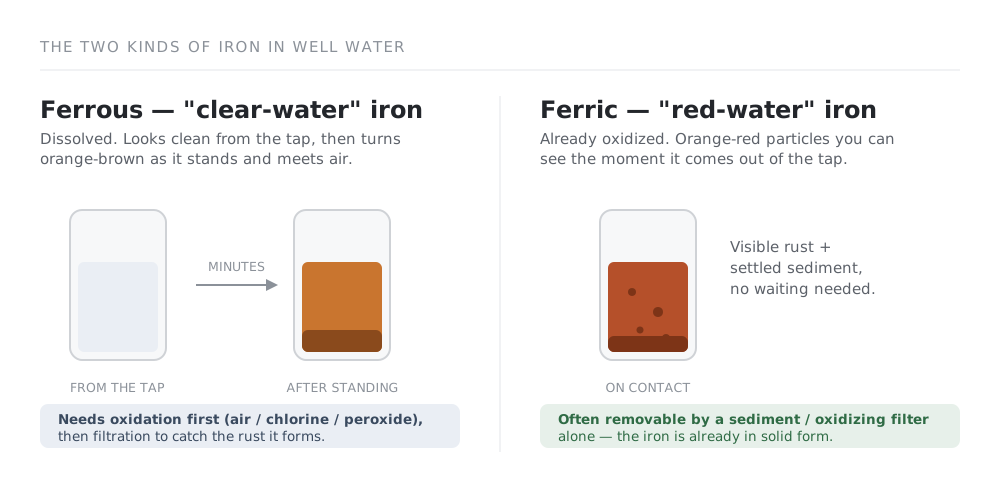
- Clear at first, turns reddish-brown or leaves sediment within 20–30 minutes → you have ferrous (“clear-water”) iron. It’s dissolved and invisible until it hits air and oxidizes.
- Already red, orange, or cloudy the moment it comes out of the tap → you have ferric (“red-water”) iron. It’s already oxidized, often because the water picked up oxygen underground or runs at a higher pH.
- A rusty, oily-looking sheen forms on standing water after a day, plus a swampy, musty, or cucumber-like smell → you likely have iron bacteria, organisms that feed on iron and leave a slime behind. It’s common in well soils and isn’t itself a health risk, but it clogs pumps, screens, and plumbing if it’s left alone. (Minnesota Dept. of Health)
This test is a fast first read, not a substitute for a real test.
It won’t tell you the concentration, and it can miss manganese or hardness riding along with the iron, both of which change the fix.
Test for iron, manganese, and hardness together before you buy anything.
If you haven’t tested yet, see well water testing or the best well water test kits to get real numbers first.
Quick diagnosis by symptom
- Rust or orange stains on toilets, sinks, tubs, or laundry → iron, likely ferric or ferrous that’s had time to oxidize.
- Metallic taste, water looks fine → ferrous iron, still dissolved when it reaches your glass.
- Rainbow, oily-looking sheen on standing water → iron bacteria.
- Black staining along with the rust → manganese is probably along for the ride; test for it too.
- Rotten-egg smell as well as the staining → you likely have sulfur too. See why your well water smells like rotten eggs for that half of the fix.
- Yellow or tea-colored water with no metallic taste → that’s more likely tannins, not iron; the fix is different.
Is iron in well water dangerous?
No.
The EPA doesn’t set a health-based limit for iron, only a secondary (aesthetic) standard of 0.3 mg/L (0.3 ppm), above which water is considered objectionable to taste, smell, or look at.
Iron’s real cost is cosmetic and mechanical: stained fixtures and laundry, a metallic taste, and, over years, buildup inside pipes, water heaters, and appliances that can cut flow and shorten their life.
Iron bacteria’s slime isn’t a disease risk on its own, but it can create conditions for other organisms to grow and will clog a well screen or pump if you never deal with it. (Penn State Extension; Minnesota Dept. of Health)
Why a water softener usually isn’t the fix
This is the most common wasted purchase in well water treatment, and it’s the same mistake people make with sulfur: a softener trades calcium and magnesium for sodium.
It can pull out some dissolved ferrous iron incidentally, within a fairly narrow range, but ferric iron particles foul and clog the resin bed instead of being removed by it, and a softener does nothing at all for iron bacteria.
If your water is also hard, and your lab report is confirmed ferrous iron in the light-to-moderate range, a softener can carry some of the load.
But if you’re seeing rust-colored water or a slime/sheen, skip it and go straight to an oxidizing filter.
Match the fix to your iron type and severity
| Your situation | The fix | What to expect |
|---|---|---|
| Ferrous iron, light-moderate, water also hard | Water softener (if pH and hardness are in range), or air injection | Softener may handle it incidentally; if staining is visible, air injection is the safer bet |
| Ferric iron, or ferrous above softener range (roughly 3–10+ ppm) | Air-injection oxidation (AIO) or manganese greensand filter | The standard whole-house fix; no chemicals, oxidizes the iron and filters it out in one tank |
| Heavy iron (above ~10–15 ppm) or iron + manganese together | Chemical oxidation (chlorine or hydrogen peroxide injection) + filter | Handles loads a single-tank system can’t; more upkeep |
| Iron bacteria (slime, sheen, swampy smell) | Shock chlorination of the well and system, sometimes repeated; a filter afterward for any remaining staining | Filtration alone won’t kill bacteria living in the well or plumbing |
A few specifics behind the table:
Ferric or moderate-heavy ferrous: air-injection oxidation
This is the workhorse fix for most well owners with visible iron.
It pulls air into the tank, the oxygen converts dissolved and particulate iron into a form the filter media can catch, and it backwashes itself clean on a schedule.
No salt, no chemicals to refill.
It’s the same class of system already compared in depth, with real specs and pricing, on the best whole-house filters for well water: the SpringWell WS1/WS4 is rated up to roughly 7 ppm iron, and the US Water Systems Matrixx InFusion handles roughly 20–30 ppm and is rated against iron/sulfur bacteria for heavier cases.
PureHouse scoreSpringWell WS Whole-House Iron Filter8.9/10
PureHouse scoreUS Water Systems Matrixx inFusion7.9/10
Heavy iron or iron plus manganese: chemical oxidation
When the concentration is high, or manganese is riding along at meaningful levels, air alone may not oxidize it fast enough.
A small chemical-feed system doses chlorine or hydrogen peroxide ahead of a filter that removes what forms.
It’s more capable and needs more upkeep than air injection, and it’s the tier the Matrixx InFusion (linked above) is built for.
Iron bacteria: shock chlorination first
Filtration doesn’t kill bacteria living in your well casing or plumbing, so treating the water alone won’t solve it.
Shock chlorination, a strong chlorine dose through the well and system, is the standard first move, and it sometimes needs repeating.
A filter afterward handles any staining left over.
If shock chlorination doesn’t hold, that’s a job for a licensed well contractor, not a bigger filter. (Minnesota Dept. of Health)
Set expectations before you do it once and call it fixed: a Penn State study of coliform-contaminated wells found that shock chlorination plus a sanitary well cap kept bacteria out for a full year in only 15% of wells.
That’s why the table above says “sometimes needs repeating”: at a 15% one-year success rate, repeat treatment is the normal case.
A persistent recurrence points to a real contamination source, like a cracked casing, a missing well cap, or a nearby septic system, that a bigger dose of bleach won’t fix. (Penn State Extension)
Professional shock chlorination commonly runs $300–500 plus $100–200 for the follow-up test to confirm it worked; DIY with bleach and the right safety gear costs a fraction of that. (Angi)
System snapshot: flow, upkeep, and price
Here’s the same match-up as a buying snapshot, so you can size and budget before you click through: typical whole-house flow, the upkeep each system needs, and a price band.
| System type | Typical flow | Backwash / upkeep | Typical price |
|---|---|---|---|
| Water softener (light ferrous only) | 11–20 GPM | Regenerates with salt on a meter | $1,000–3,000 installed |
| Air-injection oxidation (AIO) | 12–20 GPM | Self-backwashes on a timer; no salt or chemical, under $150/yr | ≈ $2,204–2,963 (SpringWell WS) |
| Manganese greensand | 10–15 GPM | Backwashes, plus periodic media regeneration | $1,000–2,500 installed |
| Chemical oxidation (peroxide or chlorine) | ~10 GPM | Meters chemical ahead of a filter; $250–600/yr | ≈ $3,065–3,195 (US Water Matrixx InFusion) |
| Shock chlorination (iron bacteria) | One-off well and plumbing dose | Strong chlorine dose, often repeated | $300–500, plus $100–200 follow-up test |
The AIO and chemical-oxidation bands are equipment prices for the SpringWell WS and US Water Systems Matrixx InFusion; a plumber typically adds $200–500 to install either. Softener, greensand, and shock-chlorination figures already include labor.
Full specs and current pricing for the SpringWell and US Water Systems picks live on the best whole-house filters for well water.
What it costs
Residential iron filter systems commonly run $700–4,500 installed, with most homeowners landing around $1,000–2,500 for a single-tank air-injection or greensand system.
Air-injection specifically tends to run $1,200–2,500 installed; installation typically adds $200–500 on top of equipment when you hire a plumber.
Heavier cases needing chemical injection cost more upfront and carry an ongoing chemical expense.
These figures sit inside the same range already used for whole-house systems on this site: see the full cost and sizing breakdown for the specific SpringWell and US Water Systems pricing.
What a softener-first guess costs you
A water softener commonly runs $1,000–3,000 installed (HomeGuide), which is in the same ballpark as an air-injection system, so buying the wrong one first is a real cost worth avoiding:
| Cost | |
|---|---|
| Softener only (doesn’t fix ferric iron or bacteria) | ~$2,000 (midpoint of $1,000–3,000) |
| Air-injection, bought afterward once staining continues | ~$1,850 (midpoint of $1,200–2,500) |
| Total if you buy both | ~$3,850 |
| Air-injection, bought first (correct call for ferric iron) | ~$1,850 |
Guessing softener-first on ferric or heavier ferrous iron leaves the staining in place and adds roughly $2,000 on top of the air-injection system you needed anyway.
The 5-minute test above exists specifically to avoid that stacked cost: it tells you which tier you’re actually in before you buy anything.
Frequently asked questions
What’s the difference between ferrous and ferric iron?
Ferrous (“clear-water”) iron is dissolved and invisible until it hits air and turns rusty after sitting.
Ferric (“red-water”) iron is already oxidized and visibly red or orange the moment it leaves the tap.
Will a water softener remove iron from well water?
Only in a narrow case: light, dissolved (ferrous) iron in water that’s also hard, and within the resin’s range.
Ferric iron and iron bacteria will foul a softener’s resin instead of being removed by it.
How do I know if I have iron bacteria?
Look for a rusty, oily-looking sheen on water that’s been standing, plus a swampy, musty, or cucumber-like smell, especially after the tap hasn’t run for a while.
A lab culture test or a professional inspection confirms it, since the signs can overlap with plain iron staining.
What level of iron in well water is too much?
The EPA’s aesthetic threshold is 0.3 mg/L (0.3 ppm); above that, most people notice staining or taste.
Treatment tier depends on how far above that you are: light-moderate calls for a softener or air injection, heavier levels (roughly above 10–15 ppm) call for chemical oxidation.
How much does an iron filter for well water cost?
Commonly $700–4,500 installed, with most homeowners in the $1,000–2,500 range for a single-tank air-injection or greensand system.
Chemical-injection systems for heavier loads cost more and add an ongoing chemical expense.
What’s the best whole-house filter for iron in well water?
It depends on your concentration and whether bacteria are confirmed.
See the full SpringWell vs. US Water Systems comparison for specs, pricing, and which pick fits which iron level.
Not sure what’s actually in your water yet? Start with well water testing or compare well water test kits to get real numbers before you buy anything.
Ready to shop once you know your iron level? See the best whole-house filters for well water.
Also dealing with a rotten-egg smell? See the sulfur fix.
Seeing sand or grit as well? A sediment filter goes ahead of the iron filter and keeps grit off the media.
Iron and sulfur commonly show up together and are treated in the same tank.
For the full test-to-installed-system framework, see well water filtration system.
How we researched this
We built this guide from Penn State Extension and Minnesota Department of Health guidance on iron and iron bacteria in private wells, cross-checked against water-treatment specialists for cost ranges.
We don’t test these systems in-house yet, so we don’t claim to.
Every figure here traces to a cited source, and where we point to a specific product, it’s the SpringWell and US Water Systems picks already compared in depth on this site.
We may earn a commission if you buy through a link on the pages this one links to, at no cost to you.