Manganese in well water: why it stains black and how to remove it
Black or dark-brown stains in your toilet, sink, or laundry, plus a bitter, metallic taste, usually mean manganese in your well water.
Manganese is dissolved and invisible at the tap, then turns into black particles when it hits air, your fixtures, or your wash.
It almost always shows up alongside iron, usually at a lower concentration, and the same oxidizing filter often handles both.
The catch is that manganese comes out harder than iron: it oxidizes more slowly and needs a higher pH, so the fix has to be matched to your numbers.
Why your water stains black and tastes bitter
The staining is the giveaway.
Manganese leaves black, dark-brown, or almost purple stains on toilets, sinks, tubs, dishwashers, and light-colored laundry. (Penn State Extension)
You may also see black specks or an oily-looking black film on standing water, and taste a bitter, metallic edge. (Penn State Extension)
The reason you can’t see it coming is that dissolved manganese is clear at the tap.
It only turns black once it meets oxygen, which is why the stains appear inside fixtures and on clothes rather than in the glass.
Whites and light fabrics are the worst hit, and the stains set hard, so ordinary bleach can make manganese staining darker instead of lifting it.
Iron leaves rust-orange stains; manganese leaves black ones, and many wells have both.
If you’re seeing rust and black together, read this alongside the best iron filter for well water, because the two are usually removed in the same tank.
Where manganese in well water comes from
Manganese is a naturally occurring metal, not a sign of pollution.
It dissolves out of the soil and bedrock your well draws through, the same way iron does. (Penn State Extension)
That’s why the two travel together: iron and manganese often occur in the same groundwater, with manganese usually present at a much lower concentration than iron. (Penn State Extension)
Because it comes from local geology, levels vary well to well, so a neighbor’s clean result doesn’t tell you much about yours.
A lab test is the only way to get your actual number, and you want iron, manganese, and pH measured together, since all three decide the fix.
If you haven’t tested yet, see well water testing or the best well water test kits and get a real number, not a guess.
Is manganese in well water dangerous?
It depends on how much you have, and this is where manganese is unusual.
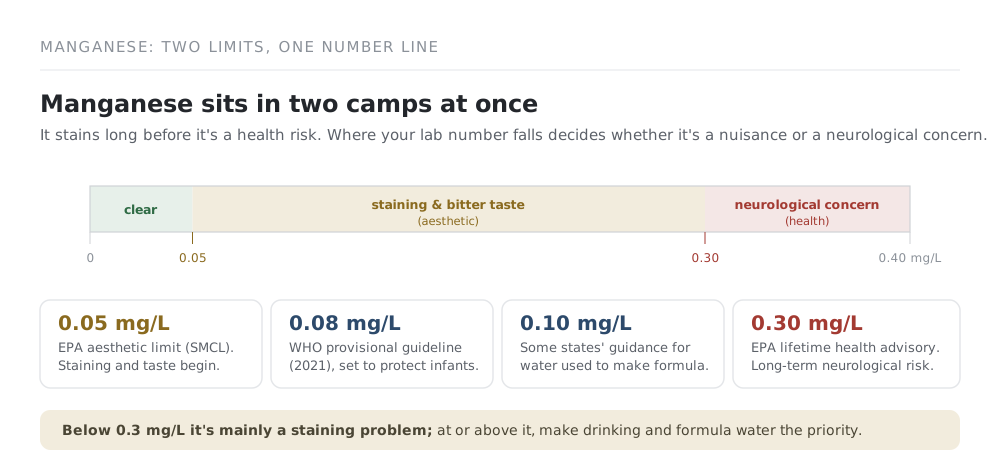
Most well-water metals are either an aesthetic nuisance or a health risk. Manganese is both, at different levels.
At low levels it’s an aesthetic problem: the black staining and bitter taste that brought you here.
At higher levels it becomes a genuine neurological health concern, which is why it carries two separate benchmarks.
| Benchmark | Level | What it’s based on |
|---|---|---|
| EPA secondary standard (SMCL) | 0.05 mg/L | Aesthetic: black staining and bitter, metallic taste |
| WHO provisional guideline (2021) | 0.08 mg/L | Health: neurological effects, set to protect bottle-fed infants |
| EPA lifetime health advisory | 0.3 mg/L | Health: long-term neurological risk |
| EPA short-term advisory (1-day and 10-day) | 1 mg/L | Acute exposure; for infants under 6 months, EPA applies the lower 0.3 mg/L |
Sources: EPA drinking water health advisory, WHO — Manganese in drinking-water (2021), Water Quality Association.
The staining shows up around 0.05 mg/L, well below the level where health becomes the concern, so most people notice manganese long before it’s a medical issue.
The health worry is neurological.
Long-term exposure to elevated manganese in drinking water is linked to problems with memory, attention, and motor skills in children and adults. (Minnesota Dept. of Health)
Infants are the most sensitive group, and this is the part worth taking seriously.
Babies under one year old can develop learning and behavior problems from drinking water, or formula made with water, that carries too much manganese. (Minnesota Dept. of Health)
The EPA advises that water for infants under six months stay at or below 0.3 mg/L.
It also says not to use water above that level for formula for more than a total of 10 days a year. (Water Quality Association)
Minnesota goes further and recommends 0.1 mg/L (100 µg/L) or less for water used to make infant formula. (Minnesota Dept. of Health)
If you have a bottle-fed baby and manganese on your test, the simplest safe move is to make formula with reverse-osmosis or bottled water while you sort out treatment.
One more benchmark if you’re in Canada: Health Canada sets a health-based maximum of 0.12 mg/L and an aesthetic objective of 0.02 mg/L. (Water Quality Association)
Like all these limits, they’re guidance for private wells, not law, so the number you test against is your call.
Why a plain iron filter can miss manganese
Manganese and iron look like the same problem, and they’re often removed in the same tank, but manganese is harder to catch.
It oxidizes more slowly than iron, and it needs a higher pH to oxidize fully.
For a filter to reliably pull manganese out, the water usually needs a pH above about 8, which is higher than iron requires.
Below that, dissolved manganese can slip straight through media that’s happily removing your iron.
That’s the trap: a system sized and set up for iron can leave black staining behind if the pH is too low or the media isn’t right for manganese.
Two things fix it.
The media has to be manganese-capable, such as manganese greensand or a manganese-dioxide catalytic media (sold as Birm, Filox, or Catalox).
And if your pH runs low, it may need to be raised ahead of the filter, or the manganese oxidized with a chemical feed, so the media actually catches it.
Ask whoever specs your system to confirm it’s rated for your manganese level at your pH, not just your iron.
Match the media to your manganese and pH
Each filter media catches manganese only over a certain concentration band and only above a certain pH. Here’s how the common ones line up.
Two quick terms for the table. Dissolved oxygen is the free oxygen already in your water; catalytic media need it to turn manganese into particles they can trap. Potassium permanganate is a purple oxidizer used to recharge greensand.
| Media | Manganese it handles | pH it needs | Notes |
|---|---|---|---|
| Water softener (ion exchange) | Low, still-dissolved only | Above 6.7 | Carries dissolved manganese out with the hardness. Fails once manganese has turned to black particles. |
| Birm | Low, and only with oxygen in the water | 8.0–9.0 (keep below 8.5 if iron is present too) | Needs dissolved oxygen of at least 15% of the iron level. It ignores manganese below pH 8. |
| Manganese greensand / GreensandPlus | Combined iron and manganese roughly 3–10 mg/L | 6.2 or higher (correct a lower pH first) | Coated media recharged with potassium permanganate. The mid-range workhorse. |
| Catalytic manganese-dioxide media (Filox, Pyrolox) | Up to about 5 mg/L manganese, 10 mg/L iron | 6.5–9, but 8 or higher for manganese | More manganese-dioxide ore than Birm, so it oxidizes faster and tolerates a bit less pH. |
| Chemical oxidation (chlorine or potassium permanganate) then filter | Combined levels over about 10 mg/L | Works at low pH with the right feed | For heavy loads air alone can’t oxidize. Chlorine is a poor pick for very high manganese, which needs a very high pH. |
Sources: Penn State Extension for the softener and greensand ranges; Clack for Birm; Inversand for the greensand pH floor; the Filox-R data sheet for the catalytic media.
The pattern across the table is the same one that trips up iron-only systems: manganese wants a higher pH than iron, so read your pH before you pick the media.
What actually removes manganese
| Your situation | The fix | What to expect |
|---|---|---|
| Manganese with iron, visible staining, whole house, pH near neutral | Air-injection oxidation (AIO) filter (the same tank that handles iron and sulfur) | No salt or chemicals; oxidizes and filters both metals; needs adequate pH and a periodic backwash |
| Combined iron + manganese around 3–10 mg/L | Manganese greensand filter, recharged with potassium permanganate | Reliable in this range; you top up the permanganate feed |
| High combined levels (over ~10 mg/L), or low pH that stalls oxidation | Chemical oxidation (chlorine or hydrogen-peroxide injection) + filter | Handles loads air alone can’t; more upkeep and ongoing chemical cost |
| Low, still-dissolved manganese, water also hard, pH under 8 | Water softener (ion exchange) | Pulls out low levels while it stays dissolved; fails once staining is already visible |
| Drinking and formula water only, lowest upfront cost, infant in the house | Under-sink reverse osmosis | Treats one tap; reverse osmosis removes manganese and is the simple fix for baby formula |
| Haven’t tested yet | Certified lab test (iron, manganese, and pH together) | Strips won’t give you the numbers that decide the fix |
Read your lab report in this order
Three numbers decide your fix: your pH, your combined iron and manganese, and what you actually want to solve.
Work through them in that order.
- Start with pH. Below about 8, manganese won’t oxidize cleanly, so you either raise the pH ahead of the filter or oxidize the manganese with a chemical feed. At 8 or above, an oxidizing filter can catch it as it comes.
- Then read your combined iron and manganese. Low and still dissolved, in hard water, and a softener can carry it as part of softening. Roughly 3–10 mg/L points to manganese greensand. Above about 10 mg/L calls for chemical or peroxide injection.
- Then ask what you’re solving. Whole-house staining needs an oxidizing filter on the main line. Safe drinking and formula water on its own needs only an under-sink reverse-osmosis unit.
Most wells with visible black staining land on an air-injection filter at step 2, because it clears iron and manganese in the same tank once the pH is right.
A few specifics behind the table.
Oxidation-filtration: the workhorse for iron plus manganese
For most wells with visible staining, an oxidizing filter is the answer, because it removes iron and manganese in one tank.
Air injection draws a pocket of air into the tank so the oxygen turns dissolved iron and manganese into particles the media traps, then it backwashes itself clean.
Manganese greensand does the same job with a coated media that you recharge now and then with potassium permanganate.
It’s a common pick when combined iron and manganese sit in the roughly 3–10 mg/L range. (Penn State Extension)
This is the same class of system compared in depth, with real specs, on the best whole-house filters for well water: the SpringWell WS is rated for iron, sulfur, and manganese, and the US Water Systems Matrixx inFusion uses peroxide injection for heavier iron, sulfur, and manganese loads.
PureHouse scoreSpringWell WS Whole-House Iron Filter8.9/10
PureHouse scoreUS Water Systems Matrixx inFusion7.9/10
If manganese is your main concern, make sure the system is set up for it specifically, since the pH and media that clear iron won’t always clear manganese.
When the load is heavy or the pH is low
When combined iron and manganese climb above about 10 mg/L, air alone may not oxidize it fast enough, and a chemical feed ahead of the filter does the work. (Penn State Extension)
Chlorine is a common oxidizer, but it’s a poor choice for very high manganese, because completely oxidizing manganese with chlorine needs a very high pH. (Penn State Extension)
Hydrogen-peroxide injection, the approach the US Water Matrixx uses, is the tier built for these heavier, harder-to-oxidize loads.
Where a softener helps, and where it doesn’t
A water softener removes low levels of dissolved manganese by ion exchange, the same way it handles light dissolved iron.
But it only works while the manganese stays dissolved, which means low total dissolved solids, low oxygen, and a pH under 8.
Once manganese has oxidized into black particles, it fouls the resin instead of being removed by it, so a softener is not the fix if you’re already seeing stains.
If your water is hard and your manganese is low and confirmed dissolved, a softener can carry it as part of softening; otherwise, treat the manganese with an oxidizing filter.
For drinking and baby formula: reverse osmosis
If the health side is your real worry, especially with a bottle-fed infant, an under-sink reverse-osmosis unit covers the tap you drink and cook from.
Reverse osmosis removes manganese, and it’s the cheapest way to get formula-safe water without treating the whole house. (Water Quality Association)
It doesn’t stop the staining elsewhere in the house, so many households pair a whole-house oxidizing filter for the stains with point-of-use reverse osmosis for drinking water.
What it costs
Manganese uses the same equipment as iron, so the costs match the iron-filter ranges already broken down on this site.
Whole-house oxidation filters (air-injection or greensand) commonly run $700–4,500 installed, with most homeowners landing around $1,000–2,500 for a single-tank system.
HomeGuide’s cost data lines up with that: it puts air-injection systems at $1,200–2,500 installed and greensand or catalytic filters at $1,000–2,500 installed. (HomeGuide)
Chemical or peroxide-injection systems for heavier loads cost more upfront and add an ongoing chemical and media expense, roughly $250–600 a year for a unit like the US Water Matrixx.
Under-sink reverse osmosis for drinking and formula water commonly runs $300–2,000 installed, and treats only the tap you connect it to.
For the specific SpringWell and US Water Systems pricing and sizing, see the best whole-house filters for well water and the iron filter guide, since manganese is treated with the same systems.
The one cost worth avoiding
The expensive mistake with manganese is buying a system set up for iron and finding the black staining still there.
That happens when the pH is too low or the media isn’t manganese-rated, and the fix is a second call-out or a second system.
A test that reports manganese and pH, before you buy, is what keeps you from paying twice.
Frequently asked questions
Is manganese in well water dangerous?
At low levels it’s mainly an aesthetic problem, the black staining and bitter taste.
At higher levels it’s a real neurological health concern, linked to problems with memory, attention, and motor skills, and to learning and behavior problems in infants.
The EPA’s health advisory sits at 0.3 mg/L, and bottle-fed babies are the most sensitive group.
What level of manganese in well water is safe?
The EPA’s aesthetic limit is 0.05 mg/L, where staining and taste begin, and its health advisory is 0.3 mg/L.
The WHO’s provisional guideline is 0.08 mg/L, set to protect infants, and some state agencies recommend 0.1 mg/L or less for water used to make formula.
Private wells aren’t required to meet these, but they’re the benchmarks to test against.
Why does my well water leave black stains?
Dissolved manganese is clear at the tap, then oxidizes into black particles when it meets air, fixtures, or laundry.
That’s why the stains show up in toilets, tubs, dishwashers, and on light-colored clothes rather than in the glass.
Does a water softener remove manganese?
Only low levels of still-dissolved manganese, and only while your water has low dissolved solids, low oxygen, and a pH under 8.
Once manganese has oxidized into black particles, it fouls the softener resin, so a softener isn’t the fix if you already see staining.
Does reverse osmosis remove manganese?
Yes.
An under-sink reverse-osmosis unit removes manganese and is the simplest way to get safe drinking and formula water without treating the whole house.
Can one filter remove both iron and manganese?
Usually, yes, an oxidizing filter can handle both in one tank, but manganese is harder to catch.
It oxidizes more slowly and needs a higher pH, around 8, so the system has to be set up for manganese specifically, not just iron.
Is manganese in well water safe for babies?
Bottle-fed infants are the most sensitive group, and water above 0.3 mg/L shouldn’t be used for formula for more than about 10 days a year, per the EPA.
If your test shows manganese, make formula with reverse-osmosis or bottled water until treatment is in place.
Haven’t tested yet? Start with well water testing or compare well water test kits, and ask for iron, manganese, and pH on the same report.
Seeing rust-orange stains too? Manganese and iron usually travel together and come out in the same tank; see the best iron filter for well water.
Ready to shop once you know your numbers? See the best whole-house filters for well water.
For the full test-to-installed-system framework, see well water filtration system.
How we researched this
We built this guide from EPA drinking-water health advisory documents, the World Health Organization’s 2021 manganese review, Penn State Extension and Minnesota Department of Health guidance on iron and manganese in private wells, water-treatment technical references for the pH and media details, and HomeGuide cost data for installed pricing.
We don’t test these systems in-house yet, so we don’t claim to.
Every figure here traces to a cited source, and where we point to a specific product, it’s the SpringWell and US Water Systems picks already compared in depth on this site.
We were not able to pull first-hand well-owner language for manganese from Reddit or forum threads in this research pass, since those sources weren’t reachable during research; we describe the symptoms from extension and health-department sources rather than inventing quotes.
We may earn a commission if you buy through a link on the pages this one links to, at no cost to you.
Sources
- EPA — Drinking Water Health Advisory for Manganese (SMCL 0.05 mg/L; HA 0.3 mg/L; 1 mg/L acute)
- WHO — Manganese in drinking-water, 2021 (provisional guideline value 0.08 mg/L, WHO/HEP/ECH/WSH/2021.5)
- Penn State Extension — Iron and Manganese in Private Water Systems
- Minnesota Dept. of Health — Manganese in Drinking Water
- Water Quality Association — Manganese fact sheet (infant/formula guidance; reverse osmosis removal; Health Canada limits)
- HomeGuide — Well Water Filtration System Cost (air-injection and greensand installed pricing)
- Clack Corporation — Birm media spec sheet (pH and oxygen needs)
- Inversand — greensand technical notes (pH floor)
- Filox-R media data sheet (iron, manganese, and pH limits)