Well water filtration system: the complete guide
A well water filtration system is equipment installed where water enters your house (point-of-entry, or POE) that treats every tap and appliance at once, usually as a sequence of stages, each stage aimed at one contaminant: sediment, iron and sulfur, hardness, taste and chlorine, or bacteria.
There’s rarely a single box that does all of it.
The system you need depends on what’s actually in your water, so the real starting point is a test, not a product.
Buy first and test later, and you’ll usually get a perfectly decent system sized for the wrong water: a stage out of order, or a tank built for your neighbor’s iron levels instead of your own.
This guide walks through that decision in order: test, identify what you have, match the treatment stages, size it to your house, then decide who installs it.
For the full how-to on testing itself, see well water testing.
If you already know your problem, jump straight to why your well water smells like rotten eggs or the best whole-house filters for well water for the product-level comparison.
This page is the map that connects them.
On city water, or not sure your problem is well-specific? Start one level up with which home water filtration system you need, then come back here if it points you to a well.
What a well water filtration system actually is
“Filtration system” is a catch-all.
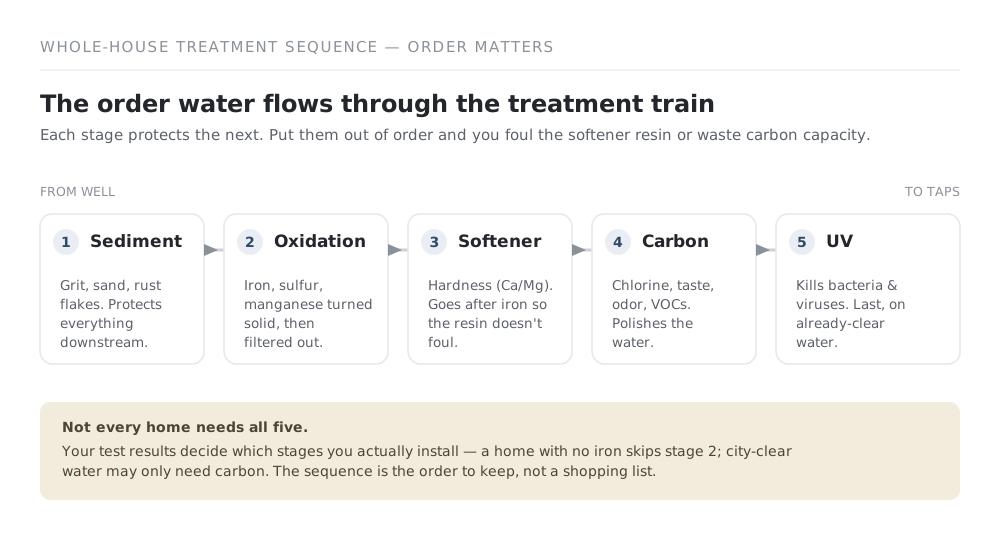
What it usually means, installed at the main line before water reaches your fixtures, is one or more of these stages, in this order:
- Sediment filter: catches grit and dirt so it doesn’t wear out everything downstream.
- Iron/manganese/sulfur oxidation-filtration: the workhorse stage for well water; converts dissolved iron, manganese, or hydrogen sulfide (the rotten-egg smell) into particles a filter bed can catch.
- Acid neutralizer (if your pH is low): protects plumbing and fixtures from corrosion.
- Water softener: exchanges calcium and magnesium (hardness) for sodium. Only after oxidation, never before, since raw iron and hydrogen sulfide will foul softener resin if they hit it first.
- Carbon filter: polishes taste and odor, reduces chlorine if you’re on a shared system.
- UV disinfection: kills bacteria, installed last because UV needs clear water to work. Sediment, iron, and hardness all block it or coat the UV sleeve.
Some products combine steps.
SpringWell’s WS air-injection tank, for example, handles sediment and iron/sulfur oxidation in one unit.
But no single tank on the market does all six stages, and a system sized for your neighbor’s iron levels can be the wrong size for your sulfur levels.
That’s why “buy a filtration system” is really “build a short stack of stages that match your water,” and it starts with a test.
Point-of-entry (POE) vs. point-of-use (POU): a whole-house system is POE, treating water for the entire structure at the main line.
Reverse osmosis for drinking water is usually POU, installed at one tap and treating only the water you drink and cook with.
Most homes on a well end up with both: a POE system for the whole house, and sometimes a POU system under the kitchen sink for drinking water on top of that. (EPA)
Step 1: test before you buy anything
Private wells aren’t regulated the way city water is.
There’s no utility checking your water for you.
If you’re on a well, you’re your own water utility, and testing is on you. (EPA)
Test annually for total coliform bacteria, nitrates, total dissolved solids, and pH.
Those four cover the most common and most urgent problems.
Run a broader panel (iron, manganese, arsenic, VOCs, and other metals) every 3–5 years, or right away if you notice a new smell, stain, or taste. (EPA)
A lab report gives you numbers in mg/L or ppm.
Those numbers, not how bad the smell or stain looks, are what size the system correctly.
Two houses with the same rotten-egg smell can need very different equipment depending on the actual hydrogen sulfide concentration.
One caveat: hydrogen sulfide escapes as gas fast, so a mailed-in sample often reads lower than what’s really at your tap.
Test that one at the tap or with a field kit instead.
For how to take a proper sample, how often to test, and what DIY kits vs. certified labs each get right, see well water testing.
Before you pay for a private lab panel, check whether your county already covers it.
Some states run free or subsidized well-testing at real scale: Iowa’s Private Well Grants Program, for instance, provides free sampling and analysis to private well owners and users in nearly every county in the state. (Iowa DNR)
Worth a five-minute check before you spend $50–500 on a test you might not have to pay for.
Step 2: identify what’s actually in your water
Once the lab report is back, match your numbers to a problem category.
The most common well water issues, and where to go deeper on each:
| What the test (or your senses) show | Likely problem | Go deeper |
|---|---|---|
| Rotten-egg smell, especially in hot water | Hydrogen sulfide (sulfur) | Sulfur smell diagnosis and fix → |
| Orange/rust staining, metallic taste | Iron | Best iron filter for well water → |
| Spots on glasses, dishes, soap won’t lather | Hardness (calcium/magnesium) | Water softener system guide → |
| Positive coliform/E. coli result | Bacteria | Bacteria in well water → |
| Elevated nitrate/nitrite | Nitrates (often near farmland or septic) | Nitrates in well water → |
| Elevated arsenic | Arsenic | Arsenic in well water → |
| Black staining, metallic taste, elevated Mn | Manganese | Manganese in well water → |
| Tea-colored water, staining on fabric | Tannins | Tannins in well water → |
Most wells have more than one issue at once.
Iron and sulfur commonly show up together, and hardness is nearly universal in well water.
That’s normal; it just means your stack has more than one stage.
Step 3: match the treatment stage to the problem
This is the core of the “system,” and it’s the piece a lot of first-time buyers get backwards: a water softener is not a filter.
It swaps hardness minerals for sodium and does nothing to iron, sulfur, sediment, or bacteria.
If you buy a softener expecting it to fix a smell or stop rust staining, it won’t, and that’s the single most common wasted purchase in well water treatment.
| Problem | Treatment stage | Removes hardness too? |
|---|---|---|
| Sediment/grit | Sediment pre-filter | No |
| Iron, manganese, hydrogen sulfide (light-moderate) | Air-injection oxidation (AIO) filter | No |
| Iron, sulfur (heavier) or confirmed bacteria in the iron/sulfur system | Chemical oxidation (chlorine/peroxide injection) + filter | No |
| Hardness | Water softener | N/A (this is what it does) |
| Chlorine taste/odor, general polish | Carbon filter | No |
| Bacteria | UV disinfection | No |
| Broad-spectrum drinking water polish (arsenic, nitrates, lead, most dissolved solids) | Reverse osmosis (usually POU, under-sink) | Partially, at the tap it serves |
Order matters as much as the stage list.
Sediment always goes first.
Oxidation for iron/sulfur always goes before the softener.
UV always goes last, because it needs water that’s already clear.
Skipping the order can shorten the life of downstream equipment, not just underperform: raw iron will foul softener resin, and sediment or iron will coat a UV sleeve and block the light bacteria need to see.
One correction to the table above: a positive coliform result calls for shock chlorination first, not a UV-shopping trip.
UV disinfection protects against bacteria going forward; it doesn’t clear an active contamination already in the well and plumbing.
And don’t treat one round of shock chlorination as case-closed — a Penn State study of contaminated wells found shock chlorination plus a sanitary well cap kept bacteria out for a full year in only 15% of wells, which is why persistent positives point to a real source (a cracked casing, a missing cap, a nearby septic system) that needs fixing before UV becomes the long-term safeguard rather than the first response. (Penn State Extension)
For most well owners with moderate iron or sulfur and no confirmed bacteria, a single-tank air-injection system (like the picks compared on best whole-house filters for well water) covers steps 1–2 in one unit.
Heavier levels or confirmed bacteria call for a chemical-injection system built for that load, also covered on that page with the actual specs and pricing.
Step 4: size it to your house, not just your water
A system correctly matched to your contaminants still needs to be sized for flow rate, measured in gallons per minute (GPM).
Practical minimum household flow is around 6 GPM; most whole-house filters are sold in tiers by bathroom count, roughly 10–12 GPM for 1–3 bathrooms and 15–20 GPM for 4–6 bathrooms. (Penn State Extension)
What actually drives peak demand is simultaneous use: a shower, the washing machine, and the dishwasher running at once.
Undersize the system and you’ll feel it as a pressure drop right when you need water most.
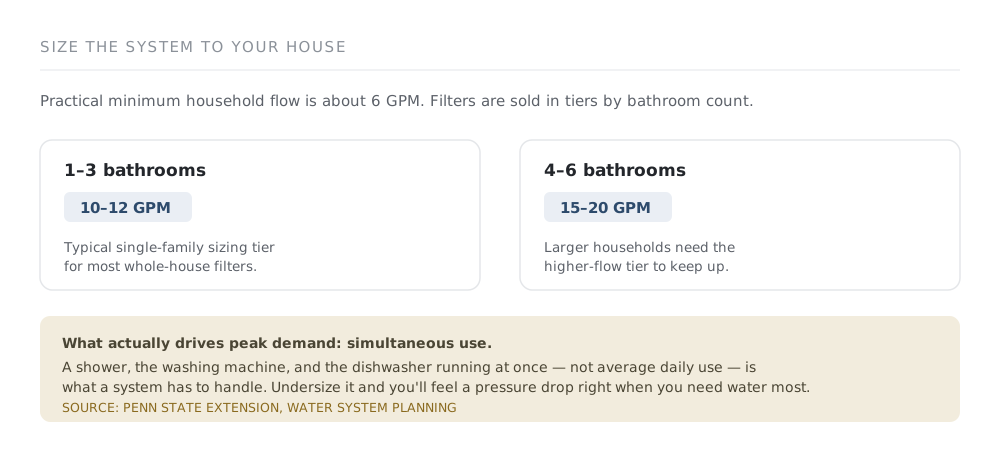
Penn State Extension publishes minimum flow rates by house size. Use them as the floor your system has to clear, then add headroom if several fixtures run at once.
| Household | Size the system for at least | Rough peak load |
|---|---|---|
| 2 bedrooms, 1 bath | 6 GPM | one shower plus a sink |
| 3 bedrooms, 1.5 baths | 10 GPM | shower plus washer |
| 4 bedrooms, 2 baths | 12 GPM | shower, washer, dishwasher |
| 4 bedrooms, 3 baths | 16 GPM | two showers plus an appliance |
Minimum flow figures from Penn State Extension. A single 8-minute shower already draws about 20 gallons, and a top-load washer 43–51 gallons a load, so peak demand climbs fast when uses overlap.
Tank size is the next question, and it’s where a simple “3 baths equals this tank” chart misleads.
A backwashing filter’s real service flow depends on the media inside it, not just the tank diameter.
The same 13-inch tank might pass 12 GPM of softener resin but only about 4 GPM of an iron-oxidizing media, because that media needs slower contact to work.
So one tank has a flow ceiling. Homes with heavy iron and high demand sometimes run two filters in parallel rather than one oversized tank.
Softeners are sized differently again, by grain capacity (your household’s daily water use times your hardness), not by GPM.
Match the GPM tier above to the product’s published service-flow rating, and size the softener from your hardness number, on the best whole-house filter comparison and the well water softener guide.
What your full stack actually costs
Every cost figure on this site so far has been for one stage at a time.
Most wells need more than one stage, so here’s what the combinations actually run, built by adding our own per-stage numbers together rather than quoting a single vague “whole-house system” range:
| Your test results | Stages you need | Typical installed cost |
|---|---|---|
| Iron or sulfur alone, moderate | Sediment + air-injection oxidation | ~$2,200–3,000 |
| Iron/sulfur + hardness | + water softener | ~$3,200–6,000 |
| Iron/sulfur + hardness + confirmed bacteria | + UV disinfection | ~$3,900–8,500 |
| Heavier iron/sulfur (or confirmed iron/sulfur bacteria) + hardness + bacteria | Chemical-injection stage instead of air-injection, + softener + UV | ~$4,800–10,500 |
*Built from: the air-injection stage priced on best whole-house filters for well water ($2,204–3,065 for the SpringWell-to-InFusion range); water softeners, commonly $1,000–3,000 installed (HomeGuide); and UV disinfection, commonly $700–2,500 installed (HomeGuide). These are additive estimates, not a quote — get one from a local installer once you know your stack.
What skipping Step 1 costs
Step 1 above says test before you buy anything.
Here’s the dollar reason why: a well owner who skips testing and installs the full “cover everything” stack, rather than the tier their water actually needs, pays for stages that were never necessary.
| Typical installed cost | |
|---|---|
| Correct fix, if the test shows iron/sulfur alone | ~$2,600 (midpoint of $2,200–3,000) |
| “Just in case” full stack — chemical injection + softener + UV | ~$7,650 (midpoint of $4,800–10,500) |
| Overspend from guessing instead of testing | ~$5,050 |
Most wells don’t need the full stack.
With a single iron or sulfur filter, skipping the test risks buying the one wrong stage.
With a whole stack, it risks paying for two or three stages you never needed, since there’s no test result narrowing down which ones actually apply.
Step 5: decide who installs it
Whole-house systems tie into your main water line, so installation is either a DIY plumbing project or a job for a local plumber.
All-in cost for a mid-range iron/sulfur system commonly runs $1,500–5,000 including professional installation; a basic sediment-only setup can be a few hundred dollars, and a multi-stage system covering iron, manganese, and bacteria can run $10,000+.
Professional install typically adds $150–500 on top of equipment. (HomeGuide)
If you’re comfortable cutting into your main line, DIY is realistic and saves that install fee.
If you haven’t done plumbing work like this before, the $150–500 for a plumber is cheap insurance against a leak in your basement.
The DIY install checklist
The exact fittings vary by product, so follow the manufacturer’s manual for torque and connection type. The order below is the same for almost any whole-house stage, and skipping a step is how basements flood.
- Shut off and depressurize. Close the main supply valve, then open the lowest faucet in the house to drain the line and drop the pressure to zero.
- Pick the spot. Install on the main line after the pressure tank but before the water heater, so the whole house is covered. Leave clearance above the tank for cartridge or media changes.
- Plumb in a bypass. Add a three-valve bypass loop (in, out, and a bridge). It lets you take the unit offline for service without cutting water to the house.
- Make the connections. Cut in, add unions on both sides so the unit comes out without re-cutting pipe, and seal every threaded joint. Point any drain line to a proper air-gapped drain for backwashing stages and UV.
- Start up slowly. Crack the main open part-way and let the tank fill gently. Rushing it slams trapped air against the media and can crack a housing.
- Purge the air. Run a nearby cold tap until the flow is smooth and free of sputtering.
- Leak-check under pressure. Bring the system to full pressure, then check every joint dry with a paper towel. Watch it for a full day, since a slow weep won’t show in the first five minutes.
- Sanitize before you drink. New plumbing and media should be disinfected and flushed per the manual before the water goes to taps, especially on a well.
Product-specific torque specs, media loading, and startup quirks live in each unit’s manual and on the best whole-house filter comparison.
Certifications worth checking
NSF/ANSI 42 covers aesthetic reduction (taste, odor, chlorine).
NSF/ANSI 53 covers reduction of contaminants with actual health effects, at thresholds the EPA sets.
NSF/ANSI 44 covers softeners, and NSF/ANSI 55 covers UV disinfection.
Not every product on the market publishes a certification number for its specific model, so confirm current status on the spec sheet rather than assuming “whole-house” means certified. (NSF)
Match the fix to your water
Once you know what’s in your water, here’s where to go for the specific problem and the system that handles it:
- Why your well water smells like rotten eggs, the 2-minute test to diagnose hydrogen sulfide and match the fix to your levels.
- Best whole-house water filtration system for well water, the SpringWell vs. US Water Systems product comparison, with specs, pricing, and 5-year cost.
- Well water testing, what to test for, how often, DIY kit vs. certified lab, how to take a sample correctly, and what your results mean.
- Best well water test kit, DIY strips vs. mail-in lab kits compared by price, accuracy, and what each one can’t detect.
- Best iron filter for well water, how to tell ferrous from ferric iron and iron bacteria apart, and which fix matches which one.
- Best sediment filter for well water, spin-down vs Big Blue cartridge vs backwashing, and which micron rating your grit needs.
- Arsenic in well water, why it’s a genuine health risk (not just an aesthetic one), why strip kits can’t detect it, and which treatment actually removes it.
- Nitrates in well water, why they’re a real health risk for infants and pregnant women, and the removal methods that actually work.
- Manganese in well water, why it stains black instead of orange like iron, and how to remove it.
- Tannins in well water, why your water runs tea-colored, and the fix that won’t just bleach the color out temporarily.
- Bacteria in well water, what a positive coliform or E. coli result means and when UV disinfection is (and isn’t) enough.
Frequently asked questions
What is a well water filtration system?
Equipment installed at the point your water enters the house that treats it before it reaches any tap or appliance.
It’s usually a short sequence of stages (sediment, iron/sulfur oxidation, softening, carbon, UV), each targeting one contaminant, rather than a single box that removes everything.
Do I need a water softener and a filter, or just one of them?
Most well owners need both, but they do different jobs.
A softener only removes hardness.
A whole-house filter (typically an oxidation system) removes iron, manganese, and sulfur.
If your water has both issues, you need both stages, with the filter installed ahead of the softener.
What’s the difference between a whole-house filter and a water softener?
A whole-house filter oxidizes and filters out iron, manganese, and hydrogen sulfide.
A softener exchanges hardness minerals (calcium, magnesium) for sodium.
Neither one does the other’s job.
What order should well water treatment stages go in?
Sediment first, then iron/sulfur oxidation, then an acid neutralizer if needed, then the softener, then carbon, then UV last.
Putting the softener before the oxidation stage fouls the resin with raw iron; putting UV before sediment or iron removal blocks the light it needs to work.
How do I know what size (GPM) system I need?
Match it to your bathroom count and how many fixtures run at once: roughly 10–12 GPM for 1–3 bathrooms, 15–20 GPM for 4–6 bathrooms.
Simultaneous use (shower, laundry, dishwasher) is what actually drives peak demand, not just the number of people in the house.
How much does a well water filtration system cost?
Commonly $1,500–5,000 installed for a mid-range iron/sulfur system.
Basic sediment-only setups run a few hundred dollars; multi-stage systems covering iron, manganese, and bacteria can exceed $10,000.
Can I install a well water filtration system myself?
If you’re comfortable cutting into your main water line, yes.
If you haven’t done that kind of plumbing work before, hiring a local plumber for $150–500 is a reasonable safeguard against a leak.
Do I need reverse osmosis if I already have a whole-house filter?
A whole-house filter doesn’t remove most dissolved contaminants like arsenic, nitrates, lead, or PFAS at the same level reverse osmosis does.
Many well owners run a whole-house system for the house and a separate under-sink reverse osmosis unit for drinking and cooking water.
How often do I need to test my well water?
Annually for coliform bacteria, nitrates, total dissolved solids, and pH.
Every 3–5 years, or right after any new smell, taste, or color change, run a broader panel that includes metals and other local contaminants.
Start with a test, then come back here to match the fix.
Need the how-to on testing itself? See well water testing.
Already diagnosed a rotten-egg smell? Go to the sulfur fix.
Ready to compare whole-house systems? See the SpringWell vs. US Water Systems comparison.
How we researched this
We built this guide from EPA private-well guidance, Penn State Extension’s treatment-threshold and flow-rate research, NSF/ANSI standards documentation, and cost data cross-checked against current manufacturer pricing.
We don’t run these systems ourselves yet, so we don’t claim first-hand testing, and every figure here is attributed to its source.
When we name a merchant, it’s SpringWell or US Water Systems, and we may earn a commission if you buy through a link on the pages this one links to, at no cost to you.
Sources
- EPA — Point-of-Use and Point-of-Entry Treatment Devices
- EPA — Protect Your Home’s Water
- Penn State Extension — Iron and Manganese in Private Water Systems
- Penn State Extension — Water System Planning: Estimating Water Needs
- NSF — NSF/ANSI 42, 53, and 401: Filtration Systems Standards
- HomeGuide — Well Water Filtration System Cost
- HomeGuide — Water Softener Cost
- Penn State Extension — Shock Chlorination of Wells and Springs
- Iowa DNR — Private Well Program: Well Testing