Best water softeners for well water
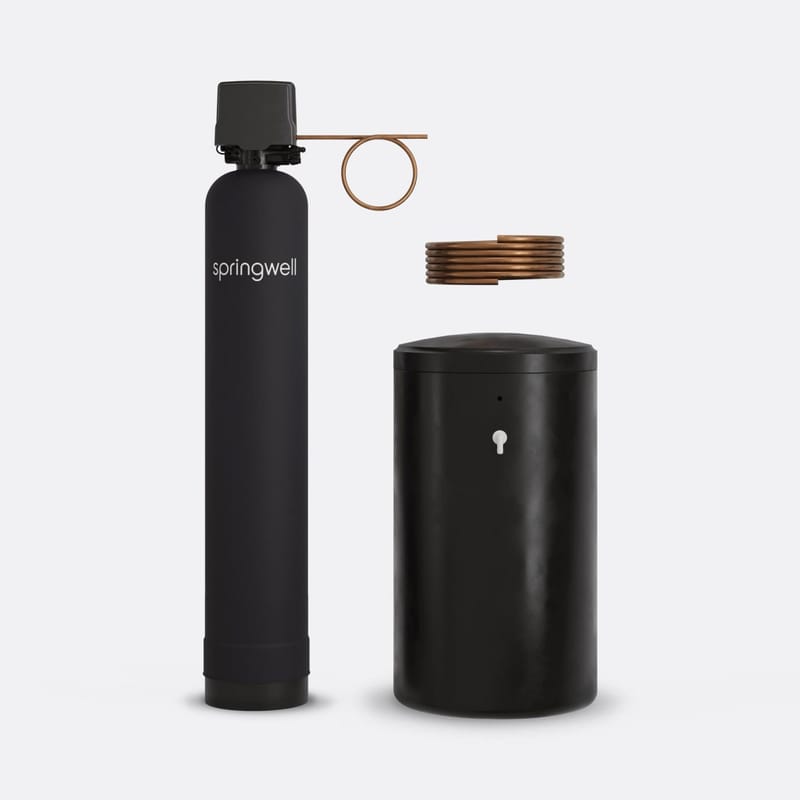
- Genuine ion-exchange softening for soft water at every tap.
- Smart metered regeneration recharges on actual water use, saving salt.
- Backed by a lifetime warranty on the tanks and valve.
- Simple enough for most owners to install without a dealer.
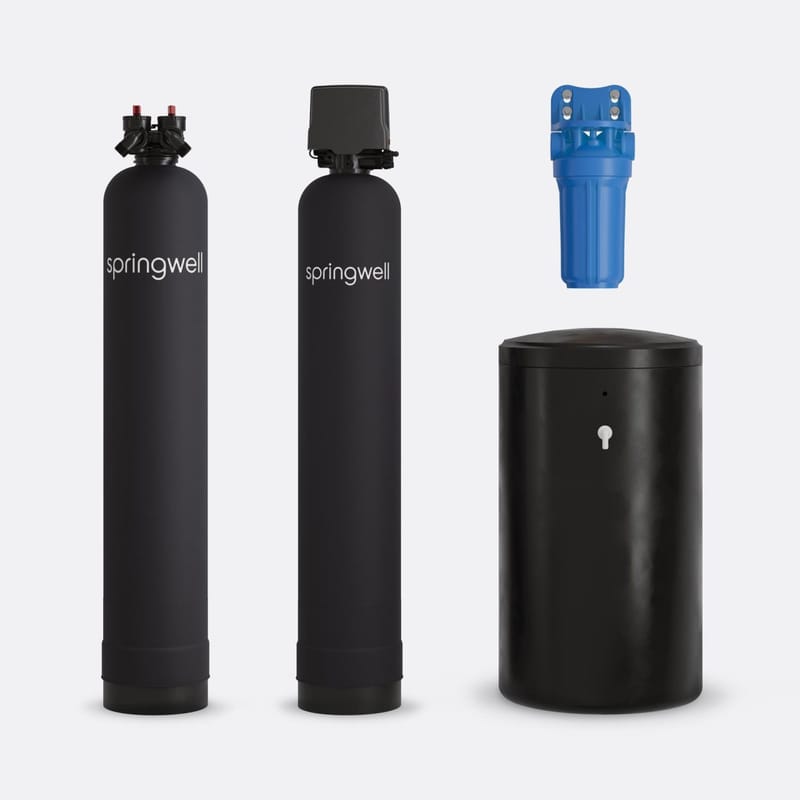
- Softens and clears iron, sulfur, and manganese in one install.
- The air-injection filter sits ahead of the softener, so raw iron never reaches the resin.
- Lifetime warranty, and no chemicals to dose.
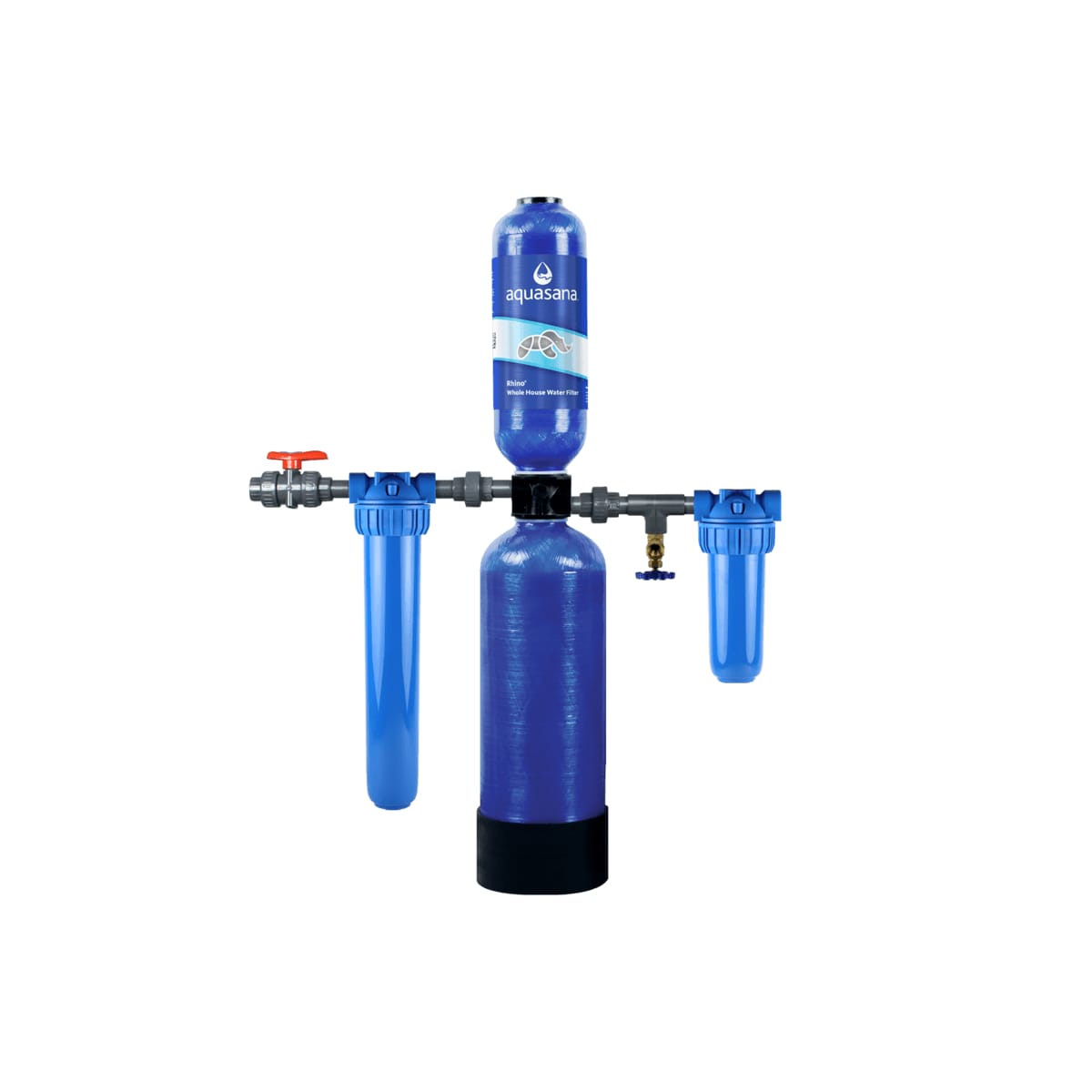
- No salt, no wastewater, and no drain line to run.
- Removes chlorine taste and odor along with scale control.
Well water usually brings hardness and a second problem: iron, sulfur, or sediment. These well water softener picks are ranked on how well they soften and what they cost to own, with a clear note on what each leaves for a separate filter.
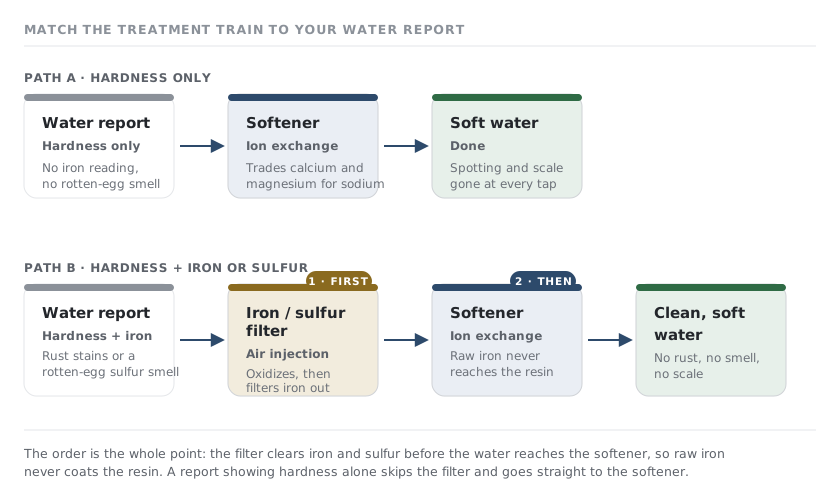
Read your water report first. Hardness on its own goes straight to a softener; iron or a sulfur smell needs an air-injection filter ahead of it, so raw iron never reaches the resin. That single ordering rule is why the ranked picks below fall where they do.
Start with your actual problem
Match what your water is actually doing to the fix it points to. A softener only earns its place once you know which of these you have.
| What you see | What it is | Where to go |
|---|---|---|
| Rust stains | Dissolved iron | Iron filter picks → |
| Rotten-egg smell | Hydrogen sulfide | Sulfur fix → |
| Spots and scale only | Hardness | Softener picks → |
How to choose
Four things decide which softener fits, and they all start with your water report rather than the price tag.
- Size it from a hardness number. Your hardness in grains per gallon (gpg), times how much water the household uses, sets the capacity you need. Guess it and you get a unit that regenerates constantly or runs out mid-shower, so test first.
- Treat iron and sulfur ahead of the softener. Iron much above ~7 ppm or a rotten-egg sulfur smell will foul softening resin, so those need a dedicated iron or air-injection filter in front. That ordering is why the combination units rank where they do below.
- Decide softening versus scale control. A salt-based ion-exchange unit actually removes the calcium and magnesium; a salt-free conditioner leaves the minerals in but stops them sticking as scale. Choose softening for slippery-soft water and longer water-heater life, a conditioner when scale is the only complaint and you can’t run a drain line.
- Price the upkeep too, since the box is only part of the cost. A salt-based system needs salt topped up and resin that lasts years; a conditioner needs only its sediment pre-filter; a cartridge filter needs new cartridges about twice a year. That running cost is part of the real price.
What size softener
Grain capacity is the number that matters, and you can size it yourself. Read across from your hardness to your household, and the cell is the capacity to shop for.
| Water hardness | 2 people | 3 people | 4 people | 5 people |
|---|---|---|---|---|
| 5 gpg, slightly hard | 24,000 | 24,000 | 24,000 | 24,000 |
| 10 gpg, moderately hard | 24,000 | 24,000 | 24,000 | 32,000 |
| 15 gpg, hard | 24,000 | 24,000 | 32,000 | 40,000 |
| 20 gpg, very hard | 24,000 | 32,000 | 48,000 | 64,000 |
| 25 gpg, extremely hard | 32,000 | 40,000 | 64,000 | 80,000 |
Recommended grain capacity, from our own math: about 75 gallons per person per day times your hardness, sized to regenerate roughly weekly, rounded up to the nearest standard tank. Iron raises the load, so add about 4 gpg to your hardness for every 1 ppm of iron before you read the table, and test your water first so the numbers are real.
The picks
House rule: every pick lists who should skip it.
SpringWell SS1
The SS1 is the straightforward pick when your report shows hardness. You get genuine ion-exchange softening, smart metered regeneration that saves salt, and a lifetime warranty, and most people can install it themselves.
It adds a little sodium and needs a drain line, and it softens only, so it leaves any iron or sulfur for a separate filter.
Check price at SpringWell(opens on SpringWell, external site)Why it scores 8.9i
Each sub-score is our assessment, weighted into the overall. It reflects published specifications, certification listings and warranty terms — not systems we ran ourselves. How we score
- Performance9/10
- Three published sizes cover the whole household span — 32,000 grains and 11 gpm for one to three bathrooms, up to 80,000 grains and 20 gpm for seven or more — so there is a fit for almost any house. Short of a 10 because no clear-water iron tolerance is published and the manual asks you to call before installing on a well. Source ↗
- Value9/10
- Sold direct with no dealer margin, at a published price, with a lifetime warranty and a six-month money-back trial behind it. The one number you cannot check before buying is the salt bill: SpringWell publishes no rated efficiency. Source ↗
- Ownership9/10
- A DIY main-line cut-in with the drain line supplied, and then one recurring job for the life of the system — keep the brine tank in salt. No filters, no media change, no cleaning schedule. The bypass valve is an add-on at checkout rather than standard equipment. Source ↗
- Trust8/10
- A lifetime warranty on tanks, valves, housings and heads, plus six-month returns, is the strongest cover on this page. It is not NSF/ANSI 44 certified, though: the softening claims are SpringWell's own, backed by a full published specification table rather than an accredited listing. Source ↗
SpringWell WSSS combo
One system that softens and clears iron, sulfur, and manganese. The air-injection filter sits ahead of the softener, so the correct treatment order is built in and raw iron never reaches the resin.
It’s the highest upfront cost here, and the two tanks need more space and a bigger install than a standalone softener.
Check price at SpringWell(opens on SpringWell, external site)Why it scores 8.3i
Each sub-score is our assessment, weighted into the overall. It reflects published specifications, certification listings and warranty terms — not systems we ran ourselves. How we score
- Performance9/10
- Air injection oxidises iron, sulphur and manganese into particles the media catches, and the softener behind it takes the hardness — the two problems a well usually brings at once. It also puts the filter first, so raw iron never reaches the softener resin, which is the single most common way well setups fail. Source ↗
- Value8/10
- The base WSSS1 size runs about $3,300 direct (roughly $3,900 list) for two systems sold direct and sized to work together, against a lifetime warranty. It is a real investment, and buying the stages separately from a dealer would cost more. Source ↗
- Ownership8/10
- DIY or plumber on the main line, with a drain and an outlet needed for both stages. Upkeep is a sediment pre-filter and keeping the brine tank in salt; the air-injection stage has no chemical to refill. Source ↗
- Trust7/10
- A lifetime warranty and a full published specification table, but SpringWell publishes no NSF/ANSI certification number for the line, so the iron and sulphide ceilings are the manufacturer's own ratings. Source ↗
Aquasana Rhino
No salt and no drain line, and nothing to backwash. It’s great for scale and chlorine taste, though it conditions rather than truly softens, so your water still tests hard and won’t feel slippery. It also doesn’t remove iron.
Check price at Aquasana(opens on Aquasana, external site)Why it scores 7.7i
Each sub-score is our assessment, weighted into the overall. It reflects published specifications, certification listings and warranty terms — not systems we ran ourselves. How we score
- Performance8/10
- Published NSF/ANSI 42 test results of up to 97% chlorine reduction across a million gallons are the strongest checkable numbers in the category. The base model manages only up to 83% on chloramine, so a chloraminated supply needs the separate Rhino Chloramines version, and the 7 gpm rating shows as pressure drop when two fixtures run at once. Source ↗
- Value7/10
- Around $999 for the base system, but the add-ons that make it complete — UV lamp, post filter, the salt-free module — can push the real spend past $2,000, and the ten-year warranty only applies if a professional installs it. Source ↗
- Ownership7/10
- A million gallons on the main tank means roughly a decade before a media change, offset by a pre-filter swap every six months and a warranty that drops from ten years to one if you fit it yourself. Source ↗
- Trust9/10
- Aquasana publishes independent NSF/ANSI 42 test figures rather than a marketing percentage, and the tank itself is certified to NSF/ANSI 61. Naming the 83% chloramine result in its own literature is the kind of disclosure most of this category avoids. Source ↗
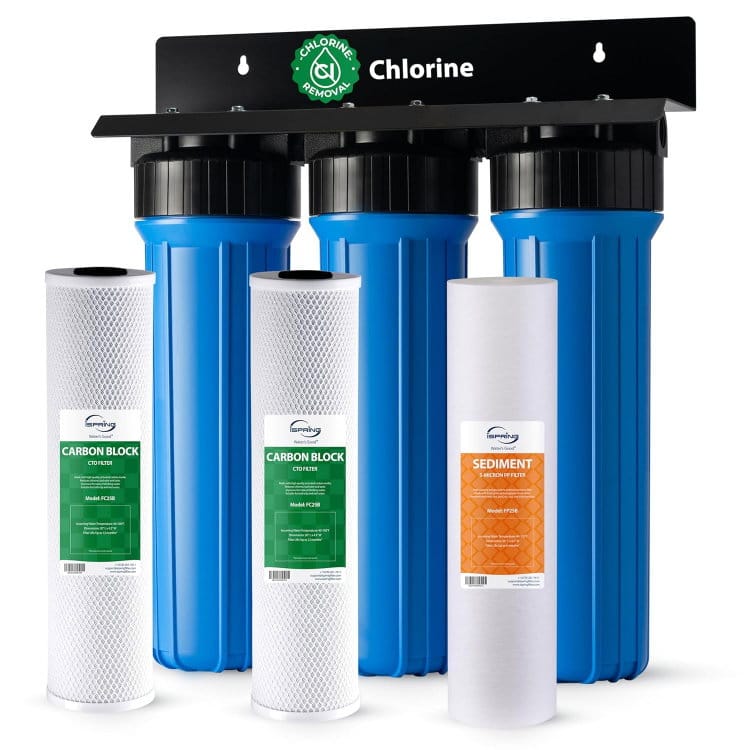
iSpring WGB32B
A three-stage sediment, carbon, and iron cartridge filter you can install yourself in an afternoon. It filters but does not soften, and the cartridges need changing about every six months.
Check price at Amazon(opens on Amazon, external site)Why it scores 7.8i
Each sub-score is our assessment, weighted into the overall. It reflects published specifications, certification listings and warranty terms — not systems we ran ourselves. How we score
- Performance8/10
- Up to 99% of chlorine along with sediment, rust and odour, at up to 15 gpm — the job it is built for, done well. It runs standard carbon block rather than catalytic, so chloramine largely passes through, and the cartridges hold about 100,000 gallons. Source ↗
- Value9/10
- About $250 buys whole-house chlorine and sediment removal, a fraction of what a tank system costs, and the cartridges are standard Big Blue parts rather than proprietary ones. Source ↗
- Ownership7/10
- Three cartridges anyone can swap with the wrench supplied, but that is a job roughly once a year rather than a media change once a decade. It mounts on a bracket and needs no drain or power. Source ↗
- Trust6/10
- iSpring publishes reduction percentages for the cartridges, and no full-system NSF/ANSI listing is published for the WGB32B, so the whole-house figures rest on the manufacturer's own data. Source ↗
Side by side
The picks compared on the specs that decide the buy. Match the “Removes” column to your water report, then weigh install and upkeep.
| System | Price | Flow rate | Removes | Install | Maintenance |
|---|---|---|---|---|---|
| SpringWell SS1 | $$$ | 11 gpm | Hardness | DIY or plumber; needs drain + power | Refill salt; smart metered regeneration |
| SpringWell WSSS combo | $$$$ | 11 gpm | Hardness, iron, sulfur, manganese | DIY or plumber; needs drain + power | Salt refills + sediment pre-filter |
| Aquasana Rhino | $$$ | Whole-house | Scale control, chlorine taste | Pro recommended | Pre-filter every ~6 months |
| iSpring WGB32B | $$ | Whole-house | Sediment, light iron, chlorine | DIY | Cartridges every ~6 months |
Frequently asked questions
Do I need to soften and filter, or just one?
Different jobs. Softening removes hardness; filtration removes iron, sulfur, sediment, or chlorine. A water report showing both means you likely need both stages, with the filter ahead of the softener.
Can I install a whole-house system myself?
If you are comfortable cutting into your main water line, DIY is realistic and saves the install fee. If not, a local plumber typically charges $150 to $500, cheap insurance against a basement leak.
How often do I add salt or change cartridges?
A salt-based softener needs salt topped up roughly monthly, depending on usage and hardness. Cartridge filters like the iSpring run about six months per set. Salt-free conditioners only need the sediment pre-filter changed.
New to well water? Start with the well water filtration guide, then well water testing and hard water in well water.
Have iron or a rotten-egg smell? See best iron filter for well water and the sulfur smell fix.
Want the type-by-type view for any home? See best water softener and best salt-free water softener.
How we researched this
We built this guide from manufacturer spec sheets (SpringWell, Aquasana, iSpring), the sizing math shown above (our own calculation, not lifted from a merchant), and the well-water treatment order that decides where each system belongs. We don’t run these systems ourselves yet, so we don’t claim first-hand testing, and how each pick earns its PureHouse Score is spelled out on the card. Prices move constantly, so treat every dollar figure as approximate and confirm the current price before you buy. When we name a merchant it may be an affiliate link, and we may earn a commission if you buy through it, at no cost to you. See how we test and pick.