Why your well water smells like rotten eggs (and how to fix it)
That rotten-egg smell is hydrogen sulfide gas (H₂S) in your water.
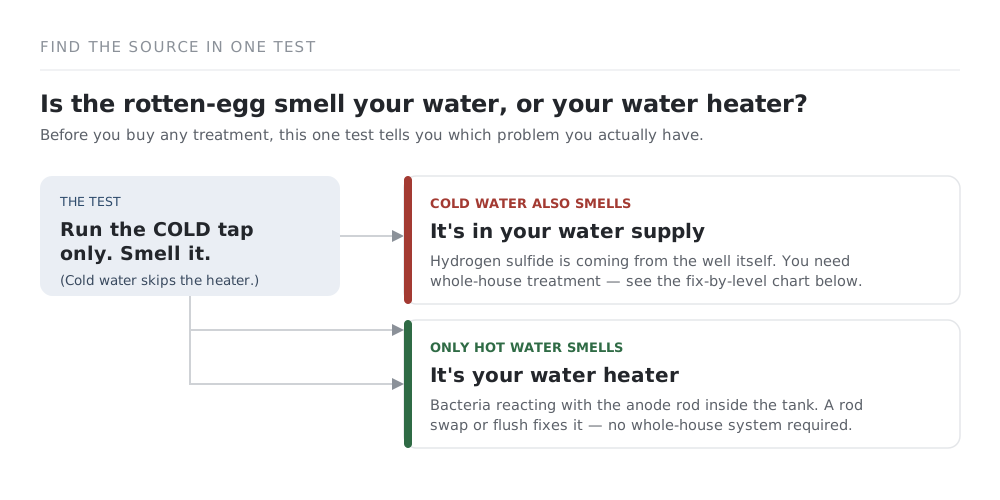
Before you buy anything, run one test: turn on a cold tap by itself and smell it.
If only the hot water stinks, the problem is inside your water heater and the fix is cheap.
If both hot and cold smell, the gas is coming from your well, and you’ll want a whole-house filter.
That one test is the difference between a $30 part and a whole-house system, and skipping it is the single most common reason people overspend on this problem.
The right system depends on how strong the smell is and whether you also have iron, so start with the test, then match the fix below.
First, the 2-minute test: your water heater or your well?
Run the cold tap after nobody’s used water for a few hours, and smell it on its own.
- Only the hot water smells → it’s your water heater, not your well. The magnesium anode rod inside the tank reacts with sulfur in the water and makes the gas. Your well is probably fine.
- Both hot and cold smell → the H₂S is in your water supply, and you need to treat the whole house.
- The smell fades as the water runs → you likely have sulfur bacteria in the well or pipes.
- The smell stays no matter how long it runs → you likely have dissolved H₂S in the groundwater.
That last distinction matters, because bacteria and dissolved gas call for slightly different systems.
Minnesota’s health department lays out the same test if you want to confirm it. (Minnesota Dept. of Health)
Other clues worth noting
A few more signs, beyond the cold-tap test above, that change which fix you need:
- Black stains on silverware, sinks, or fixtures → sulfur plus a little manganese; you’ll want an oxidizing filter, not just carbon.
- Orange or rusty staining along with the smell → iron is in the water too, which points to an air-injection system that handles both at once.
- Slimy black or grey buildup in the toilet tank → bacterial growth; plan on chlorination or peroxide, not just filtration.
Is the rotten-egg smell dangerous?
For most homes, no.
At household levels, hydrogen sulfide is a nuisance, not a health risk, and the sulfur bacteria behind it don’t make you sick. (Penn State Extension)
Two things are still worth knowing.
First, H₂S is corrosive: it tarnishes silverware, leaves black stains on sinks and fixtures, and can eat at plumbing over time.
Second, at high concentrations the gas can build up in an enclosed space like a basement or a well pit, where it does become hazardous and needs venting.
So it’s a comfort-and-plumbing problem for nearly everyone, and a safety one only in the rare high-level case.
Why a water softener won’t fix the smell
This is the most common wasted purchase in well water.
A softener swaps out the calcium and magnesium that make water hard.
It does nothing to the hydrogen sulfide gas that makes the smell, so a softener alone will leave your water soft and still stinking.
If you want both soft water and no odor, put an air-injection or carbon filter ahead of the softener, in that order.
Treat the smell first, soften second.
How to get rid of the smell, matched to your water
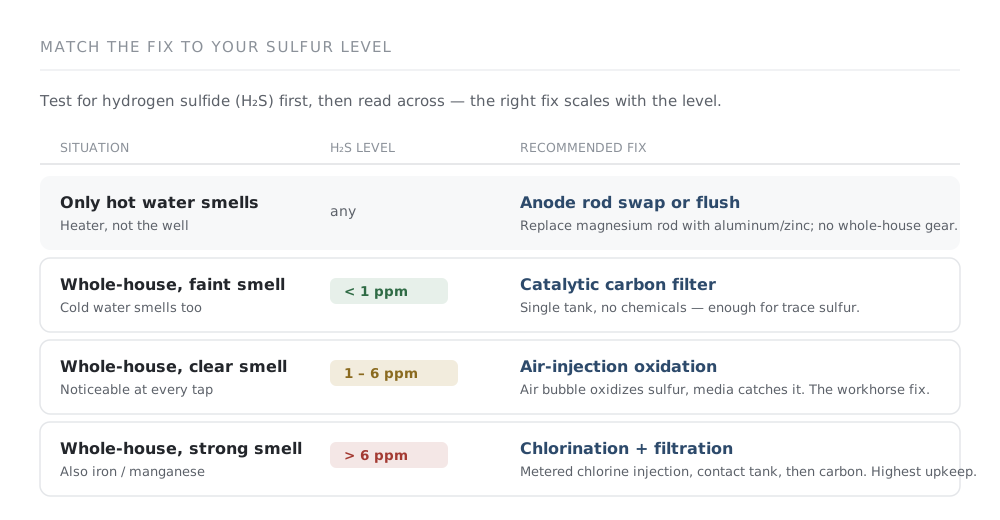
Pick the fix that fits what your test showed and how strong the odor is.
If you have a lab result, match your hydrogen sulfide (H₂S) number in mg/L to the row below (mg/L and ppm are the same unit for water). If you don’t, the smell strength is a rough proxy, but a number is far better because most people can smell H₂S below 0.5 mg/L, well under the level any filter is sized for.
Spending more than this doesn’t help; spending less usually means it comes back.
| Your situation | The fix | What to expect |
|---|---|---|
| Smell in hot water only | Replace the water heater’s magnesium anode rod with an aluminum/zinc or powered anode, then disinfect and flush the tank | ~$30–150 part, a DIY afternoon. No whole-house system needed. This is a source fix, so the mg/L cutoffs below don’t apply. |
| Light smell, both taps, under ~1 mg/L | Catalytic carbon whole-house filter | Simplest supply-side option; the media adsorbs the gas until it’s saturated and needs replacing. Plain activated carbon fades below ~0.3 mg/L; catalytic carbon reaches higher but needs at least 4 mg/L of dissolved oxygen in the water. |
| Moderate smell, both taps, ~1–6 mg/L | Air-injection oxidation (AIO) or oxidizing-media filter | The workhorse for well water: chemical-free, and it removes iron and manganese in the same tank. Aeration alone fades above ~2 mg/L; oxidizing media stretches the band, with manganese greensand rated up to ~10 mg/L. |
| Heavy smell (above ~6 mg/L) or sulfur bacteria | Continuous chlorination (chemical feed pump) or hydrogen-peroxide injection, followed by a filter | Handles the worst cases and scales to very high H₂S (up to ~75 mg/L); more maintenance and a bit more to run. |
Threshold sources: Penn State Extension (activated carbon below ~1 mg/L; aeration not used above ~2 mg/L; oxidizing filters remove ~2–3 mg/L; chlorination most often above 6 mg/L) and UGA Extension (GAC below ~0.3 mg/L; manganese greensand up to ~10 mg/L; chlorination for medium 6 mg/L to very high 75 mg/L).
What each tier actually costs
The table above tells you which fix; here’s what each one runs, so you can sanity-check a quote against the tier your test actually put you in rather than against “whole-house filter” as one vague price:
| Tier | Typical installed cost |
|---|---|
| Anode rod swap (hot water only) | $30–150, DIY |
| Catalytic carbon (light smell, both taps) | $600–2,000 |
| Air-injection oxidation (moderate smell) | $2,200–3,000 (the SpringWell WS1/WS4 range) |
| Chlorination or peroxide feed + filter (heavy smell or bacteria) | ~$1,100–4,300: $324–809 for the feed pump and tank, plus $150–500 install, plus the follow-up filter stage above |
Sources: HomeGuide for catalytic carbon, and the SpringWell/US Water Systems specs already compared on the whole-house filter page. The chlorination figure is a built-up estimate (equipment + typical install labor + the filter stage it feeds into), not a single quoted price — get an actual quote once you know your tier.
A few specifics behind the table:
Hot water only: swap the anode rod
If your cold water runs clean, don’t buy a filter.
Replace the magnesium anode rod in your water heater with an aluminum/zinc or a powered (impressed-current) rod, disinfect the tank, and flush it.
That removes the reaction that’s making the gas in the first place.
The common whole-house fix: air-injection oxidation
For most wells with a moderate rotten-egg smell, roughly 1 to 6 mg/L of H₂S, especially if you also see orange iron staining, an air-injection system is the pick.
It pulls a pocket of air into the tank, the oxygen turns the dissolved H₂S and iron into particles, and the filter media catches them.
No salt, no chemicals to refill.
Whole-house air-injection systems from makers like SpringWell and US Water Systems are built around this exact process.
(Get your water tested first so you size the system to your actual numbers.)
Heavy smell or bacteria: chlorination or peroxide
When the odor is strong, above about 6 mg/L, or you’ve confirmed sulfur bacteria, oxidation needs a stronger hand.
A small chemical-feed pump doses chlorine (or hydrogen peroxide) ahead of a filter that removes what forms.
It’s the most capable setup and the one that needs the most upkeep.
One caution: shock-chlorinating the well (pouring bleach down it once) will knock the bacteria back, but the smell usually returns within a few weeks.
It’s a useful reset, not a permanent fix.
What guessing the tier wrong costs you
The 2-minute test at the top of this page exists to stop you from overbuying, and the tier prices above show exactly how much that’s worth.
Say your smell only shows up in hot water, actually a $30–150 anode rod job, but you skip the test and a quote talks you into a whole-house air-injection system instead:
| Typical cost | |
|---|---|
| Correct fix (anode rod, hot-water-only) | ~$90 (midpoint of $30–150) |
| Wrong fix (whole-house air-injection) | ~$2,600 (midpoint of $2,200–3,000) |
| Overspend from skipping the test | ~$2,510 |
That gap is the entire cost of the 2-minute test, run in reverse: skip it, and a DIY afternoon can turn into a whole-house system installed in your basement that you never needed.
Test your water before you buy
Hydrogen sulfide escapes as a gas the moment water hits the air, so a sample mailed to a lab often reads lower than what’s really at your tap.
Test at the tap or with a field kit, and while you’re at it, test for iron, manganese, sulfate, and sulfur bacteria too.
Those tend to show up together, and which ones you have decides whether a simple carbon filter is enough or you want air injection.
Frequently asked questions
Is the rotten-egg smell in my well water dangerous?
Usually no.
At household levels it’s a nuisance odor, not a health hazard, and the sulfur bacteria don’t cause illness.
The exception is very high H₂S in an enclosed space like a basement or well pit, which should be vented. [Penn State Extension]
Why does only my hot water smell like rotten eggs?
The magnesium anode rod inside your water heater is reacting with sulfur in the water and producing the gas.
Swap it for an aluminum/zinc or powered anode and flush the tank, and the smell should go.
Will a water softener get rid of the sulfur smell?
No.
Softeners remove hardness, not hydrogen sulfide.
If you want both, install an air-injection or carbon filter before the softener.
How much does it cost to remove sulfur smell from well water?
A water-heater-only fix is about $30–150 in parts.
A whole-house carbon or air-injection system is a larger one-time investment; a chlorination setup costs a little more and needs ongoing chemical.
Size it to your test results so you don’t overspend.
Does the smell mean my water has bacteria?
Sometimes.
Sulfur bacteria are one source, but the gas can also come straight from the groundwater.
The “does the smell fade as the water runs” test is the quick tell; a bacteria test confirms it.
Can I fix it myself?
The anode-rod swap is a common DIY job.
Whole-house filters can be owner-installed if you’re comfortable with plumbing, but many people have a local plumber set them up.
Figured out you need a whole-house system? Next: the best whole-house filters for well water and, if you also have iron staining, the best iron filters for well water. For the full decision framework, testing to sizing to install, see well water filtration system.
How we researched this
We built this guide from state health-department and university-extension guidance on hydrogen sulfide in private wells, cross-checked against water-treatment specialists, plus cost-data aggregators for the per-tier pricing table.
We don’t test these specific systems in-house yet, so we don’t claim to — where we name a system type, it’s because the science behind it fits the problem.
Where we recommend a specific product, it’s the one that fits your water, and we may earn a commission if you buy through our link at no cost to you.