Best whole house water filtration system for well water
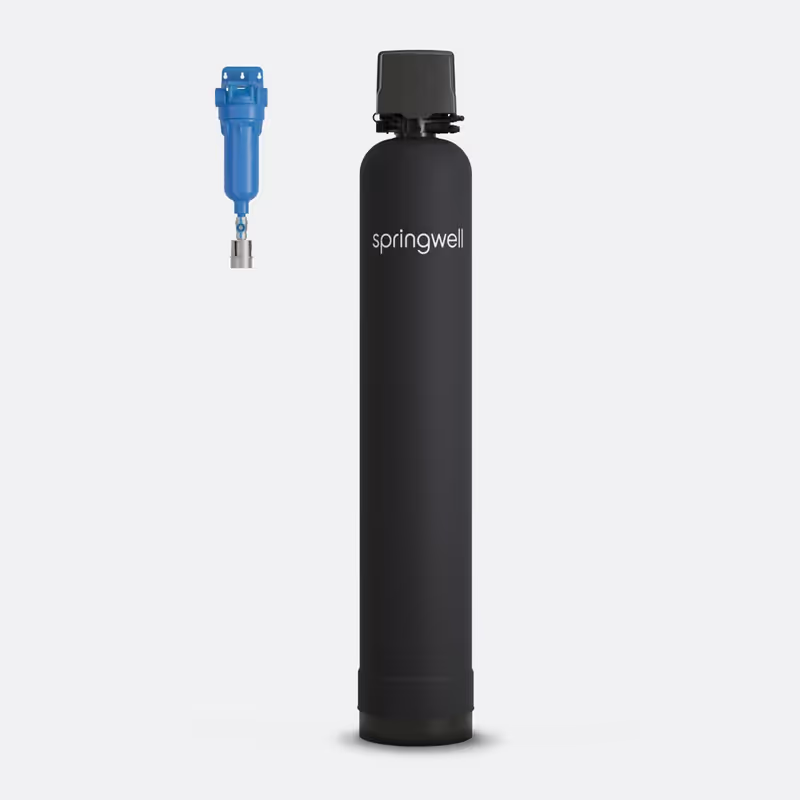
- Removes iron up to 7 ppm and hydrogen sulfide up to 8 ppm using air-injection oxidation, with no chemicals.
- Flow rates run 12 GPM on the WS1 and up to 20 GPM on the WS4.
- Carries a lifetime warranty on the tank and valve, with media rated for 18 to 25 years.
- Costs $2,204 to $2,963, with annual upkeep under $150.
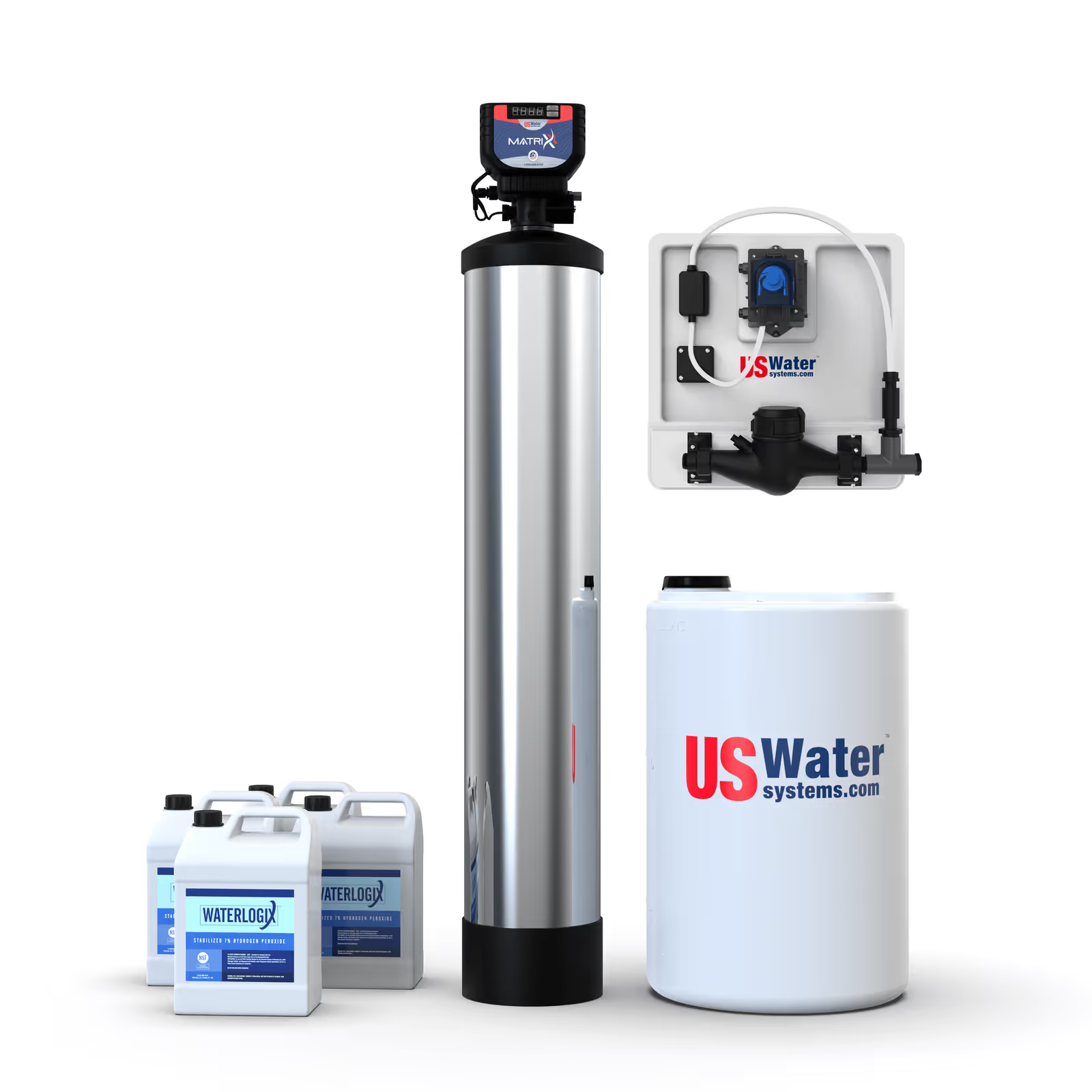
- Injects hydrogen peroxide ahead of a catalytic carbon bed, rated for iron up to 20-30 ppm and hydrogen sulfide up to 30 ppm.
- Rated effective against confirmed iron and sulfur bacteria.
- Includes a Bluetooth-enabled smart panel for monitoring the peroxide dosing.
- Costs $3,065 to $3,195, with annual upkeep of $250 to $600 for peroxide.
For most well owners with moderate iron or sulfur (roughly under 8 ppm) and no confirmed bacteria, the SpringWell WS1/WS4 is the best whole-house filter: a chemical-free air-injection system, lifetime warranty, and the lowest running cost of the picks here.
If your lab report shows heavier iron or sulfide, or you’ve confirmed iron/sulfur bacteria, the US Water Systems Matrixx InFusion is built for that load.
Get this pick wrong and an undersized system lets raw iron or sulfide straight through to foul a softener’s resin bed downstream.
Which one is right for you comes down to one number: what your water actually tested at.
Photo: William Herron / Flickr, CC BY-SA 2.0
How we chose
We built this list from manufacturer spec sheets, Penn State Extension’s treatment-threshold guidance, and independent review aggregation.
We don’t run a lab of our own yet, and we’ll say so plainly rather than pretend otherwise.
Every pick had to publish a real flow rate, a real ppm rating, and a real price. It also had to fit the treatment sequence Penn State Extension lays out: sediment first, then iron/sulfur oxidation, then the softener, never the other way around.
Two things every recommendation here has to answer:
- What’s your iron/manganese/hydrogen sulfide number, in mg/L or ppm? That number, not the smell or the stain, decides which tier of system is correctly sized.
- What’s your flow rate need? A 1–3 bathroom home and a 4–6 bathroom home don’t buy the same unit.
If you haven’t tested yet, get a real number before you buy.
The same water can call for a $1,500 system or a $3,000 one, depending on what the lab says.
The picks
SpringWell WS1 / WS4
| Spec | WS1 (1–3 baths) | WS4 (4–6 baths) |
|---|---|---|
| Flow rate | up to 12 GPM | up to 20 GPM |
| Iron removal | up to 7 ppm | up to 7 ppm |
| Hydrogen sulfide removal | up to 8 ppm | up to 8 ppm |
| Manganese removal | up to 1 ppm | up to 1 ppm |
| Price | ≈ $2,204 | ≈ $2,963 |
| Warranty | Lifetime (tank/valve) | Lifetime (tank/valve) |
| Annual upkeep | <$150/yr (sediment pre-filter swap) | <$150/yr |
It works by air-injection oxidation (AIO). The tank pulls in a pocket of air. That oxygen turns dissolved iron and hydrogen sulfide into particles, and the media catches them on the way through.
No salt, no chemical to refill, and the media itself is rated for 18–25 years.
It needs electricity for the control head and a drain line for backwashing, so it’s a basement or utility-room install, not a countertop unit.
If your test shows any of those, you’re adding a separate stage.
Its ceiling is also lower than the InFusion below. Past roughly 8 ppm iron or sulfide, or with confirmed iron/sulfur bacteria, this isn’t the right tier.
Go to the pick below instead.
Check price at SpringWell(opens on SpringWell, external site)Why it scores 8.9i
Each sub-score is our assessment, weighted into the overall. It reflects published specifications, certification listings and warranty terms — not systems we ran ourselves. How we score
- Performance9/10
- Rated to 7 ppm iron, 8 ppm hydrogen sulphide and 1 ppm manganese at 12 to 20 gpm, which covers the great majority of private wells with no chemical involved. Held short of the top by that ceiling, and because it does nothing for chlorine, PFAS or bacteria. Source ↗
- Value9/10
- About $2,204 for the WS1, with a lifetime warranty on tank and valve, media rated for 18 to 25 years, and under $150 a year to run — a sediment pre-filter and nothing else. Source ↗
- Ownership9/10
- No salt to haul and no chemical to refill: the tank draws its own pocket of air. One pre-filter swap a year is the whole job. It needs power for the head and a drain for backwashing, so it is a basement or utility-room install. Source ↗
- Trust8/10
- A lifetime warranty on tank and valve, with rated ceilings published per model rather than a single marketing figure. No NSF/ANSI certification number is published for the WS line. Source ↗
US Water Systems Matrixx InFusion
| Spec | Value |
|---|---|
| Flow rate | 10 GPM |
| Iron removal | up to 20 ppm (up to ~30 ppm on some tiers) |
| Hydrogen sulfide removal | up to 30 ppm |
| Manganese removal | rated, effective against iron/sulfur bacteria |
| Price | ≈ $3,065–3,195 |
| Warranty | Lifetime tank, 5-year injection panel |
| Annual upkeep | $250–600/yr (peroxide top-ups; media swap every 3–5 yrs) |
Instead of air, it injects hydrogen peroxide ahead of a catalytic carbon bed.
Peroxide is a stronger oxidizer. That’s why it handles roughly double SpringWell’s iron ceiling, and why it’s rated to tackle iron and sulfur bacteria.
It has a Bluetooth-enabled smart panel for monitoring the dosing.
You’re buying and refilling hydrogen peroxide every year, not just swapping a sediment cartridge.
Flow rate also tops out at 10 GPM across the line, lower than SpringWell’s WS4.
You’d be paying $250–600 a year in peroxide to treat water the SpringWell WS1 handles for under $150.
Check price at US Water Systems(opens on US Water Systems, external site)Why it scores 7.9i
Each sub-score is our assessment, weighted into the overall. It reflects published specifications, certification listings and warranty terms — not systems we ran ourselves. How we score
- Performance10/10
- Hydrogen peroxide injection ahead of a catalytic carbon bed reaches roughly double the iron ceiling air injection manages — up to 20 ppm iron and 30 ppm hydrogen sulphide — and it is rated against the iron and sulphur bacteria air injection cannot touch. Nothing else on this site reaches that water. Source ↗
- Value6/10
- Roughly $3,065 to $3,195 up front, then $250 to $600 a year in peroxide, three to four times what an air-injection filter costs to run. Fair for the water it is built for, and expensive for water that did not need it. Source ↗
- Ownership6/10
- Buying, storing and refilling hydrogen peroxide every year, plus a media swap every three to five years, is real recurring work next to a yearly cartridge. The Bluetooth panel at least makes the dosing visible. Source ↗
- Trust8/10
- A lifetime tank warranty with five years on the injection panel, from a well-water specialist that publishes rated ceilings per tier. No NSF/ANSI certification number is published for the system. Source ↗
Where these fit if you need a softener too
Neither of these picks softens water.
They oxidize and filter iron, manganese, and sulfide.
If your water is also hard, the softener goes after the filter, never before. Raw dissolved iron and hydrogen sulfide will foul softener resin if they hit it first. That order follows Penn State Extension’s guidance on private-well treatment.
The full install order is: sediment filter → iron/sulfur filter → softener → carbon → UV. UV goes last because it needs clear water to work.
We’ll cover softener picks on their own page; for now, budget for the filter first and the softener as a second, downstream purchase.
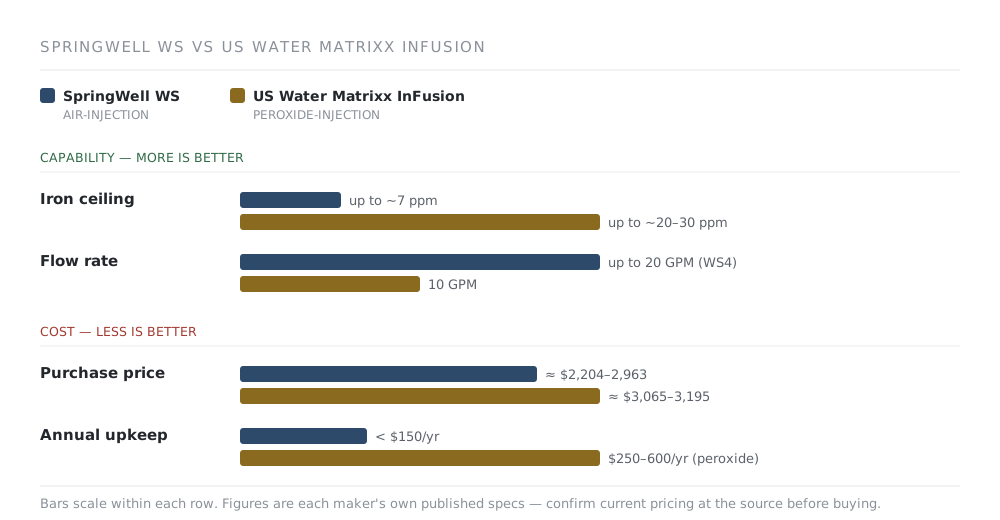
Comparison table
| SpringWell WS1/WS4 | US Water Systems Matrixx InFusion | |
|---|---|---|
| Best for | Moderate iron/sulfur, no bacteria | Heavier iron/sulfur, confirmed bacteria |
| Mechanism | Air-injection oxidation | Hydrogen-peroxide injection + catalytic carbon |
| Flow rate | 12–20 GPM | 10 GPM |
| Iron ceiling | ~7 ppm | ~20–30 ppm |
| H₂S ceiling | ~8 ppm | ~30 ppm |
| Price | $2,204–2,963 | $3,065–3,195 |
| Annual upkeep | <$150 | $250–600 |
| Chemicals | None | Hydrogen peroxide |
What each system actually costs over 5 years
The sticker price alone hides the real gap between these two.
SpringWell’s air-injection design has no consumable to buy. US Water Systems’ peroxide-injection design does, every year, for as long as you own it.
The table below works from each system’s purchase price and its own published upkeep range. For the peroxide range, we use the midpoint.
| SpringWell WS1 | SpringWell WS4 | US Water Systems InFusion | |
|---|---|---|---|
| Purchase price | $2,204 | $2,963 | $3,065 |
| Annual upkeep | ~$150/yr | ~$150/yr | ~$425/yr (midpoint of $250–600) |
| 5-year total | ~$2,954 | ~$3,713 | ~$5,190 |
Over five years, the WS1 costs less than half of what the InFusion costs, even though the WS1’s sticker price is only about $860 lower.
The gap is almost entirely the peroxide.
That’s the real argument for not buying more filter than your water needs. If your numbers fit SpringWell’s ceiling, the InFusion isn’t a “better” system for you. It’s just a more expensive one, for a problem you don’t have.
The flip side: cost per ppm of capacity
Run the same purchase prices against each system’s published iron ceiling instead of its 5-year total, and the picture inverts.
The WS1 costs roughly $315 per ppm of iron capacity ($2,204 ÷ 7 ppm).
The InFusion, sized for its full 20–30 ppm range, costs roughly $102–153 per ppm ($3,065 ÷ 20–30 ppm). That’s cheaper per ppm handled upfront, despite the higher sticker price and the ongoing peroxide cost.
That’s not a reason to buy the InFusion for moderate water; the 5-year total above still favors the WS1 there.
It’s the reason the InFusion isn’t overkill once your numbers clear SpringWell’s ceiling. At that load, you’re not paying a premium for capacity. You’re paying less per ppm for it. And the peroxide cost is simply what a heavier oxidation load requires, not a markup.
What decides the size and cost of your system
Flow rate. Penn State Extension puts minimum practical household flow around 6 GPM; most whole-house filters are sold in 10–20+ GPM tiers matched to bathroom count.
A 1–3 bath home undersizes on a unit rated for 4–6 baths running at once.
Showers, laundry, and dishwasher all pull flow at the same time, and an undersized filter drops your water pressure right when you need it.
Concentration, not symptom. Penn State Extension gives clear thresholds. At a combined iron + manganese of 3–10 mg/L, an oxidizing filter is usually the right call. Above 10 mg/L, you need oxidation followed by filtration. That means a bigger system, not just a bigger tank of the same media.
Below that, in some cases a softener alone or polyphosphate can handle light dissolved iron under 2 mg/L, but only if it’s truly dissolved and not already oxidized.
This is why a real lab number matters more than “the water smells bad”: two houses with the same smell can need very different systems.
Total cost. All-in cost for a whole-house well system (equipment plus install) commonly runs $1,500–5,000. A basic sediment-only setup can be a few hundred dollars. A multi-stage system covering iron, manganese, and bacteria can run $10,000+.
Professional installation typically adds $150–500 on top of the equipment. Plumbers commonly bill $75–150 an hour, more in pricey metros.
DIY is realistic if you’re comfortable cutting into your main water line; if you’re not, the $200–400 for a plumber is cheap insurance against a leak.
Certifications to check before you buy
NSF/ANSI 42 covers aesthetic reduction: chlorine, taste, and odor. NSF/ANSI 53 covers contaminants with real health effects, at thresholds the EPA sets.
Systems that add UV disinfection usually cite NSF 55. Softeners cite NSF 44.
As of this writing, neither SpringWell’s WS line nor US Water Systems’ InFusion line lists an NSF/ANSI certification number for the specific model on its own product page.
If certification matters to you, confirm it in the spec sheet or with the seller before you buy. Don’t assume “whole-house” means certified.
Test before you buy
The EPA says to test private wells once a year for total coliform bacteria, nitrates, total dissolved solids, and pH. Run a wider panel (metals and VOCs) every 3–5 years, or right away if the taste, smell, or color changes.
Before buying a whole-house filter specifically, get iron, manganese, and hydrogen sulfide numbers from a certified lab.
A field kit is faster but less precise for hydrogen sulfide, which off-gasses out of a sample quickly.
The number on that report is what sizes the system correctly, not the strength of the smell at your tap.
Frequently asked questions
What is the best whole-house water filter for well water?
For most well owners with moderate iron or sulfur and no confirmed bacteria, the SpringWell WS1/WS4 is the best overall pick: chemical-free, lifetime-warrantied, and the lowest annual upkeep of the systems compared here.
If your numbers are higher or you have confirmed iron/sulfur bacteria, the US Water Systems Matrixx InFusion is built for that heavier load.
Do I need a whole-house filter if I have a well?
If your water tests above safe thresholds for iron (0.3 mg/L) or manganese (0.05 mg/L), or you have a sulfur smell, staining, or confirmed bacteria, a whole-house filter is the standard fix.
It treats water at the point it enters the house, so every tap and appliance gets clean water, not just the kitchen sink.
What size (GPM) whole-house filter do I need?
Match it to your bathroom count and household size: roughly 10–12 GPM for 1–3 bathrooms, 15–20 GPM for 4–6 bathrooms.
Undersizing shows up as a pressure drop when multiple fixtures run at once.
Does a whole-house filter remove iron and sulfur smell at the same time?
Yes.
Both picks here treat iron and hydrogen sulfide (the rotten-egg smell) in the same tank, since both are handled by oxidation.
Neither removes hardness, chlorine, fluoride, PFAS, or bacteria on its own.
How much does a whole-house well water filtration system cost installed?
A mid-range iron/sulfur system usually runs $1,500–5,000 installed. A basic sediment-only setup runs a few hundred dollars. A multi-stage system that also handles bacteria can top $10,000.
Can I install a whole-house well water filter myself?
If you’re comfortable cutting into your main water line, yes.
DIY installation is realistic and saves the $150–500 professional install fee.
If you haven’t done plumbing work like this before, hiring a local plumber is a reasonable safeguard against a leak.
Do I need a water softener too, or does the whole-house filter replace it?
It doesn’t replace one.
If your water is also hard, install the softener downstream of the iron/sulfur filter, never upstream.
Raw dissolved iron and sulfide will foul softener resin if they hit it first.
How often does a whole-house well water filter need maintenance?
For an air-injection system like SpringWell’s, mainly a sediment pre-filter swap every 6–9 months (under $150/year); the core media is rated for 18–25 years.
For a peroxide-injection system like the InFusion, budget $250–600/year for peroxide refills, plus a media swap every 3–5 years.
Once you’ve matched a filter to your numbers, the next decision is usually a softener: see well water filtration system for how the whole system fits together.
Still diagnosing the problem? Start with why your well water smells like rotten eggs for odor, or the best iron filter for well water to tell ferrous from ferric iron and iron bacteria apart.
How we researched this
We built this comparison from a handful of sources. Manufacturer spec sheets (SpringWell, US Water Systems) gave the specs. Penn State Extension’s private-well guidance and EPA testing advice set the thresholds. We cross-checked the numbers against independent review round-ups.
We don’t run these systems ourselves yet, so we don’t claim first-hand testing.
Every spec below is attributed to its source, and we’ve flagged the one place (NSF certification on these specific models) where we couldn’t confirm a claim manufacturers don’t publish.
We don’t currently have a confirmed affiliate relationship with SpringWell or US Water Systems, so the links above go straight to each company’s own product page, not an affiliate link.
When we recommend a system, it’s the one that fits your lab numbers.
Sources
- NSF — NSF/ANSI 42, 53, and 401: Filtration Systems Standards
- Penn State Extension — Iron and Manganese in Private Water Systems
- Penn State Extension — Water System Planning: Estimating Water Needs
- EPA — Protect Your Home’s Water
- New Hampshire DES — Iron and/or Manganese in Drinking Water
- SpringWell — Whole House Well Water Filter System
- US Water Systems — Whole House Iron and Sulfur Systems
- HomeGuide — Well Water Filtration System Cost