Water softener system: how it works, sizing, and cost
A water softener system removes the hardness minerals in your water, calcium and magnesium, by running it through a tank of resin beads that swap those minerals for sodium, a process called ion exchange.
That is the one job it does, and the one thing to know before you buy: a softener treats hardness only, so it does nothing for iron, sulfur, sediment, or bacteria. (Culligan)
Buy one expecting it to clear a rotten-egg smell or orange staining and you have bought the wrong machine — the single most common wasted purchase in well water treatment.
This guide covers what a softener actually is, which types truly soften, how to size one from your water test, what it costs to buy and run, and the well-water order that saves your resin.
Not sure a softener is even the right machine for your water? Start with which home water filtration system you need, which sorts your problem to the right type of system first.
What a water softener system actually is
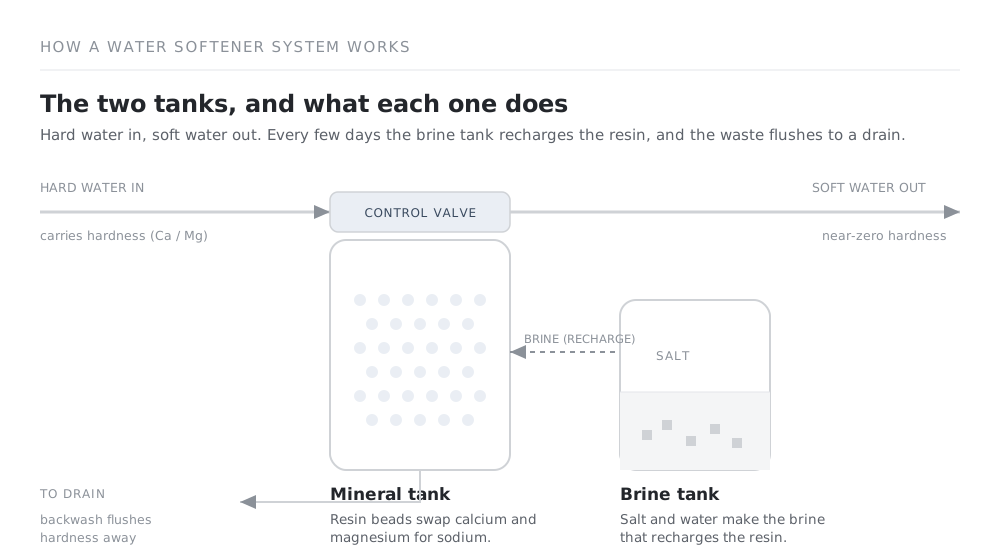
Hard water flows into a tall mineral tank packed with millions of resin beads.
Those beads carry a light charge and hold sodium, and as the water passes through, they grab the calcium and magnesium and release sodium in their place. (Culligan)
The water that leaves reads close to zero grains per gallon of hardness, which is soft water.
Eventually the beads fill up with hardness and stop working, so the system cleans itself in a cycle called regeneration.
During regeneration it draws brine from a second, shorter tank, floods the resin with concentrated salt water (about 8–10% salt) to knock the calcium and magnesium loose, and flushes the waste to a drain. (Veolia)
A metered control valve on top is the brain: it counts the gallons you use and starts regeneration on demand, so you are not recharging the resin more often than your water needs.
So there are really two states to picture: making soft water day to day, and recharging the resin with salt every few days.
Salt-based, salt-free, or magnetic: which actually softens
This is where marketing muddies the water, so here is the plain version.
Only salt-based ion exchange truly removes hardness; a salt-free “conditioner” controls scale but leaves the minerals in; and magnetic or electronic descalers have no credible evidence behind them.
| Type | Removes hardness? | What it actually does |
|---|---|---|
| Salt-based ion exchange | Yes — true softening | Swaps calcium and magnesium for sodium; hardness reads near zero |
| Salt-based twin-tank | Yes | Two resin tanks trade off, so soft water never runs out during regeneration |
| Salt-free “conditioner” (TAC) | No | Turns hardness into tiny crystals that don’t stick as scale; the minerals stay in the water |
| Magnetic / electronic descaler | No — unproven | Claims a magnetic field changes how scale forms |
Salt-free conditioners use template-assisted crystallization, and they earn their place where you want scale control without salt, a drain line, or sodium.
They work well, too: an Arizona State University study measured more than 90% scale reduction over three weeks.
The honest limits: a conditioner does not give you the slippery-soft feel or spot-free dishes of true softening, it fades on very hard well water above 10 gpg, and it does nothing for iron or staining.
For the salt-free picks and a clear read on when a conditioner is the right buy, see best salt-free water softener.
Magnetic and electronic descalers are a different story.
A Water Quality Association task force reviewed more than 100 studies and found little evidence they work, and separate government-lab tests found no measurable effect.
Treat them as unproven and spend the money on a system that actually changes your water.
The rule to carry into the rest of this guide: salt-based softens, salt-free controls scale, and “conditioner” is not a synonym for “softener.”
If that last word is what tripped you up, the water conditioner guide untangles the four different things it’s used to mean.
For a head-to-head on the two you will actually choose between, see SpringWell vs. Aquasana, a salt-based softener against a salt-free conditioner.
Do you actually need one?
Water is generally called hard at 7 grains per gallon or more, and soft below about 3.5 gpg. (Lowe’s)
If your lab report is in parts per million, divide by 17.1 to get grains per gallon, so 171 ppm is 10 gpg.
You feel hard water before you measure it: spots on glasses, soap that won’t lather, stiff laundry, and chalky scale building up on faucets and inside the water heater.
Above roughly 7–10 gpg, a softener is usually worth it for the appliance life and the everyday feel. (Consumer Reports)
Start with a number, though, not a guess.
A $20 hardness test or a full well water test tells you your gpg, and on a well it also flags the iron and sulfur that change what you should buy.
For the full picture on what causes hard water and how it wrecks appliances, see our guide to hard water.
What size softener you need
Grain capacity is the number that matters, and you can work it out yourself.
Multiply the people in your home by about 75 gallons a day, then multiply by your hardness in grains per gallon.
That gives the grains of hardness your softener removes each day.
A family of four at 10 gpg uses about 300 gallons a day, which is 3,000 grains a day.
Over a healthy 7-day gap between regenerations that is about 21,000 grains, so a 32,000-grain unit gives comfortable headroom.
Softeners come in standard sizes of 24,000, 32,000, 40,000, 48,000, and 64,000 grains, and you round up to the next one, aiming to regenerate every 5–10 days with about 25% reserve. (Lowe’s)
Well water needs one more step: add about 5 gpg of “compensated hardness” for every 1 ppm of iron before you size.
So 10 gpg hardness with 3 ppm iron is sized as 25 gpg, not 10.
That is exactly why iron-heavy wells end up with oversized, salt-hungry softeners unless they filter the iron out first.
We built a ready-made grain-capacity chart by hardness and household size on the best water softeners for well water page, so you can read your size straight off a table.
What a water softener system costs
A salt-based system runs about $400–$1,200 for the unit alone and roughly $1,200–$3,800 installed. (HomeGuide)
Salt-free conditioners land a little higher installed, about $1,500–$4,500, because you are paying for the media rather than a salt tank. (HomeGuide)
Then there is salt: most homes spend under $100 to about $300 a year on it, depending on how hard the water is and how much you use.
You can spend far more than this.
Premium dealer brands like Culligan and Kinetico are often quoted in the several-thousand-dollar range, and buyers regularly ask online whether a $5,000 quote is normal. (AnandTech forum)
It is a fair question, since a comparable do-it-yourself build costs a fraction of that. Our Culligan vs SpringWell comparison breaks down that dealer-quote-versus-published-price gap over ten years, and Kinetico vs SpringWell weighs Kinetico’s non-electric twin-tank against the same money.
If you are handy, a system built around a serviceable Fleck or Clack control valve often lands well under $1,000 and installs in an afternoon. (Water Softener Canada)
Those dealer brands do not allow DIY installation, which is part of what you weigh against the lower price of a self-installed unit.
Installing it: where it goes and DIY vs. pro
A softener ties into your main line after the pressure tank and before the water heater, at what plumbers call the softener loop.
Only the lines you route through it get softened, so many homes leave outdoor spigots on hard water to save salt.
Two things the spot needs: a drain within reach for the backwash discharge, with a proper air gap, and a bypass valve at the head so you can service the unit without shutting off the house.
Systems built on Fleck or Clack valves are well documented and realistic for a confident DIYer; dealer brands are installed by their technicians.
One caution before you buy: many areas require a plumbing permit or a specific drain air gap, and some water-stressed regions restrict salt-discharge softeners, so check your local code first.
Keeping it running: salt, resin, and lifespan
Day to day, a softener asks for very little.
Check the brine tank monthly, top it up every couple of months, and keep it at least half full of salt.
The resin bed itself lasts a long time, usually 10–15 years, and sometimes 15–20 on gentle water.
High iron, chlorine, or extreme hardness cut that short, to as little as 5–8 years, which is the well-water tax again.
Watch for the warning signs: hard-water spots creeping back, the softener regenerating more often and eating more salt, or fine resin grit showing up at a faucet.
You can clean iron-fouled resin with a resin cleaner, but that is only a patch.
The durable fix is to keep iron out of the resin in the first place.
Well water changes the order
Here is the part the manufacturer pages skip, and the reason a lot of well owners feel let down by their softener.
A softener is built for hardness, and on a well it is often sold as a cure-all, then fails to touch the iron, sulfur, or sediment that was the real complaint.
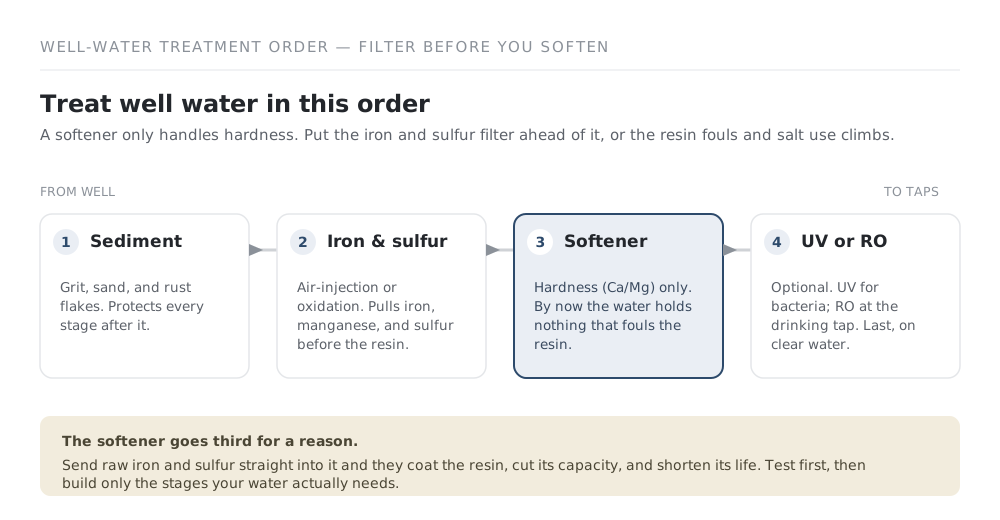
Worse, that iron and manganese coat the resin beads and clog the valve, cutting capacity, driving up salt use, and shortening the softener’s life.
A softener can handle a trace of clear-water iron, up to about 1 ppm; from 1 to 3 ppm it is risky, and at 3 ppm or more you need a dedicated iron filter ahead of the softener.
The fix is to treat your water in the right order:
- Sediment pre-filter — catches grit so it doesn’t wear the rest of the train.
- Iron, manganese, and sulfur filter — an air-injection or chemical-oxidation stage that pulls those out before they reach the resin.
- Water softener — now it only sees hardness, exactly what it is built for.
- UV or reverse osmosis if you need it — UV for bacteria, reverse osmosis at the drinking tap.
Get the order right and each stage does its one job well.
If your test shows iron or a rotten-egg smell, start with the best iron filter for well water or the sulfur smell fix, then add a softener behind it.
If you want the whole train chosen for you, the best water softeners for well water page ranks softeners and filter-plus-softener combos for exactly this situation.
Is softened water safe to drink?
For most people, yes. But ion exchange trades hardness for a little sodium, and the amount depends on how hard your water was.
It adds roughly 30 mg of sodium per grain of hardness removed, per gallon.
At 15 gpg that is about 450 mg per gallon, or roughly 28 mg in an 8-ounce glass, modest for most diets but real.
Here is what that works out to across common hardness levels, so you can find your own water:
| Your hardness | Sodium added per 8-oz glass | Per gallon |
|---|---|---|
| 5 gpg (mildly hard) | ~9 mg | ~150 mg |
| 10 gpg (moderately hard) | ~19 mg | ~300 mg |
| 15 gpg (hard) | ~28 mg | ~450 mg |
| 20 gpg (very hard) | ~37 mg | ~600 mg |
| 25 gpg (extremely hard) | ~47 mg | ~750 mg |
Calculated at about 30 mg of sodium per grain of hardness, per gallon. For scale, the FDA’s suggested daily limit is 2,300 mg, so even very hard water adds a small share of a day’s sodium per glass.
Anyone on a sodium-restricted diet, managing blood pressure or kidney issues, or mixing infant formula should factor that in and ask a doctor.
Two easy options cover it: regenerate with potassium chloride instead of salt, which is nearly sodium-free (though it costs more and is not for people limiting potassium), or keep a reverse osmosis tap for drinking and cooking.
One thing a softener never does is make unsafe water safe: it removes hardness, not contaminants, bacteria, or heavy metals, so a questionable well still needs proper filtration and disinfection.
Where to go next
Once you know what’s in your water, here’s where to go next:
- Compare the picks: best water softeners for well water, ranked with a grain-capacity sizing table and honest skip-it notes.
- Understand the problem: hard water in well water, what causes it and what it costs your appliances.
- Read a real unit: the SpringWell SS1 review, full specs and who should skip it.
- Iron or smell first: best iron filter for well water, the stage that belongs ahead of your softener.
- Test before you buy: well water testing, how to get the numbers that size everything above.
Frequently asked questions
Do I need a water softener?
If your water is above about 7–10 grains per gallon, a softener is usually worth it for longer appliance life and easier cleaning.
Test your water first to get the actual number, and on a well, to see whether iron or sulfur needs treating before hardness.
Is soft water safe to drink?
For most people, yes.
It adds a small amount of sodium, roughly 28 mg in an 8-ounce glass at 15 gpg, so anyone on a sodium-restricted diet can switch to potassium chloride or keep a reverse osmosis tap for drinking.
Does a water softener remove iron?
Only a trace of it, up to about 1 ppm, and unreliably.
At 3 ppm or more you need a dedicated iron filter installed ahead of the softener, or the iron fouls the resin and shortens its life.
Salt-based or salt-free: which do I need?
Choose salt-based if you want true soft water: slippery-soft feel, spot-free dishes, and maximum soap efficiency.
Choose salt-free if you only want to stop scale buildup and prefer no salt, no drain line, and no added sodium.
What size water softener do I need?
Multiply your household size by about 75 gallons a day, then by your hardness in grains per gallon, to get grains removed per day.
Pick a grain capacity that regenerates every 5–10 days with about 25% reserve; a family of four at 10 gpg fits a 32,000-grain unit.
How much does a water softener system cost?
About $1,200–$3,800 installed for a salt-based system, or $1,500–$4,500 for salt-free.
Budget another $100–$300 a year for salt; a DIY Fleck or Clack build often lands under $1,000.
How long do water softeners last?
The unit typically lasts 10–15 years and the resin bed 10–15 years, sometimes longer on gentle water.
High iron, chlorine, or extreme hardness can cut resin life to 5–8 years.
Do magnetic or electronic water softeners work?
The evidence says no.
A Water Quality Association review of more than 100 studies found little support for them, and government-lab tests found no measurable effect, so put the money toward a salt-based or salt-free system instead.
Know your hardness number? Read your size off the table on best water softeners for well water.
On a well with iron or a smell? Fix that first, starting with the best iron filter for well water.
Not sure what’s in your water? Begin with well water testing.
How we researched this
We built this guide from ion-exchange engineering references (Veolia’s water handbook), independent and government research on salt-free and magnetic systems (Arizona State University, the Water Quality Association, and government labs), retailer sizing and cost data (Lowe’s, HomeGuide), and well-water treatment guidance from water-treatment specialists.
We don’t run these systems ourselves yet, so we don’t claim first-hand testing, and every number here is attributed to its source.
When we name a merchant it is SpringWell, and we may earn a commission if you buy through a link on the pages this one links to, at no cost to you.