Water softener maintenance: the simple upkeep schedule
Water softener maintenance comes down to three small jobs: keep the salt topped up, keep the brine tank clean, and check now and then that the water is still soft.
Budget about 15 minutes a month and a slightly bigger clean once a year.
Do that, and a good softener runs its full 10 to 15 years with almost no drama.
Skip it, and the usual failures follow: a crust of salt that stops dissolving, a fouled resin bed, and hard water creeping back while the tank still looks full.
This guide gives you the whole schedule, the fixes for the common problems, and a realistic idea of what the upkeep costs.
What does water softener maintenance actually involve?
Less than most people fear.
A softener works by ion exchange: water runs through a tank of resin beads that trade the calcium and magnesium (hardness) for sodium, then the beads recharge themselves from a tank of salty brine. (Morton)
Almost all the upkeep is just keeping that salt supply healthy.
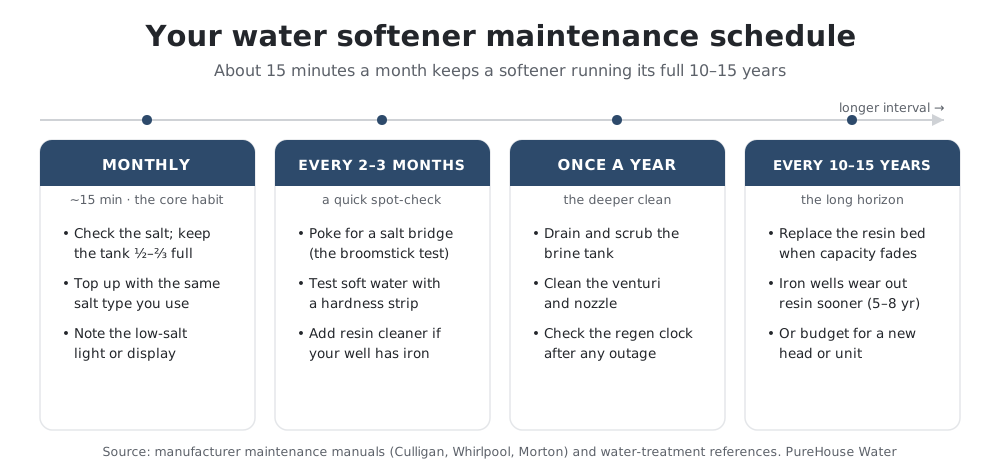
Here is the whole routine, by how often you touch it:
- Monthly: check the salt and top it up.
- Every 2 to 3 months: poke for a salt bridge, test the water to confirm it is still soft, and dose a resin cleaner if you have iron.
- Once a year: drain and scrub the brine tank, and clean the venturi.
- Every 10 to 15 years: replace the resin bed.
The rest of this guide walks each of those, starting with the one you do most.
Refilling the salt: how much, and which kind
This is the job you actually do month to month.
How much salt, and how often
Keep the brine tank between one-third and two-thirds full, and never let the salt drop below the water line.
Check it about once a month and add a bag when it runs low.
A typical family of four goes through roughly one 40 lb bag a month, so most homes buy somewhere around 8 to 12 bags a year; harder water and iron push that higher, and a metered softener uses less than an old timer unit.
Do not cram the tank to the top “to save trips.” A too-full tank sitting in a humid basement is one of the main causes of the salt bridge you will read about next.
Which salt to buy
There are three practical choices, and the differences are real:
| Salt type | What it is | Trade-off |
|---|---|---|
| Evaporated (solar) or pellets | High-purity sodium chloride | Cleanest, fewest bridging/mushing problems; the default pick |
| Rock salt | Mined sodium chloride, cheaper | More insoluble grit, so the tank fouls faster and needs cleaning more often |
| Potassium chloride (KCl) | Sodium-free salt substitute | Adds no sodium to your water, but costs roughly 3 to 4 times as much |
For most homes, evaporated crystals or pellets are the safe default: at roughly 99.5% purity they leave far less sludge in the bottom of the tank than rock salt. (CrystalQuest)
Choose potassium chloride only if a doctor or a septic rule has you avoiding added sodium; it works the same way, it just costs more.
Whatever you pick, stick with one type. Mixing pellets and crystals is another common trigger for bridging.
Worked example: what the salt actually costs
The math is simple:
bags per year x price per bag. Take a family of four on 20 gpg hard water, refilling about 8 to 12 bags a year.
- Sodium chloride (solar or pellets) at ~$10 a 40 lb bag → about $80 to $120 a year.
- Potassium chloride at ~$30 a bag, and about 10% more of it since it works a little less efficiently → about $260 to $400 a year.
So switching to the sodium-free salt adds roughly $200 a year or more. That is the number to weigh against whether you actually need to cut sodium, since a softener adds only a small amount to begin with. Plug in your own hardness and local bag price to get your figure.
Salt bridges and salt mushing: the two salt problems
When salt stops working the way it should, it is almost always one of these two.
Salt bridging
A salt bridge is a hard crust of salt that forms across the tank above the water line, leaving an empty air gap underneath.
The tank looks full, but the brine below has nothing to dissolve, so the softener quietly stops recharging and hard water comes back.
Humidity, a too-full tank, and cheap high-grit salt all make it more likely.
Find it with the broomstick test:
- Take a broom handle or a length of dowel.
- Push it straight down into the salt.
- If you hit a hard shelf well above the bottom, and it takes real force to break through, that is a bridge.
Fix it: push down with the blunt handle to crack the crust and let the loose salt fall into the water below. Pour a little warm water over a stubborn crust to help it break up. Then check that fresh salt is sitting in the brine again.
One safety note from Morton: use a broom handle or another blunt tool, never a sharp or pointed object, or you can puncture the tank. (Morton)
Salt mushing
Salt mushing is the opposite problem: dissolved salt recrystallizes into a thick sludge below the water line at the bottom of the tank.
It is worse than a bridge because you cannot just poke through it. The mush settles over the intake at the base and blocks the flow of brine, so regeneration weakens even when the tank is full.
The fix is to drain the tank, scoop out the sludge, and clean it, which brings us to the yearly job.
Cleaning the brine tank
Once a year is the right cadence for most homes, and any time you switch salt types or find mushing.
It is a 30-minute job:
- Set the softener to bypass so no water flows through it.
- Scoop out the remaining salt, then drain or bail the brine water.
- Lift out the brine grid and the brine well tube if your unit has them.
- Scrub the inside with warm water and a squirt of dish soap.
- If your manufacturer allows it, sanitize with a little unscented household bleach (about 2 ounces per cubic foot of resin), let it sit a few minutes, then rinse thoroughly. Do not exceed that dose or leave resin in strong bleach.
- Reassemble, refill with fresh salt, add a few gallons of clean water, and take it off bypass.
If your tank has an inch of grit every year, you are probably using rock salt; switching to pellets will slow that down.
Cleaning the resin: for iron and scale
The resin bed does the real work, and on some water it needs a periodic clean of its own.
If your well has iron, the iron slowly coats the resin beads, cuts their capacity, and burns more salt to do the same job.
A resin cleaner (the class of product sold as Iron-Out, Res-Care, or Pro-Res-Care) dosed into the brine tank strips that buildup back off.
On an iron-heavy well, dose it about every month or two; on ordinary hard water, once or twice a year is plenty.
It is upkeep you keep repeating, so if the iron is more than a trace, the durable fix is an iron filter ahead of the softener. See water softener for iron for where that line falls and what to install.
Checking that the water is still soft
The softener can fail quietly, so confirm it is working every couple of months.
The quickest check is a hardness test strip: run the cold tap about 30 seconds, fill a glass, dip the strip, and read it against the chart.
Softened water should read 0 to 3 grains per gallon; a reading of 7 or more means something is wrong.
If hardness is creeping back while the salt tank still looks full, work through the usual suspects in order:
- A salt bridge (do the broomstick test).
- An empty or nearly empty brine tank.
- A clogged venturi (next section).
- A regeneration clock reset by a power outage.
- Resin near the end of its life (last section).
Keep a couple of strips on the shelf, or pick one up from the best water hardness test kits.
Cleaning the venturi and nozzle
This is the small part that causes the most confusing failures.
The venturi (also called the injector or nozzle) is the fitting that creates the suction to pull brine out of the salt tank during regeneration. (Sears PartsDirect)
When sediment clogs it, the softener cannot draw brine, so it rinses with plain water and never actually recharges. The tank stays full of salt, yet the water turns hard.
Clean it about once a year:
- Put the unit on bypass and relieve the pressure.
- Unscrew the venturi cover on the valve body (check your manual for its exact spot).
- Lift out the small screen and nozzle, and soak them in white vinegar for about 15 minutes to dissolve scale.
- Gently clear the tiny orifice without enlarging it, rinse, re-grease the O-ring, and reassemble so the seals seat properly. (Sears PartsDirect)
If you have never touched the valve before, the water softener installation guide shows how the plumbing and bypass fit together.
Winterizing and long absences
If a softener will sit through a hard freeze or a long vacancy, protect it.
For a seasonal home, shut off the main water, set the unit on bypass, unplug it, and drain both the resin tank and the brine tank so nothing freezes and cracks a fitting. Never put automotive antifreeze in drinking-water equipment. (Aquasure)
For a couple of weeks away, you can leave it running; a metered softener only regenerates when it has treated enough water, so it happily sits idle.
When you come back from a long break, run a manual regeneration to freshen the resin before you drink the water.
Regeneration and error checks
Two quick things to know when something seems off.
First, check the clock after a power outage. Many older softeners keep the day and time on a small internal timer; if that resets, the unit can regenerate at the wrong hour or skip it. Reset the time so it recharges overnight when no one needs water.
Second, learn the signs of a failed regeneration: hard water returning, the softener running or making motor noise almost constantly, or salt that never goes down. Each of those points back to one of the causes above, usually a bridge, a clogged venturi, or spent resin.
When to replace the resin
Resin lasts a long time, but every bed eventually wears out.
Expect 10 to 15 years on ordinary hard water, and 5 to 8 years on iron-heavy or chlorinated water that wears the beads faster.
You will know it is failing when soft water fades even though the salt is full, the tank is clean, and the venturi is clear. That is the resin giving up.
Replacing the resin bed is a doable job for a handy owner: the media runs about $100 to $300 for a DIY swap, or roughly $300 to $600 if a pro does it.
Weigh that against the age of the whole unit. If a 12-year-old softener needs resin and the valve is also worn, a new system often makes more sense.
Compare current picks on the best water softeners, or step back to the full water softener system guide for sizing and how it all works.
Frequently asked questions
How often should I clean my water softener?
Check and refill the salt monthly, and give the brine tank a full drain-and-scrub about once a year. Clean the venturi yearly too, and dose a resin cleaner every month or two only if your water has iron.
How do I know if my water softener has a salt bridge?
Push a broom handle straight down into the salt. If you hit a hard shelf sitting above the bottom of the tank and have to force through it, that crust is a bridge. Break it up with the handle so the salt drops back into the water.
Why is my water softener not using salt?
The salt level stays the same when the unit is not drawing brine. The usual causes are a salt bridge, a clogged venturi or injector, or a regeneration schedule that reset after a power outage. Check those three before assuming the softener is broken.
What kind of salt is best for a water softener?
Evaporated crystals or pellets are the safe default because they are high purity and leave less sludge. Use potassium chloride only if you need to avoid adding sodium, and be ready for it to cost about three to four times as much.
Do I need to clean the resin in my water softener?
Only some water needs it. On iron or heavily scaled water, dose a resin cleaner into the brine tank every month or two to strip the buildup. On ordinary hard water the resin cleans itself during regeneration, so once or twice a year is enough.
How long does water softener resin last?
About 10 to 15 years on typical hard water, dropping to 5 to 8 years on iron-heavy or chlorinated supplies. Replace it when soft water fades despite a full, clean, well-running system.
Setting a softener up for the first time? See the water softener installation guide.
Want to confirm it is still working? Grab one of the best water hardness test kits.
Fighting iron in the resin? Read water softener for iron for the real fix.
Shopping for a new unit? Compare the best water softeners or read the full water softener system guide.
How we researched this
We built this schedule from manufacturer maintenance guidance (Morton) and water-treatment references on salt handling, brine-tank care, and resin lifespan (CrystalQuest, Sears PartsDirect, Aquasure), and cross-checked it against the softener sizing and iron facts already sourced on this site.
We don’t service these units in-house yet, so we don’t claim to.
Where we point to a consumable, softener salt, a resin cleaner, or replacement resin, those are stocked at any hardware store or on Amazon; we may earn a commission if you buy through a link, at no cost to you.