Water softener for iron: how much it removes, and when you need a filter
A water softener removes hardness, not iron.
It can pull out a little dissolved iron along the way, but softening hardness is the only job it is built to do.
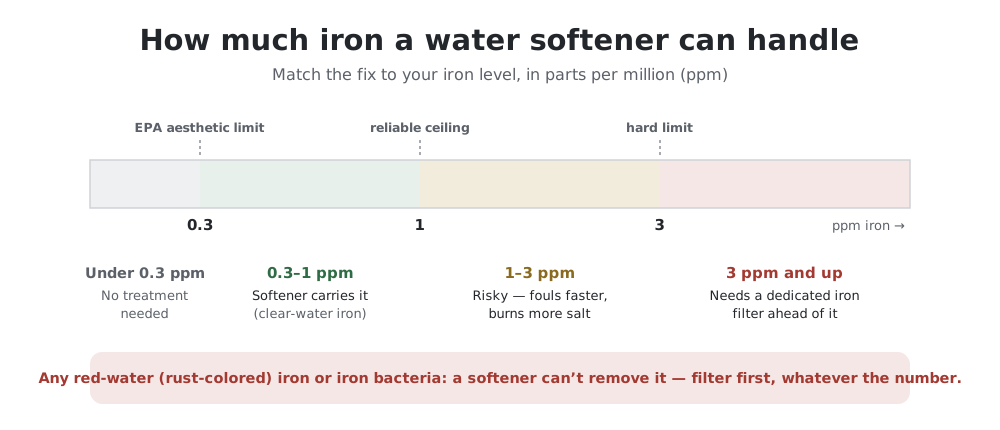
Here is the honest ceiling: a softener handles clear-water iron up to about 1 ppm reliably, gets risky from 1 to 3 ppm, and at 3 ppm or more it needs a dedicated iron filter installed ahead of it.
It does nothing for red-water iron or iron bacteria, which clog the resin instead of being removed by it.
So if you have real iron and hard water together, the fix is an iron filter feeding a softener, or a single combo unit that does both.
This guide shows you exactly where your water falls, and what to buy for it.
Does a water softener remove iron?
A little, and only one kind.
A softener works by ion exchange: it swaps the calcium and magnesium that make water hard for sodium, using a tank of resin beads. (Culligan)
That same resin can trade out dissolved iron, the clear-water kind, because dissolved iron behaves chemically like the hardness minerals.
But it only works while the iron stays dissolved and the amount stays small.
The moment iron oxidizes into rust particles, the resin can’t trade it, and the particles start coating the beads instead.
That is why “will a softener remove iron” has a yes-and-no answer: yes for a trace of clear-water iron, no for anything you can actually see.
Which iron do you have?
The type matters more than the number here, so start with a five-minute check.
Fill a clear glass from an unfiltered tap and let it stand:
- Clear at first, turns rusty or drops sediment after 20–30 minutes → ferrous (clear-water) iron. This is the only kind a softener can touch.
- Already red, orange, or cloudy from the tap → ferric (red-water) iron. It is already oxidized, and a softener can’t remove it.
- An oily, rainbow sheen and a swampy smell on standing water → likely iron bacteria. A softener does nothing for it and gets fouled by the slime.
For the full diagnosis, including iron bacteria and manganese riding along, see the best iron filter for well water, which walks through each type and its fix.
How much iron can a water softener handle?
Use this as your buying rule:
| Iron in your water | What a softener does | What to do |
|---|---|---|
| Under ~0.3 ppm | No treatment needed | Below the EPA aesthetic threshold; most people don’t notice it |
| 0.3–1 ppm, clear-water (ferrous) | Handles it, if water is also hard and pH is in range | A quality softener alone can carry this |
| 1–3 ppm, clear-water | Risky; fouls faster, uses more salt | A fine-mesh “iron” softener may hold, but a filter ahead is safer |
| 3 ppm or more, or any red-water iron | Fails, and the iron clogs the resin | Put a dedicated iron filter ahead of the softener |
| Any iron bacteria | Fails, and the slime fouls the resin | Shock-chlorinate the well, then filter; see the iron guide |
The 1 ppm reliable ceiling and the 3 ppm hard limit come from water-treatment specialists, and they line up with what well owners report when a softener slowly loses ground to iron.
One more reason the number matters: iron makes a softener harder to size.
You add about 5 grains per gallon of “compensated hardness” for every 1 ppm of iron before you size the unit, so 10 gpg hardness with 3 ppm iron is sized as 25 gpg, not 10.
That is how iron-heavy wells end up with oversized, salt-hungry softeners, unless you filter the iron out first.
What iron does to your softener’s resin
This is the part that turns a softener into a slow, expensive mistake on an iron well.
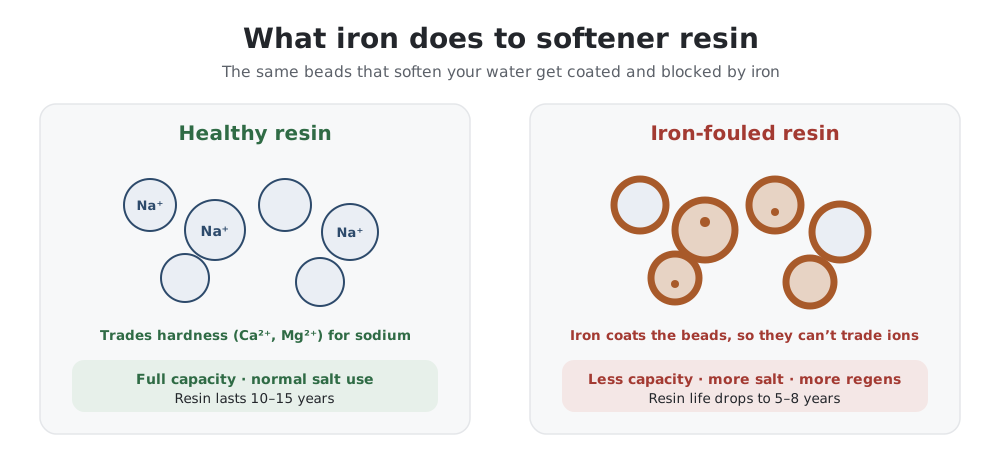
Iron and manganese coat the resin beads and clog the control valve.
As they build up, the softener holds less hardness, regenerates more often, and eats more salt to do the same work.
Left alone, iron fouling can cut resin life from a normal 10–15 years down to 5–8.
You can see it coming: hard-water spots creep back, the system runs through salt faster, and rust staining you thought the softener would stop keeps showing up.
Can you clean iron out of the resin?
Up to a point.
A resin cleaner dosed into the brine tank, the class of product sold as Iron-Out, strips some of the iron back off the beads and buys the softener more time.
But it is maintenance you keep repeating for the life of the unit.
You are cleaning up iron the softener was never meant to take, over and over, to keep it limping along.
The durable answer is to keep the iron out of the resin in the first place.
What about a “water softener with iron removal”?
You will see softeners marketed for iron, built on fine-mesh resin that regenerates more aggressively.
They do raise the ceiling a little for light, clear-water iron, and for a well that is just over the 1 ppm line, one can be a reasonable convenience.
The honest limits are the same as any softener: they still can’t remove red-water iron or iron bacteria, and they still foul faster than a setup that filters the iron before it ever reaches the resin.
Treat a fine-mesh “iron” softener as a stretch for light ferrous iron, not as an iron system.
If your test shows more than a trace of iron, or any of it is already rust-colored, you want a real filter in front, which is the next section.
The right setup for iron and hard water
When you genuinely have both problems, there are two clean ways to solve them.
Option 1: an iron filter, then a softener (two tanks).
You treat the water in order, and each stage does one job well:
- Sediment pre-filter — catches grit before it wears the rest of the train.
- Iron filter — an air-injection oxidation stage oxidizes the iron and filters it out, using no salt or chemicals.
- Water softener — now it only ever sees hardness, exactly what it is built for.
Get that order right and the softener lasts its full life.
Two separate tanks give you the most flexibility, because you size the iron filter to your iron and the softener to your hardness.
For the filter half of this pair, the best iron filter for well water compares the actual units, specs, and prices.
Option 2: a filter-plus-softener combo (one unit).
A combo puts an air-injection iron, sulfur, and manganese filter and a salt-based softener in one system, plumbed and controlled together.
You get one install and one thing to maintain, at a higher upfront price than either tank alone.
The SpringWell WSSS is the combo we point to: it removes iron, hydrogen sulfide, manganese, and hardness, and flows around 11 gpm for a whole house.
The base WSSS1 size runs about $3,300 direct from SpringWell, roughly $3,900 at list price. (SpringWell)
PureHouse scoreSpringWell WSSS Well Filter + Softener Combo8.3/10
For heavier iron, roughly 7 ppm and up, or confirmed iron or sulfur bacteria, that is specialist territory; the best whole-house filter guide covers the US Water Systems Matrixx InFusion for those cases.
PureHouse scoreUS Water Systems Matrixx inFusion7.9/10
Combo or two tanks: which to pick
- Choose two tanks if you want to size each stage precisely, spread the cost, or already own one half.
- Choose a combo if you want one system, one install, and one control valve, and your iron is in the range a single air-injection stage handles.
Either way, the iron gets oxidized and filtered before the softener, which is the whole point.
What it costs
The setups above land in familiar ranges.
- A salt-based softener runs about $1,200–3,800 installed. (HomeGuide)
- An air-injection iron filter runs about $1,200–2,500 installed.
- A filter-plus-softener combo sits at the top of the range, since you are buying both stages in one unit.
The cost worth avoiding is buying a plain softener for iron it can’t handle, watching the staining continue, and then buying the iron filter you needed anyway, which stacks roughly $2,000 onto the job. (HomeGuide)
Testing first is what prevents that, and it costs about $20 to $50.
Get real numbers with well water testing, or compare the best well water test kits, before you size or buy anything.
Frequently asked questions
Does a water softener remove iron from well water?
Only a small amount of dissolved clear-water (ferrous) iron, up to about 1 ppm, and only while your water is also hard.
It cannot remove red-water (ferric) iron or iron bacteria, which foul the resin instead of being removed by it.
How much iron can a water softener handle?
Count on it for iron up to about 1 ppm.
From 1 to 3 ppm it works but fouls faster and burns more salt, and at 3 ppm or more you need a dedicated iron filter installed ahead of the softener.
Is there a water softener that also removes iron?
Some softeners use fine-mesh resin and heavier regeneration to stretch a little further on light clear-water iron, but they still can’t remove ferric iron or bacteria.
For anything past a trace of iron, use an iron filter ahead of the softener, or a combo unit that includes one.
Do I need an iron filter or a water softener, or both?
If you have hardness and more than about 1 ppm of iron, you need both: an iron filter to remove the iron, then a softener for the hardness.
A single combo unit packages both stages together if you prefer one system.
Iron ruined my softener’s resin. Can I fix it?
A resin cleaner dosed into the brine tank strips some iron back off and buys time, but it is ongoing maintenance, not a cure.
The lasting fix is to add an iron filter ahead of the softener so iron stops reaching the resin.
Will a water softener stop the rust stains on my toilets and laundry?
Only if the staining comes from a trace of clear-water iron in otherwise hard water.
Visible rust staining usually means ferric iron or a higher concentration, which needs an iron filter, not a softener.
Have iron you can see or a rotten-egg smell? Fix that first with the best iron filter for well water.
Choosing the softener itself? Compare picks and sizing on the best water softeners.
Want the full how-it-works, sizing, and cost picture? See the water softener system guide.
Not sure what’s in your water yet? Start with well water testing or a well water test kit.
How we researched this
We built this guide from water-treatment engineering and specialist guidance on iron and softener resin (Culligan, Clean Water Store, Pure Water Products, SoftPro), cross-checked against the iron-type and cost facts already sourced on this site.
We don’t test these systems in-house yet, so we don’t claim to.
When we name a product it is the SpringWell and US Water Systems picks already compared in depth on the pages this one links to, and we may earn a commission if you buy through those links, at no cost to you.