Best well water test kit: DIY strips vs. mail-in lab kits compared
- Color-match strip covers pH, hardness, alkalinity, nitrate, nitrite, coliform bacteria, copper, lead, and chlorine.
- Gives a result in about 10 minutes and costs under $25.
- Doesn’t detect arsenic, PFAS, VOCs, or radon.
- Results aren’t legally usable for a closing or health department follow-up.
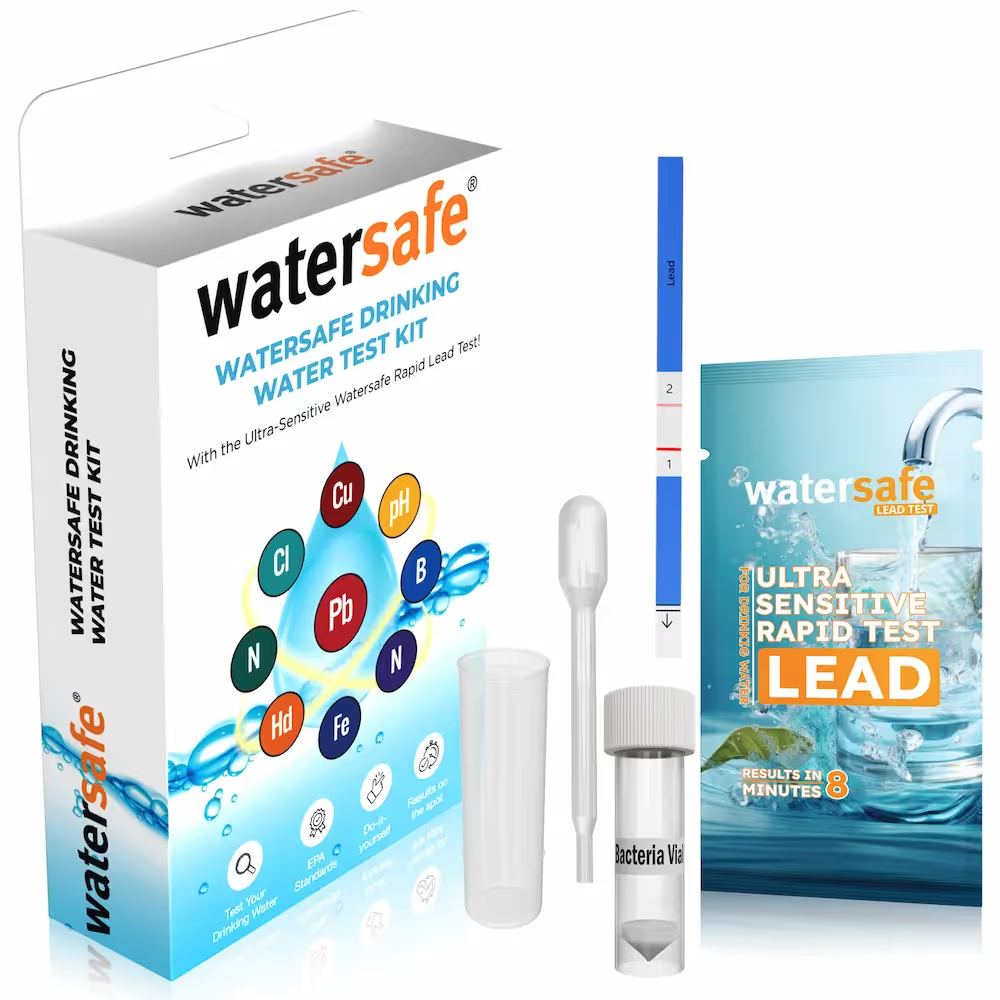
- Lead strip is independently verified against a recognized lab method, reading down to under 5 ppb.
- Also covers iron, copper, bacteria, pesticides, nitrate/nitrite, chlorine, pH, and hardness.
- Gives a result in about 10 minutes, with bacteria taking up to 48 hours.
- Costs under $40, but doesn’t include an arsenic test.

- Mail-in certified lab test covers 54 analytes, including E. coli, nitrate, fluoride, and 25 metals.
- Runs through an ISO/NELAC/ELAP-accredited lab network and returns precise lab measurements.
- Takes about 5 lab days plus 2–3 days shipping each way, and costs $209.
- Results are legally usable, covering the EPA’s annual baseline plus the broader metals panel.
The best well water test kit is the one matched to the question you’re answering, from a $15 strip to a certified lab panel.
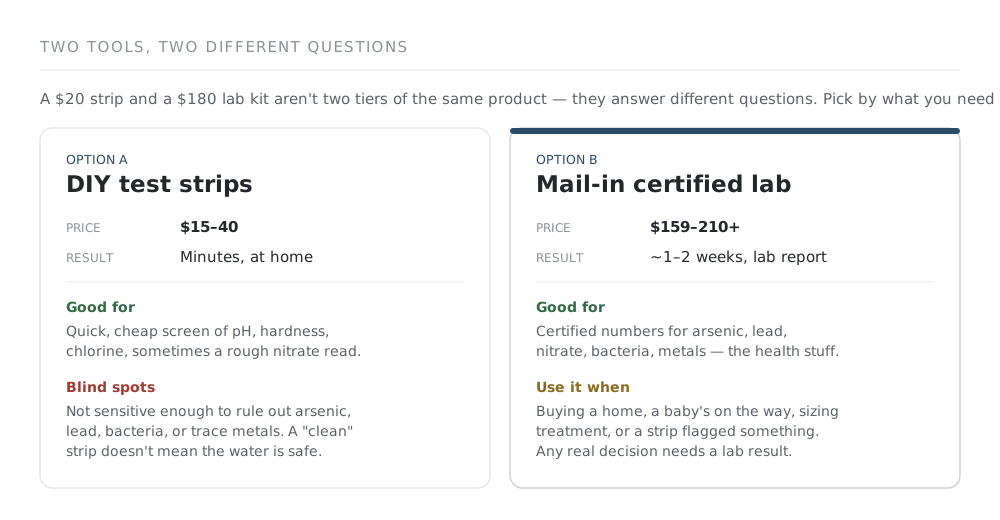
For a fast pH or hardness check, a DIY strip kit (Health Metric or Watersafe, $15–40) is enough.
For anything that decides a health or purchase question, bacteria, arsenic, lead, or the annual EPA baseline, you need a mail-in lab kit processed at a certified lab, starting around $159–210 for an entry-level panel like Tap Score’s Essential or WaterCheck’s Basic.
A strip and a lab kit are two different tools for two different questions, and picking the wrong one for yours wastes money either way.
How we chose
We built this comparison from manufacturer and lab spec sheets (Tap Score/SimpleLab, WaterCheck/National Testing Laboratories, Watersafe, Health Metric), EPA and CDC private-well testing guidance, and a peer-reviewed field evaluation of arsenic test kits.
We don’t run a lab or sell test kits ourselves, so we won’t pretend to rank them by hands-on results; every figure here is attributed to its source.
What we can do is tell you plainly what each kit type can and can’t answer, and what real ones cost.
Two questions decide which kit is right for you:
- What are you trying to find out? A quick hardness check and “is this water safe to drink” are not the same question, and they don’t take the same kit.
- Does the result need to hold up legally? Closing on a home with a well, an insurance requirement, or a health department follow-up all need a certified lab result. A strip test doesn’t count.
If you haven’t read why testing matters and what the EPA baseline covers, start there.
This page picks the actual product once you know what you’re testing for.
The picks
Health Metric Drinking Water Test Kit
| Spec | Value |
|---|---|
| Type | DIY color-match strip |
| Covers | pH, hardness, alkalinity, nitrate, nitrite, total coliform bacteria, copper, lead, total chlorine |
| Result time | About 10 minutes |
| Price | Under $25 |
| Legally usable | No |
You dip a strip, wait, and match the color to a printed card.
It’s genuinely useful for what it’s built for: a quick, cheap read on the parameters that don’t need lab precision.
It is not built to catch arsenic, PFAS, VOCs, or radon, and it doesn’t detect any of them.
A “clean” strip result doesn’t mean your water is actually safe on those two.
Go to a lab kit below instead.
Check price at Amazon(opens on Amazon, external site)Watersafe Well & Tap Water Test Kit
| Spec | Value |
|---|---|
| Type | DIY color-match strip |
| Covers | Iron, copper, lead (sensitive to under 5 ppb), bacteria, pesticides, nitrate/nitrite, chlorine, pH, hardness |
| Result time | About 10 minutes (bacteria up to 48 hours) |
| Price | Under $40 |
| Legally usable | No |
Watersafe’s lead strip is independently verified against a recognized lab method and reads down to under 5 parts per billion, tighter than most strip kits manage.
It’s still a screening tool, but for lead specifically, it’s a stronger strip than most.
If arsenic is a concern in your area, you’ll need a separate arsenic strip or a lab panel that includes it.
Check price at Amazon(opens on Amazon, external site)Tap Score Essential Well Water Test
| Spec | Value |
|---|---|
| Type | Mail-in, certified lab |
| Covers | 54 analytes: pH, TDS, hardness, turbidity, alkalinity, conductivity, E. coli + total coliform, nitrate/nitrite, fluoride, 25 metals (arsenic, lead, uranium, and more), minerals, hydrogen sulfide self-test |
| Result time | About 5 lab days plus 2–3 days shipping each way |
| Price | $209 |
| Legally usable | Yes |
Samples run through a network of ISO/NELAC/ELAP-accredited labs, and the report comes back as actual numbers against health thresholds, not a color match.
This is the kit that answers “is my water safe” with a real answer, and the one that covers the EPA’s annual baseline plus the broader metals panel in one order.
Overkill if all you need is a hardness number.
Use a strip kit instead and save the money for a lab test on the parameters that actually matter.
See the current kit on Tap Score’s site(opens in a new tab, external site)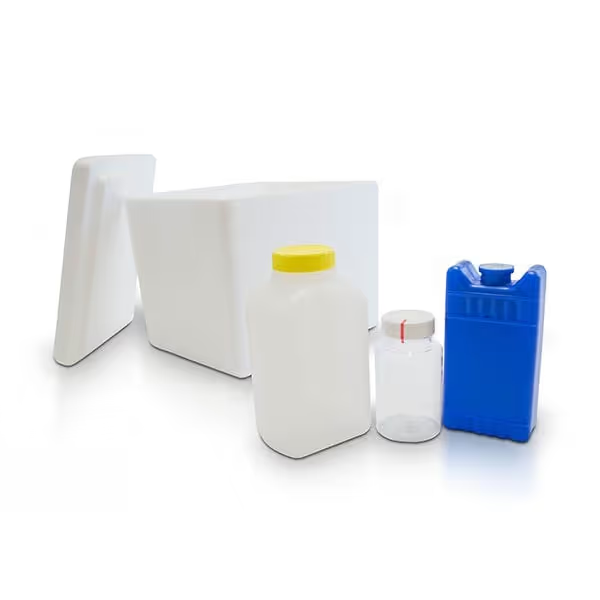
WaterCheck Basic (National Testing Laboratories)
| Spec | Value |
|---|---|
| Type | Mail-in, certified lab |
| Covers | 36 analytes: bacteria (coliform + E. coli), 22 heavy metals/minerals, 7 inorganics, 5 physical factors |
| Result time | A few business days at the lab |
| Price | $205 |
| Legally usable | Yes |
A narrower panel than Tap Score’s Essential at a close price, so it’s less of an automatic pick, but it’s a real certified-lab result from an established provider, and National Testing Laboratories offers step-up tiers (Standard at $239 adds VOCs and trihalomethanes; Deluxe at $295 adds pesticides, herbicides, PCBs, and uranium) if you want to expand later.
Comparison table
| Health Metric strip | Watersafe strip | Tap Score Essential | WaterCheck Basic | |
|---|---|---|---|---|
| Type | DIY strip | DIY strip | Mail-in lab | Mail-in lab |
| Price | Under $25 | Under $40 | $209 | $205 |
| Analytes | 9 | 9 | 54 | 36 |
| Includes arsenic? | No | No | Yes | Yes |
| Result time | ~10 min | ~10 min | ~1 week | Few days |
| Legally usable | No | No | Yes | Yes |
What a strip kit can and can’t tell you
Strip kits work by color match: dip the strip, wait, hold it against a printed card.
That’s fast and cheap, and it’s a reasonable way to check pH or hardness between real tests.
It’s the wrong tool for anything that decides whether the water is safe or whether a sale can close.
Certified labs detect total coliform bacteria down to roughly 1 colony-forming unit per 100 mL; most strip kits only flag bacteria above roughly 100 CFU/100 mL.
That’s the gap between catching a contamination and missing it outright.
Arsenic is worse: strips can’t resolve the 0–10 parts-per-billion range where the EPA’s limit actually sits.
A peer-reviewed field evaluation of six arsenic test kits found most were either accurate or precise, but not both.
Colors frequently read too light against the kit’s own calibration chart, a real risk of a false “safe” reading on water that’s actually over the limit.
Strips also can’t see PFAS, VOCs, or radon at all, and none of them carry legal weight for a real estate closing or insurance requirement.
None of that makes strips useless.
It makes them a screening tool, not a substitute for a lab result on anything that matters for health or a sale.
What a mail-in lab kit actually gets you
A mail-in kit ships you a set of sterile sample bottles and a prepaid return label.
You collect the sample yourself (see how to take a sample that gives you a real result for the step-by-step), mail it back, and the sample runs through an accredited lab using EPA-recognized test methods, ICP-MS for most metals.
What comes back is a real number in mg/L or ppb, checked against the EPA’s health-based thresholds, not a color range.
That number is what a lender, an insurer, or a health department will accept, and it’s what actually sizes a filtration system correctly.
It costs more and takes longer, and for anything beyond a quick screening check, that trade is worth it.
Match the kit to your situation
| Your situation | Get this |
|---|---|
| Quick pH/hardness check between real tests | Strip kit ($15–40) |
| Annual EPA baseline (bacteria, nitrate, TDS, pH) | Entry-tier mail-in lab ($159–210) |
| Ruling out arsenic, lead, PFAS, or radon | Lab kit covering that analyte specifically ($200–415+) |
| Buying or selling a home with a well | Certified lab result, required for FHA loans and most sale contracts |
| Suspected sulfur (rotten-egg smell) | Field-test at the tap, not by mail; hydrogen sulfide off-gasses before a mailed sample arrives |
If you already know your symptom, you may not need the full panel to start narrowing it down.
See why your well water smells like rotten eggs if that’s what you’re smelling, the best iron filter for well water if you’re seeing rust staining, or arsenic in well water if a lab flagged it, since a strip kit won’t reliably catch it.
Dedicated pages on the other individual contaminants are coming.
Once your results are back
Getting the number back is only step one.
If bacteria comes back positive, call your local health department before you shop for anything.
If iron, manganese, or sulfur come back elevated, that’s a whole-house filter question.
See the best whole-house filters for well water to match a system to your actual ppm numbers, or well water filtration system for the full five-step framework from test to installed system.
Frequently asked questions
What is the best well water test kit?
It depends on the question.
For a quick screening check on pH or hardness, Health Metric or Watersafe’s DIY strip kits (under $40) are enough.
For anything health- or purchase-related, bacteria, arsenic, lead, or the EPA’s annual baseline, Tap Score’s Essential Well Water Test ($209) is the strongest entry-tier mail-in lab option, with WaterCheck Basic ($205) as a close, narrower alternative.
Are DIY well water test kits accurate?
For pH, hardness, and similar parameters, they’re a reasonable quick check.
For bacteria, arsenic, or lead, they’re not sensitive or precise enough to rule out a real problem.
Certified labs detect bacteria at roughly 1 CFU per 100 mL versus roughly 100 for most strips, and peer-reviewed testing of arsenic strips found accuracy problems in most kits evaluated.
How much does a well water test kit cost?
DIY strip kits run under $40.
Entry-level mail-in lab kits run $159–210.
Mid-range panels that add VOCs run $239–400.
Comprehensive panels covering 100+ parameters can run $500 or more.
Standalone PFAS tests run $335–415, and radon-only tests run around $145.
What should a well water test kit test for?
At minimum, the EPA’s annual baseline: total coliform bacteria, nitrate, TDS, and pH.
A broader panel should add arsenic, lead, manganese, and iron, plus anything specific to your area (VOCs near industrial sites, pesticides near farmland, radon in some regions).
Can a well water test kit detect arsenic and lead?
A basic DIY strip usually can’t detect arsenic at all, and most strips aren’t precise enough on lead to rule out a problem, though some (like Watersafe’s) test lead specifically and read down to under 5 ppb.
Mail-in lab kits that include a metals panel, such as Tap Score’s Essential or WaterCheck’s Basic, test both accurately.
How long does a mail-in well water test kit take?
Typically about a week total: a few business days at the lab plus shipping time each way.
Some entry-tier kits report results in as few as 2–5 business days once the sample arrives.
Is a well water test kit legally valid for buying or selling a home?
Only a certified-lab result counts.
FHA-insured loans require a water test on any home served by a private well, and DIY strip results aren’t accepted for that purpose.
Use a mail-in kit from an accredited lab, or a local state-certified lab.
How often should I use a well water test kit?
Run the certified-lab baseline (bacteria, nitrate, TDS, pH) annually, and a broader lab panel every 3–5 years.
A strip kit can supplement that between real tests, but shouldn’t replace it.
Results in hand? If iron came back elevated or you’re seeing rust staining, go to the best iron filter for well water to match the fix to your type.
Sulfur smell? See the sulfur fix.
Either way, or for the full system, see the best whole-house filters for well water or well water filtration system.
How we researched this
We built this comparison from manufacturer and lab spec sheets (Tap Score/SimpleLab, National Testing Laboratories’ WaterCheck, Watersafe, Health Metric), EPA and CDC private-well testing guidance, and a peer-reviewed evaluation of arsenic field test kits.
We don’t run a lab or sell test kits ourselves, so we don’t claim first-hand results here.
We also weren’t able to pull real-time user discussion for this page: the well-water forums and Reddit threads we’d normally check for lived experience were inaccessible this pass (one returned a paywall, Reddit returned no results), so this page leans more heavily on manufacturer specs, retailer aggregation, and published research than the community language in our other pages.
We don’t currently have a confirmed affiliate relationship with any test kit or lab brand, so the links above go straight to each company’s own product page, not an affiliate link.
Sources
- EPA — Protect Your Home’s Water
- CDC — Guidelines for Testing Well Water
- Tap Score — Lab Tests or Test Strips: The Best Water Test for You
- Tap Score — Essential Well Water Test
- WaterCheck — Well Water Testing
- Watersafe Test Kits
- Health Metric — Drinking Water Test Kit
- ScienceDirect — Evaluation of arsenic field test kits for drinking water
- NSF — Product Certification Standards (Water Quality Testing Devices)