Arsenic in well water: what it means and how to remove it
Arsenic in well water has no taste, smell, or color, so the only way to know it’s there is a lab test, not your senses.
If your test shows arsenic at or above the EPA’s limit of 0.010 mg/L (10 parts per billion), take it seriously. It’s a naturally occurring, chronic-exposure risk, and it’s treatable.
The EPA sets that limit based on the risk of bladder and lung cancer from years of exposure. That means a “normal-looking” glass of water can carry a real, cumulative risk you’d never taste or see coming.
The right fix depends on which form of arsenic is in your water and whether you want to treat one tap or the whole house.
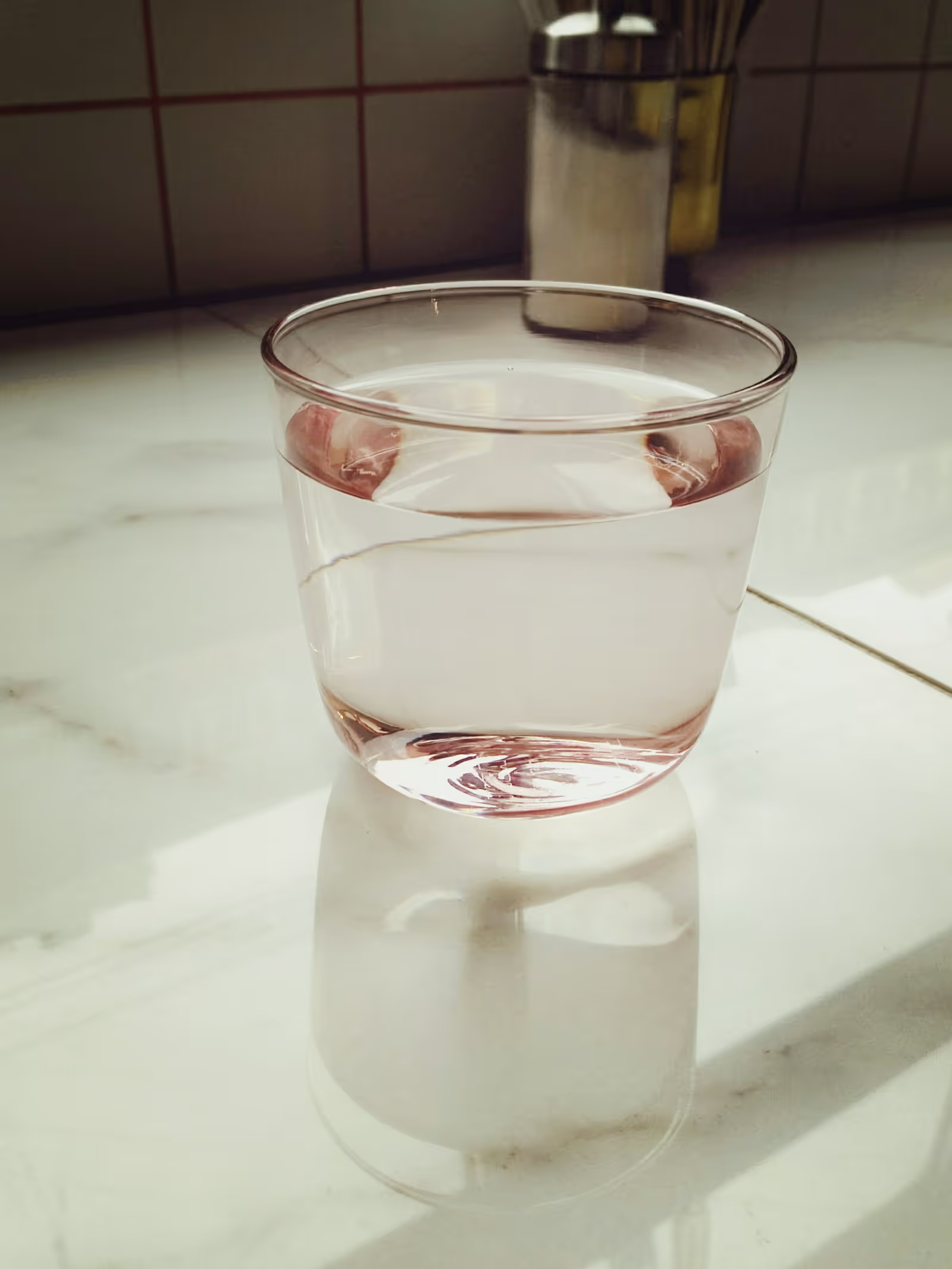
Why you can’t tell by looking, smelling, or tasting
Iron turns your water rusty. Sulfur smells like rotten eggs.
Arsenic does neither — and neither does nitrate, another well contaminant a lab test alone can catch.
It’s colorless, odorless, and tasteless at every concentration that matters for health. That means a well can carry arsenic well above the safe limit while looking and tasting completely normal.
A lab test is the only way to find out. A color-strip kit isn’t a reliable substitute: strips can’t resolve concentrations in the 0–10 ppb range, which is exactly the range the EPA’s limit sits in.
A peer-reviewed evaluation of arsenic field test kits found accuracy problems in most of the kits tested.
If you haven’t tested yet, see well water testing or the best well water test kits and use a certified lab, not a strip, for this one.
Where arsenic in well water comes from
Almost all arsenic in well water is naturally occurring, not pollution.
Certain bedrock holds minerals that carry arsenic, mainly arsenopyrite and arsenic-substituted pyrite.
Groundwater moves through fractures in that rock. As it moves, it slowly dissolves trace arsenic out of the minerals and carries it into the aquifer your well draws from.
Bedrock fracturing is uneven. So two wells a few hundred feet apart can test very differently, and your neighbor’s clean result doesn’t tell you much about your own well.
New Hampshire is a well-documented example. Private wells there have roughly a 1-in-4 chance of naturally occurring arsenic above 5 ppb, and roughly a 1-in-5 chance of testing above the 10 ppb actionable level. That risk ties directly to the state’s granite and metamorphic bedrock. (NH DES)
Parts of Maine, New Jersey, the upper Midwest, and the Southwest have similar hot spots.
Your local health department is the best source for whether your area is a known one.

Is arsenic in well water dangerous?
Yes, in a different way than iron or sulfur.
Those are aesthetic problems: unpleasant, but not a health risk at the levels usually seen in well water.
Arsenic is a genuine chronic health hazard.
The EPA sets its drinking water limit, called the Maximum Contaminant Level (MCL), at 0.010 mg/L (10 ppb). It bases that number on the risk of bladder and lung cancer from long-term exposure.
The World Health Organization’s guideline is the same number, 10 µg/L. WHO is explicit that it’s a “provisional” value, set by what routine labs and treatment could practically achieve, not by what’s fully safe.
Chronic, years-long exposure at elevated levels is linked to cancers of the bladder, lung, skin, kidney, and liver. It’s also linked to non-cancer effects, including skin lesions, cardiovascular disease, diabetes, and reduced cognitive development in children. (EPA; WHO)
The risk here is cumulative exposure, not a single glass of water.
This isn’t a smell you can shrug off or a stain you can live with. But it also isn’t an emergency. You don’t need to stop drinking your water tonight while you research a fix over the next few weeks.
There’s one exception, and it’s worth knowing. If your result comes back very high, above 200 ppb, or about 20 times the EPA limit, Massachusetts DEP says to stop drinking the water right away and switch to another source until you treat it. Results that high are rare, but at that point the fix moves from weeks to today. Bathing and showering still stay safe below 500 ppb, since arsenic isn’t absorbed through skin. (MassDEP)
Note too: private well arsenic isn’t federally regulated the way public water systems are.
The EPA’s MCL doesn’t apply to your well by law. It’s the benchmark you’re testing against by choice.
One myth worth killing directly: boiling does not remove arsenic.
Arsenic isn’t volatile, so boiling can leave it exactly where it was, or even concentrate it slightly as water evaporates.
If you’ve been boiling water because of an arsenic result, stop, and treat or switch to tested-safe water instead.
Arsenic III vs. arsenic V: why the form matters
Arsenic shows up in groundwater in two chemical forms. Which one you have changes what treatment actually works.
- Arsenite (arsenic III) carries no electrical charge at typical well-water pH. It’s common in low-oxygen (anoxic) well water.
- Arsenate (arsenic V) carries a negative charge at the pH range most well water sits in (roughly 6.5–8.5).
Anion exchange resin and activated alumina both work by grabbing charged particles. So they remove arsenic V well but do a much weaker job on uncharged arsenic III.
Reverse osmosis membranes reject larger, charged molecules far more completely than the small, uncharged arsenic III molecule. Because of that, reverse osmosis also removes arsenic V better than arsenic III. (University of Maine)
The practical fix: if your well has meaningful arsenic III, add an oxidation step ahead of the treatment system. Chlorine, potassium permanganate, or an air-injection filter can do this. That step converts arsenic III to arsenic V, so the downstream media or membrane can actually catch it. (Wastewater Digest)
Your lab report may not tell you the III/V split by default. Ask the lab or a water treatment professional whether your report includes it, since it decides whether you need that oxidation step.
What actually removes arsenic
| Your situation | The fix | What to expect |
|---|---|---|
| Want drinking/cooking water covered, lowest upfront cost | Point-of-use reverse osmosis (under-sink) | $300–2,000 installed; doesn’t treat shower/bath water, which is fine since arsenic isn’t absorbed through skin at meaningful levels |
| Want every tap in the house covered | Point-of-entry anion exchange or activated alumina (plus an oxidation step if arsenic III is present) | $1,500–3,000 installed, roughly $200–300/year in media |
| Well already has iron or manganese along with arsenic | Iron/manganese oxidation-filtration system for the iron, plus a dedicated reverse osmosis or anion-exchange stage for the arsenic | The iron system may pull down some arsenic through co-precipitation, but it isn’t a reliable arsenic fix on its own |
| Haven’t tested yet | Certified lab test first | Strips aren’t reliable for arsenic; see testing links below |
A few specifics behind the table:
Point-of-use reverse osmosis: the default for most households
This is the setup that shows up most often in real-world data, and for good reason. It’s cheaper to install than whole-house treatment. And since arsenic poses no meaningful risk from skin contact or inhalation, treating only your drinking and cooking tap covers the actual exposure that matters.
A study of Maine and New Jersey well households looked at installed treatment systems, mostly point-of-use reverse osmosis in Maine. It found they cut median arsenic from 71.7 µg/L to 0.8 µg/L, roughly a 7-fold reduction. (USGS)
That same study found 16–19% of installed systems still failed to reach below the MCL. Most of those failures traced to skipped maintenance, not a design flaw.
Whichever system you buy, retest it after installation. Retest again periodically after that, since the media loses capacity over time without any warning sign.
Whole-house anion exchange or activated alumina
Maybe you’d rather not think about a specific tap. Or maybe you’re on a private system where the whole house should meet the same standard. Either way, point-of-entry anion exchange or activated alumina treats every tap.
Activated alumina, run at its optimal pH range (roughly 5.5–6.0), removes up to about 95% of arsenic V.
Both media types need periodic replacement or regeneration. Both also need that upstream oxidation step if your water carries meaningful arsenic III.
Don’t rely on your iron/sulfur system for arsenic
You may already have, or be about to buy, an oxidation-filtration system for iron or sulfur (the pick covered on the best whole-house filter for well water). Know this: that system is not sold or certified as an arsenic-removal system.
Dissolved iron oxidizes into solid particles. Some arsenic can adsorb onto those particles and get carried out with them, real chemistry called co-precipitation. But how much it removes depends on your iron-to-arsenic ratio, pH, and contact time. It isn’t something you can count on to hit the MCL. (ScienceDirect)
If arsenic is confirmed on your test, treat it as its own project. Use a dedicated reverse osmosis or anion-exchange stage, not a side effect of your iron fix.
What it costs
Point-of-use reverse osmosis commonly runs $300–2,000 installed. One survey put the median install cost around $1,200, with median annual maintenance (filter/membrane replacement) around $340/year.
Whole-house anion exchange or activated alumina commonly runs $1,500–3,000 installed, plus roughly $200–300/year in media and upkeep.
Reverse osmosis tends to cost less than adsorptive media systems at a comparable scale. That’s part of why it’s the more common choice for single-family wells.
The 5-year math behind that
Sticker prices alone don’t show the real gap. One option has a much bigger ongoing cost.
Working from the median/midpoint figures above:
| Point-of-use reverse osmosis | Whole-house anion exchange / activated alumina | |
|---|---|---|
| Install cost | $1,200 (survey median) | $2,250 (midpoint of $1,500–3,000) |
| Annual upkeep | $340/yr | $250/yr (midpoint of $200–300) |
| 5-year total | ~$2,900 | ~$3,500 |
POU reverse osmosis costs roughly $600 less over five years, on top of already being cheaper to install.
The gap isn’t really a treatment-quality difference. It’s a coverage difference: whole-house treats every tap, while POU treats only the one you drink and cook from.
Arsenic poses no meaningful risk from skin contact or inhalation. So that extra $600 buys coverage most households don’t actually need.
Frequently asked questions
Is arsenic in well water dangerous?
Yes, chronically.
Iron or sulfur are mostly aesthetic problems. Arsenic is different: it’s a genuine health risk tied to years of exposure, linked to bladder, lung, skin, kidney, and liver cancers along with several non-cancer effects.
The risk comes from long-term exposure, not a single glass.
What level of arsenic in well water is safe?
The EPA’s limit (MCL) is 0.010 mg/L (10 ppb), and the WHO’s guideline is the same number. WHO notes it’s a provisional value based on practical testing and treatment limits, not a fully risk-free threshold.
Private wells aren’t legally required to meet it, but it’s the benchmark to test against.
Does reverse osmosis remove arsenic from well water?
Yes, especially arsenic V.
It’s less complete against arsenic III, the uncharged form common in low-oxygen well water, unless an oxidation step runs ahead of the reverse osmosis membrane to convert it to arsenic V first.
Can a water softener or iron filter remove arsenic?
Not reliably — a softener isn’t built for it.
An iron/sulfur oxidation-filtration system can pull down some arsenic as a side effect of removing iron, through a process called co-precipitation. But it isn’t a certified arsenic treatment, and it shouldn’t be your only fix if arsenic is confirmed.
Can a test strip detect arsenic?
No, not reliably.
Strips can’t resolve concentrations in the 0–10 ppb range, which is exactly where the EPA’s limit sits.
Use a certified lab test instead; see well water testing or well water test kits.
How much does it cost to remove arsenic from well water?
Point-of-use reverse osmosis commonly runs $300–2,000 installed.
Whole-house anion exchange or activated alumina commonly runs $1,500–3,000 installed, plus roughly $200–300 a year in media and upkeep.
Does boiling well water remove arsenic?
No — arsenic isn’t volatile, so boiling doesn’t remove it and can even concentrate it slightly as water evaporates.
Treat or switch to tested water instead of boiling.
Haven’t tested yet? Start with well water testing or compare well water test kits, and use a certified lab, not a strip, for arsenic.
Also dealing with rust staining or a metallic taste? See the best iron filter for well water (iron and arsenic can occur together, but they need separate fixes).
For the full test-to-installed-system framework, see well water filtration system.
How we researched this
We built this guide from EPA and WHO drinking-water standards, plus New Hampshire DES and Massachusetts DEP guidance on arsenic in bedrock wells. We also drew on University of Maine’s treatment-technology research and a USGS study of real-world arsenic treatment outcomes in Maine and New Jersey households.
We don’t test these systems in-house yet, so we don’t claim to.
Every figure here traces to a cited source.
We were not able to pull first-hand well-owner language for arsenic specifically from Reddit or forum threads in this research pass. Search results surfaced review and aggregator sites rather than raw community discussion, so we say so here rather than inventing quotes.
We may earn a commission if you buy through a link on the pages this one links to, at no cost to you.
Sources
- EPA — Chemical Contaminant Rules (Arsenic Rule, MCL 0.010 mg/L)
- WHO — Arsenic fact sheet
- NH DES — Arsenic in New Hampshire Well Water
- MassDEP — Arsenic in Private Well Water FAQs (200 ppb stop-drinking threshold; 500 ppb bathing)
- University of Maine — Arsenic: Treatment Options and Technologies
- Wastewater Digest — Oxidizing Arsenic III to Arsenic V for Better Removal
- ScienceDirect — Deep-dive into iron-based co-precipitation of arsenic
- USGS — Reduction in drinking water arsenic exposure and health risk through arsenic treatment
- ScienceDirect — Evaluation of arsenic field test kits for drinking water