Nitrates in well water: the risk to infants and how to remove it
Nitrate in well water has no taste, smell, or color, so the only way to know it’s there is a lab test, not your senses.
If your test shows nitrate at or above the EPA’s limit of 10 mg/L (measured as nitrogen), it’s a real health risk, and it’s treatable.
The danger here is different from most contaminants: nitrate is an acute threat to infants under six months, so a high result is something to act on today, not over the coming weeks.
The right fix depends on whether you want to treat one drinking tap or the whole house, and on what else is in your water.
Why you can’t tell by looking, smelling, or tasting
Iron turns your water rusty. Sulfur smells like rotten eggs.
Nitrate does neither.
It’s colorless, odorless, and tasteless, which means a well can carry nitrate well above the safe limit while looking and tasting completely normal. (Minnesota Department of Health)
A lab test is the only way to find out, and this is one contaminant where the number matters a lot, because the limit is set on an infant’s risk.
If you haven’t tested yet, see well water testing or the best well water test kits and use a certified lab.
Where nitrates in well water come from
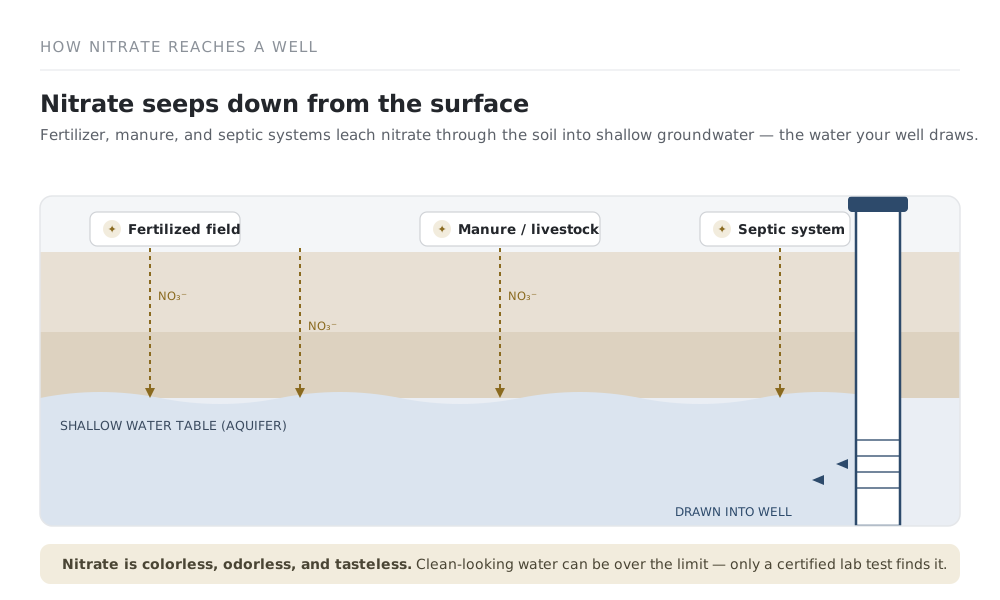
Most nitrate in well water comes from the surface, not the bedrock.
The three big sources are agricultural fertilizer runoff, animal manure, and septic systems. (EPA)
Rain and irrigation carry dissolved nitrate down through the soil, and it moves easily into groundwater because nitrate doesn’t bind to soil particles the way many contaminants do.
That’s why the geography of nitrate follows farmland and rural housing rather than a specific rock type.
Shallow wells are the most exposed, since the contaminant has less soil and rock to pass through before it reaches the water table.
More than 20% of shallow household wells in agricultural areas test above the 10 mg/L limit, according to USGS sampling. (EPA / USGS)
A dug or bored well, a well with a damaged casing, or a well downhill from a barnyard, feedlot, or septic drain field all raise the odds further.
Your local health department can tell you whether your area is a known nitrate hot spot.
Is nitrate in well water dangerous?
Yes, and in a way that’s worth understanding, because it’s the opposite of a slow-building risk.
Arsenic is a chronic hazard, where the danger comes from years of exposure.
Nitrate’s headline risk is acute: it can harm a susceptible infant within days.
The condition is methemoglobinemia, known as “blue baby syndrome.”
Nitrate converts to nitrite in an infant’s body, and nitrite binds the oxygen sites on red blood cells, so the blood carries less oxygen and the baby’s skin can turn bluish. (Minnesota Department of Health)
Bottle-fed babies under six months old are at the highest risk, because formula is mixed with tap water and their body chemistry converts more nitrate to nitrite than an adult’s does. (EPA)
Untreated, severe cases can be fatal, which is why the EPA sets the limit on this exact risk.
Pregnant women are the other group who should avoid high-nitrate water, since some studies link it to higher risk of miscarriage and birth defects. (Penn State Extension)
For healthy older children and adults, nitrate at typical well levels is a much smaller concern.
Because the danger is acute, the response is different from arsenic too.
If your water tests above 10 mg/L and you have a formula-fed infant or someone pregnant in the house, switch them to bottled or reverse-osmosis water today while you plan a permanent fix. (Washington State Department of Health)
One myth worth killing directly: boiling does not remove nitrate.
Boiling drives off some water while the nitrate stays behind, so it concentrates the nitrate and makes the water more dangerous, not less. (Minnesota Department of Health)
Reading your test: nitrate-nitrogen vs. nitrate
Nitrate results come in two different units, and mixing them up can make a safe result look scary or a dangerous one look fine.
The EPA limit is 10 mg/L measured “as nitrogen” (you’ll see it written as NO3-N or nitrate-nitrogen).
That same limit is 45 mg/L when measured “as the nitrate ion” (written as NO3). (Penn State Extension)
So a report reading “40 mg/L as NO3” is below the limit, while “12 mg/L as nitrate-nitrogen” is above it.
Check which unit your lab used before you compare your number to 10, and ask the lab if the report doesn’t say.
What actually removes nitrates
First, the things that don’t work, because they’re the most common wasted purchases.
A water softener is built for hardness and won’t remove nitrate.
A carbon filter, a sediment filter, and a pitcher or fridge filter won’t either. (Penn State Extension)
Three methods do remove nitrate: reverse osmosis, anion exchange, and distillation.
| Your situation | The fix | What to expect |
|---|---|---|
| Want drinking/cooking water covered, lowest upfront cost | Point-of-use reverse osmosis (under-sink) | $300–2,000 installed; treats the one tap you drink and cook from, which covers the exposure that matters for infants |
| Want every tap in the house covered | Point-of-entry anion exchange with nitrate-selective resin | $1,500–3,000 installed, roughly $200–300/year in salt and upkeep |
| Well is high in sulfate as well as nitrate | Anion exchange with a nitrate-selective resin specifically, or reverse osmosis | Standard resin can dump nitrate when it fills up; the selective resin prevents that (see below) |
| Just need safe water for a baby or pregnancy right now | Bottled or reverse osmosis water for drinking and formula, today | A stopgap while you install a permanent system and retest |
| Haven’t tested yet | Certified lab test first | Confirm the level and the unit before buying anything |
A few specifics behind the table:
Point-of-use reverse osmosis: the default for most households
An under-sink reverse osmosis unit pushes water through a membrane fine enough to reject nitrate, and it’s the cheapest way to make one tap safe.
Reverse osmosis removes roughly 83–92% of nitrate in typical use. (Penn State Extension)
Since the infant and pregnancy risk is about water you drink and mix formula with, treating the kitchen tap covers the exposure that actually matters, at a fraction of whole-house cost.
The tradeoff is that reverse osmosis wastes some water as brine and the membrane needs periodic replacement, so retest after installation and on the maker’s schedule.
The specialist route here is US Water Systems, which builds reverse osmosis and nitrate-specific systems for private wells; the honest catch is that a pro install is recommended and they don’t publish an NSF certification number for every unit, so ask for the spec on the exact model.
Whole-house anion exchange
If you want every tap to meet the standard, a point-of-entry anion exchange system trades chloride ions for nitrate across your whole supply, working much like a softener but tuned for nitrate.
It costs more upfront and uses salt, and it produces a high-nitrate brine you’ll need to discharge properly. (Penn State Extension)
For a broad whole-house filter catalog with a recurring-media angle, Crystal Quest is the other specialist worth pricing; the tradeoff is the ongoing cost of replacement media.
The sulfate trap: why “nitrate-selective” resin matters
This is the detail most pages skip, and it can turn a treatment system into a hazard.
A standard anion resin actually prefers sulfate over nitrate.
As the resin fills up with sulfate, it pushes previously captured nitrate back off the beads, so the water leaving the system can briefly carry more nitrate than the water going in.
In one worked example, water with 80 ppm nitrate and 85 ppm sulfate spiked to around 165 ppm nitrate in the treated water when the unit was run past capacity. (Wastewater Digest)
A nitrate-selective resin reverses that preference, so nitrate in the treated water can never rise above the level going in. (Wastewater Digest)
If your water is high in sulfate and you’re treating nitrate with anion exchange, specify the nitrate-selective resin and stay on top of regeneration.
What it costs
Point-of-use reverse osmosis commonly runs $300–2,000 installed, plus roughly $100–340/year for membrane and filter replacement.
Whole-house anion exchange commonly runs $1,500–3,000 installed, plus roughly $200–300/year in salt and upkeep.
Reverse osmosis tends to cost less than a whole-house system, which is part of why it’s the more common choice for a single-family well when the goal is safe drinking water.
The 5-year math behind that
Sticker prices alone hide the real gap, since the two options carry different ongoing costs.
Working from the midpoint of each range above:
| Point-of-use reverse osmosis | Whole-house anion exchange | |
|---|---|---|
| Install cost | $1,150 (midpoint of $300–2,000) | $2,250 (midpoint of $1,500–3,000) |
| Annual upkeep | $220/yr (midpoint of $100–340) | $250/yr (midpoint of $200–300) |
| 5-year total | ~$2,250 | ~$3,500 |
Point-of-use reverse osmosis costs roughly $1,250 less over five years, on top of a lower install.
The gap is a coverage difference: whole-house treats every tap, while reverse osmosis treats only the tap you drink and cook from.
Since the nitrate risk is about water you swallow, that lower-cost option covers the exposure that matters for most households.
Frequently asked questions
Is nitrate in well water dangerous?
Yes, mainly to infants.
Bottle-fed babies under six months can develop methemoglobinemia (“blue baby syndrome”) from high-nitrate water, which can be fatal if untreated.
Pregnant women should also avoid it, while the risk to healthy older children and adults is much lower.
What level of nitrate in well water is safe?
The EPA’s limit is 10 mg/L measured as nitrogen, which is the same as 45 mg/L measured as the nitrate ion.
Check which unit your lab used before comparing your result to 10.
Private wells aren’t legally required to meet the limit, but it’s the benchmark to test against.
Does reverse osmosis remove nitrates from well water?
Yes.
An under-sink reverse osmosis system removes roughly 83–92% of nitrate and is the cheapest way to make your drinking and cooking tap safe.
Does boiling well water remove nitrates?
No, boiling makes it worse.
The water evaporates while the nitrate stays behind, so boiling concentrates the nitrate.
Use bottled or reverse osmosis water for infants and pregnancy instead of boiling.
Will a water softener or carbon filter remove nitrate?
No.
A softener is built for hardness, and carbon, sediment, and pitcher filters don’t remove nitrate either.
You need reverse osmosis, anion exchange, or distillation.
My baby drinks formula and our nitrate is high. What do I do right now?
Switch to bottled or reverse-osmosis water for drinking and for mixing formula today.
Don’t boil the tap water, since that concentrates the nitrate.
Then install a permanent system and retest to confirm it’s working.
How much does it cost to remove nitrate from well water?
Point-of-use reverse osmosis commonly runs $300–2,000 installed.
Whole-house anion exchange commonly runs $1,500–3,000 installed, plus roughly $200–300 a year in salt and upkeep.
Haven’t tested yet? Start with well water testing or compare well water test kits, and use a certified lab to get the number and the unit.
Nitrate often travels with other farm-country contaminants, so if your test flagged more than one thing, see the best whole-house filter for well water.
Also testing high for arsenic? See arsenic in well water (the two need separate fixes, though reverse osmosis handles both).
For the full test-to-installed-system framework, see well water filtration system.
How we researched this
We built this guide from EPA drinking-water standards, USGS groundwater sampling, university extension guidance from Penn State, and state health-department fact sheets from Minnesota and Washington.
We don’t test these systems in-house yet, so we don’t claim to.
Every figure here traces to a cited source, and the 5-year cost comparison is our own arithmetic from the stated ranges.
We were not able to pull first-hand well-owner language for nitrate specifically from Reddit or forum threads in this research pass; search results surfaced health-department and extension pages rather than raw community discussion, so we say so rather than inventing quotes.
We may earn a commission if you buy through a link on the pages this one links to, at no cost to you.
Sources
- EPA — National Primary Drinking Water Regulations (Nitrate MCL 10 mg/L as N)
- EPA / USGS — Nitrate in Ground Water (shallow agricultural wells)
- Minnesota Department of Health — Nitrate in Drinking Water
- Penn State Extension — Nitrates in Drinking Water
- Washington State Department of Health — Nitrate in Drinking Water
- Wastewater Digest — Nitrate Removal by Ion Exchange (sulfate competition and nitrate dumping)