Home water filtration system: which type do you actually need?
The right home water filtration system depends on two things: whether you’re on city or well water, and what a test says is actually in it.
There’s no single box that fixes everything, and the biggest reason people overspend is buying one before they know which problem they have.
A softener, a carbon filter, an iron filter, and a reverse osmosis unit all do completely different jobs.
Match the wrong one to your water and you’ll pay for a system that doesn’t fix the smell, the stains, or the spots you bought it for.
So this guide skips the sales pitch and does one thing: it sorts you by your water and your symptom, tells you which type of system solves it, and points you to the detailed page for that fix.
Start with the symptom you actually have.
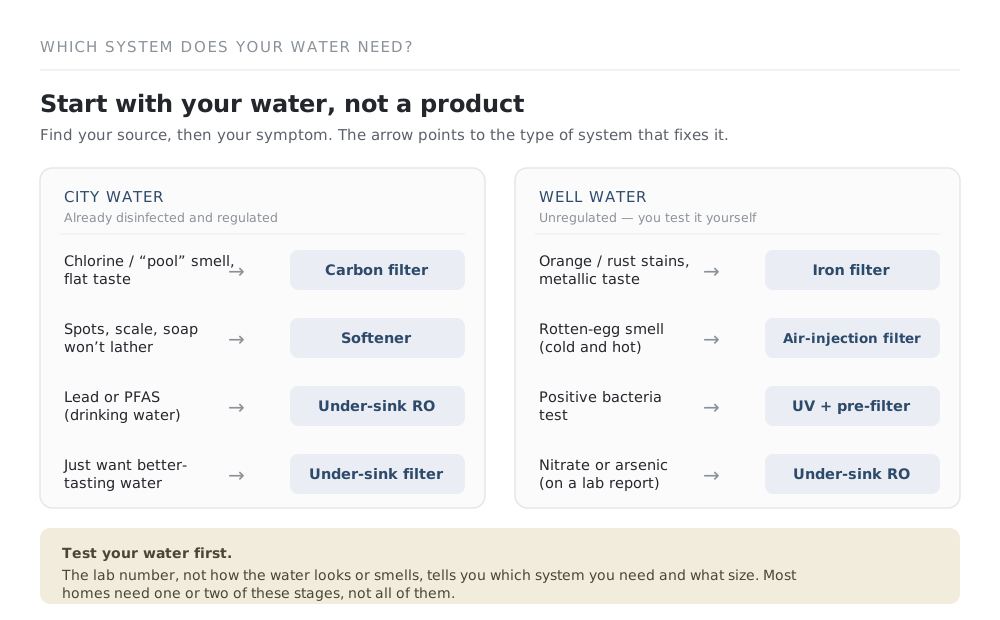
Start here: what’s actually wrong with your water?
Every good filtration decision starts from a symptom or a test result, not a product.
Find your symptom below, and the rest of this guide explains the fix and links to the deep-dive page for it.
| What you notice (or your test shows) | Likely cause | The type of system that fixes it |
|---|---|---|
| Chlorine or “pool” smell, flat taste (city water) | Chlorine / chloramine | Whole-house carbon filter |
| Spots on glasses, scale on fixtures, soap won’t lather | Hardness | Salt-based softener |
| Orange or rust staining, metallic taste | Iron | Oxidizing iron filter |
| Rotten-egg smell in cold and hot water | Hydrogen sulfide | Air-injection oxidation filter |
| Rotten-egg smell in the hot water only | Water-heater anode rod | Replace the rod (no system needed) |
| Positive coliform or E. coli test | Bacteria | UV disinfection |
| High nitrate, arsenic, lead, or PFAS on a lab report | Dissolved health contaminant | Under-sink reverse osmosis |
| Sandy, cloudy, or gritty water (well) | Sediment | Sediment pre-filter |
| You just want better-tasting drinking water at one tap | General taste | Under-sink or countertop filter |
Most homes have more than one of these at once.
Well water especially tends to stack problems: hardness plus iron, or iron plus a sulfur smell.
That’s normal, and it just means your setup has more than one stage.
City water vs. well water: this is the first fork
Before anything else, know which kind of water you have, because it changes the whole approach.
City (municipal) water is already disinfected and regulated by the utility.
Your common complaints are the taste and smell of chlorine or chloramine, hard-water scale, and specific targets like lead from old home plumbing or PFAS from the source. (EPA)
That usually points to a carbon filter, maybe a softener, and an under-sink reverse osmosis unit for drinking water.
Private well water is not regulated, and no one tests it for you.
If you’re on a well, you’re your own water utility, and the problems are iron, hardness, sulfur, manganese, nitrate, arsenic, and bacteria. (EPA)
The CDC and EPA both recommend testing a private well at least once a year for coliform bacteria and nitrate, and more often if anyone in the house is pregnant, an infant, or elderly. (EPA)
If you’re on a well, the detailed roadmap is our well water filtration system guide, which builds on everything below.
Test your water first (it’s the real first step, and it’s cheap)
Everything after this is a guess until you know your numbers.
A water test turns “my water smells funny” into “0.8 mg/L hydrogen sulfide,” and that number is what tells you which system, and what size, you actually need.
On city water, start with your utility’s annual Consumer Confidence Report, which is free, then test at the tap for hardness, chlorine or chloramine, and lead or PFAS if you’re concerned.
On well water, test at least annually for coliform bacteria and nitrate, and add hardness (in grains per gallon), iron, manganese, hydrogen sulfide, pH, and arsenic if you’re in a known-risk area. (EPA)
Use a certified lab for health contaminants like arsenic, nitrate, and bacteria.
At-home strips are fine for a first read on hardness and iron, but not for anything that affects health.
For how to take a proper sample and read the results, see well water testing, and for the kits themselves, the best well water test kits compares DIY strips against mail-in lab kits.
We haven’t run these systems ourselves yet, so every number in this guide comes from a manufacturer spec, an NSF/ANSI standard, or a government or university source, and we say which.
The eight home water filtration system types, and what each does
There are really only a handful of system types, and each one targets a specific problem.
Here’s what each does, roughly what it costs installed, and who it’s for.
1. Sediment pre-filter. Removes sand, silt, and rust particles so they don’t clog and wear out every stage after it. It’s the first stage in any well-water setup and a requirement ahead of UV. Cost is small, roughly $50–150 as part of a larger train.
2. Whole-house carbon filter. Reduces chlorine (up to about 97%), and catalytic carbon also reduces chloramine (up to about 83%), plus general taste and odor. This is the standard fix for city-water taste and smell — see our best whole-house carbon filter picks. What it does not do is soften water, remove iron, or remove lead, arsenic, PFAS, or nitrate, because NSF/ANSI 42 is an aesthetic standard only. (Frizzlife) Cost runs about $500–1,500 for a basic unit, more for multi-stage.
3. Salt-based water softener. Swaps hardness minerals (calcium and magnesium) for sodium through ion exchange, which is the only method that truly softens water. This is the fix for scale on fixtures, spots on glasses, and soap that won’t lather. A softener does not remove iron above roughly 1 ppm, and it does nothing for chlorine, sulfur, or bacteria. See the water softener system guide and the best water softeners for picks.
4. Salt-free conditioner (TAC). Uses template-assisted crystallization to turn hardness minerals into microscopic crystals so scale won’t stick to your pipes and heater. It does not remove hardness, so your water is still technically hard and you may still see some spotting. Vendors widely cite an Arizona State University study for the “over 90% scale reduction” figure, so treat that as a manufacturer claim rather than an independent result. It’s a city-water, scale-control choice, and it struggles on well water with iron or manganese, which foul it. The salt-free water softener guide covers where it fits.
5. Air-injection oxidation (iron/sulfur) filter. Adds oxygen to convert dissolved iron, manganese, and hydrogen sulfide into particles the filter bed can catch, with no chemicals to add. Manufacturers spec high-end units to handle up to about 30 ppm iron, 7 ppm manganese, and 5 ppm hydrogen sulfide, though those are vendor figures, not independent tests. This is the workhorse for rust stains and rotten-egg smell on a well. See best iron filter for well water and why your well water smells like rotten eggs.
6. Reverse osmosis (reverse osmosis). Pushes water through a membrane that removes the contaminants nothing else reliably does: lead, arsenic, PFAS, fluoride, and nitrate. For almost every home, reverse osmosis belongs under the kitchen sink for drinking and cooking water, not on the whole house. Whole-house reverse osmosis is expensive, needs a storage tank, and is unnecessary for typical water. Under-sink units run about $150–1,300 installed; our guide to the best reverse osmosis system by type walks through under-sink, tankless, and whole-house reverse osmosis, or browse the reverse osmosis and under-sink filter sections.
7. UV disinfection. Inactivates 99.99% of coliform bacteria, E. coli, and other pathogens by scrambling their DNA so they can’t reproduce, with no chemicals. Every UV system needs a 5-micron sediment pre-filter ahead of it, because cloudy water lets organisms hide from the light. UV goes last and does nothing for iron, hardness, or chemicals. See bacteria in well water for when UV is (and isn’t) enough.
8. Point-of-use drinking filter. An under-sink or countertop filter that cleans water at one tap for drinking and cooking. It’s the cheap, targeted answer when your only goal is better-tasting drinking water, and it does nothing for the rest of the house. Our guide to the best under sink water filter walks through the one choice that matters here: a carbon filter or reverse osmosis.
One naming trap worth calling out: point-of-entry (POE) means whole-house, installed where water enters the building; point-of-use (POU) means one tap. Most homes end up with a POE system for the house and a small POU unit under the kitchen sink for drinking water.
Match your problem to the right system
This is the section to bookmark.
Find your problem on the left, and the right column is the type of system that fixes it plus the page that goes deep on it.
| Your symptom or test result | The fix | Go deeper |
|---|---|---|
| Chlorine / pool smell, city water | Whole-house carbon filter | Best whole-house carbon filter → |
| Spots, scale, soap won’t lather; hardness over ~7 gpg | Salt-based softener | Water softener system → |
| Want scale control without salt, city water | Salt-free conditioner (TAC) | Salt-free water softener → |
| Orange/rust stains, metallic taste, iron over 0.3 ppm | Oxidizing iron filter | Best iron filter for well water → |
| Rotten-egg smell, cold and hot | Air-injection oxidation filter | Sulfur smell fix → |
| Rotten-egg smell, hot water only | Replace the water-heater anode rod | Sulfur smell diagnosis → |
| Positive coliform / E. coli | UV disinfection + pre-filter | Bacteria in well water → |
| High nitrate on a lab report | Under-sink reverse osmosis | Nitrates in well water → |
| Elevated arsenic | Under-sink reverse osmosis / specialty media | Arsenic in well water → |
| Lead or PFAS concern (city) | Under-sink reverse osmosis | Reverse osmosis → |
| Whole well needs a full setup | A staged train, sized to your test | Best whole-house filters for well water → |
Most well owners with more than one problem need a short stack of stages in the right order: sediment first, then iron or sulfur oxidation, then a softener, with UV last.
Getting that order wrong is a common and costly mistake, because raw iron will foul softener resin and cloudy water blocks UV.
The best whole-house filters for well water walks through building that stack with real products and pricing.
What it really costs, installed and to maintain
Prices vary by your water and your house, but here are realistic 2026 ranges from cost-tracking sources, not from us.
| System type | Installed cost | Ongoing cost |
|---|---|---|
| Sediment pre-filter | ~$50–150 (part of a train) | Cartridge every 3–6 months |
| Whole-house carbon | $500–1,500 basic; $1,000–3,000 multi-stage | Media rebed every 5–10 years |
| Salt-based softener | $1,200–3,800 total | Salt, a few bags a year at ~$5–10 each |
| Salt-free conditioner | ~$800–2,000 | Media every 3–6 years; no salt or power |
| Air-injection iron/sulfur filter | ~$1,000–2,500+ | Low; periodic media |
| Under-sink reverse osmosis | $150–1,300 | Filters and membrane yearly, ~$50–150 |
| Whole-house reverse osmosis | $4,800–8,000+ | Membrane and tank upkeep, high |
| UV disinfection | ~$300–1,000+ (plus the pre-filter) | UV lamp yearly, ~$80–150 |
Ranges from HomeGuide, Angi, and This Old House. These are estimates, not a quote; get a local installer’s number once you know your stack.
For a typical whole-house system, HomeGuide puts the all-in range at about $850–5,400, with an average near $2,273, before you add a separate under-sink reverse osmosis for drinking water. (HomeGuide)
Professional installation is usually a few hundred dollars on top of the equipment, and a DIY plumber comfortable cutting into the main line can save that fee.
Myths that cost people money
“A water softener will get rid of my rust stains.” It won’t. A softener removes hardness, not the iron that causes orange staining, and it can’t handle iron that has already oxidized (turned orange). For anything above about 1 ppm of iron you need an iron filter, usually installed ahead of the softener, which is the single most common wasted purchase in water treatment.
“A whole-house carbon filter cleans everything.” Carbon handles chlorine, taste, and smell. It does not soften water, remove iron, or remove lead, arsenic, PFAS, or nitrate, which need a softener, an iron filter, or reverse osmosis. (Frizzlife)
“Salt-free is just a softener without the salt.” Salt-free conditioners don’t remove hardness at all; they only stop scale from sticking. They’re fine for city scale control and wrong for anyone who wants genuinely soft water or has iron in a well.
“I need whole-house reverse osmosis.” Almost nobody does. Whole-house reverse osmosis is expensive, wastes water, and strips minerals, so put a reverse osmosis unit under the kitchen sink for drinking water and treat the rest of the house with the specific filter its problem calls for.
“A pitcher or fridge filter is basically a home system.” A point-of-use filter cleans one tap’s taste. It doesn’t protect your plumbing or appliances, doesn’t reach every faucet, and does nothing for hardness or iron.
“The rotten-egg smell means my whole well is bad.” If the smell is only in the hot water, the cause is usually the water heater’s anode rod, not the well, and swapping it for an aluminum rod fixes it for a fraction of the cost of a filter. (Penn State Extension)
Where to go next
Once you know your water source and your main symptom, here’s the specific page for the fix:
- Best water filtration system, our named picks for each water situation once you’re ready to compare actual systems, with real costs and the honest downside on each.
- Best drinking water filtration system, if your goal is just clean water to drink and cook with, the point-of-use picks that treat the kitchen tap for a fraction of a whole-house price.
- Well water filtration system: the complete guide, the full roadmap if you’re on a private well, with the five-step test-and-match framework.
- Water softener system guide and the best water softeners, for hardness, scale, and spotty glasses.
- Salt-free water softener, for scale control without salt on city water.
- Best iron filter for well water, for orange and rust staining and metallic taste.
- Why your well water smells like rotten eggs, the quick test that tells you whether it’s your well or just your water heater.
- Bacteria in well water, what a positive coliform result means and when UV is enough.
- Nitrates in well water and arsenic in well water, the two health contaminants that need reverse osmosis, not a softener.
- Best whole-house filters for well water, the product comparison for building a full staged system.
- Well water testing and the best well water test kits, the first step for everyone on a well.
Frequently asked questions
How do I know which water filtration system I need?
Start with your water source and your main symptom. City water usually needs carbon for chlorine taste, maybe a softener, and under-sink reverse osmosis for drinking; well water needs a test first, then a stage matched to each problem the test finds (iron, hardness, sulfur, bacteria).
What’s the difference between a water softener and a water filter?
A softener removes hardness by swapping calcium and magnesium for sodium, and that’s all it does. A filter (carbon, iron, sediment) removes something else — chlorine, iron, sulfur, or particles — so many homes need both.
Do I need a whole-house filter or just one for drinking water?
If your problem affects the whole house (scale, iron staining, chlorine smell in every shower), you need a whole-house (point-of-entry) system. If you only want better drinking water, an under-sink point-of-use filter is cheaper and enough.
Will a water softener remove iron or rust stains?
Only very low, dissolved iron under about 1 ppm. Above that, or once the iron has turned orange, you need a dedicated iron filter, usually installed ahead of the softener.
Why does my water smell like rotten eggs, and how do I fix it?
That’s hydrogen sulfide. If the smell is in both cold and hot water, it’s coming from the well and needs an air-injection oxidation filter; if it’s only in the hot water, it’s usually the water heater’s anode rod, which is a cheap swap.
Does a whole-house carbon filter remove chlorine and PFAS?
It removes chlorine, and catalytic carbon also reduces chloramine, but a standard carbon filter (NSF/ANSI 42) is not certified for PFAS. PFAS removal needs a filter certified to NSF/ANSI 53 or a reverse osmosis system.
Is a salt-free water conditioner as good as a softener?
For preventing scale on a city-water home, it works without salt or power. It does not actually soften your water, so if you want soft water for skin, laundry, and lather, or you have well iron, choose a salt-based softener.
Do I need reverse osmosis for my whole house?
Almost certainly not. Under-sink reverse osmosis for drinking and cooking water is the right choice for nearly every home; whole-house reverse osmosis is expensive and unnecessary unless a specific situation calls for it.
How much does a home water filtration system cost to install?
A typical whole-house system runs about $850–5,400 installed, averaging near $2,273, depending on how many stages your water needs. An under-sink reverse osmosis for drinking water is a separate $150–1,300.
What should I test my well water for, and how often?
At least once a year for coliform bacteria and nitrate, plus hardness, iron, manganese, hydrogen sulfide, and pH. Add arsenic and a broader metals panel every few years or if you notice a new smell, stain, or taste.
What order do the filters go in for well water?
Sediment first, then iron or sulfur oxidation, then the softener, with UV last. The order matters because raw iron fouls softener resin and cloudy water blocks the UV light.
Not sure where to start? Begin with a water test, then come back and match the fix.
On a private well? The complete well water filtration guide is your roadmap.
How we researched this
We built this guide from EPA and CDC private-well guidance, Penn State Extension research on hydrogen sulfide and treatment thresholds, NSF/ANSI standards documentation, and cost data from HomeGuide, Angi, and This Old House cross-checked against current manufacturer specs.
We don’t run these systems ourselves yet, so we don’t claim first-hand testing, and every figure here is attributed to its source.
When we name a merchant, it’s SpringWell, US Water Systems, Aquasana, or iSpring, and we may earn a commission if you buy through a link on the pages this one connects to, at no cost to you.
Sources
- EPA — Protect Your Home’s Water (private wells)
- Penn State Extension — Hydrogen Sulfide (Rotten-Egg Odor) in Water Wells
- Frizzlife — NSF/ANSI 42 vs 53 vs 58 vs 401
- HomeGuide — home water filtration system cost (2026)
- Angi — water softener installation cost (2026)
- This Old House — reverse osmosis system cost (2026)