Bacteria in well water: what a positive test means and how to fix it
Bacteria in well water has no color, taste, or smell, so the only way to know it’s there is a lab test, not your senses.
If your test comes back positive for total coliform, it’s a warning that surface contamination has found a way into your well.
If it comes back positive for E. coli, that’s the serious one: it means waste has reached your water, and you should stop drinking it and boil it until the well is fixed and retests clean.
The good news is that bacteria is one of the most fixable well-water problems, and continuous UV disinfection is the standard whole-house fix once the well is clean.
What a positive coliform test actually means
A total coliform result is a signal to investigate, and it works a lot like a smoke alarm.
Coliform bacteria live in soil, on plants, and in surface water almost everywhere.
They aren’t usually harmful on their own, and most of them won’t make you sick. (CDC)
They matter for one reason: they don’t belong in deep groundwater, so finding them means surface water has reached your well.
That same path could let more dangerous germs in too, which is why labs use coliform as an indicator. (Montana State University Extension)
So a total-coliform-positive result tells you a door is open, and it tells you to find and close it, but it doesn’t by itself mean your water contains something that will make you ill.
One thing worth doing first: a coliform positive can come from a sloppy sample.
If you didn’t sanitize the tap, remove the aerator, and follow the lab’s collection steps, the result can be a false alarm from the faucet, not the well. (Purdue Extension)
Retesting carefully, and asking the lab to check specifically for E. coli, is the right next move.
Coliform vs E. coli: which result is the one to worry about
This is the distinction that trips up almost everyone, so it’s worth being precise.
E. coli is a specific type of coliform that comes from the gut of warm-blooded animals and people. (Montana State University Extension)
Its presence means the water has been in contact with feces, and that harmful germs may be present right now.
Total coliform without E. coli is a caution; E. coli confirmed is an act-now result.
| Your result | What it means | What to do |
|---|---|---|
| Total coliform positive, E. coli negative | A pathway from the surface exists, but there’s no direct sign of fecal contamination yet | Retest carefully; find and fix the entry point; disinfect the well |
| E. coli (or fecal coliform) positive | Human or animal waste has reached your water, and dangerous germs may be present | Stop drinking it, boil water now, and disinfect the well before you retest |
| Both negative | No coliform detected in this sample | Keep testing yearly; bacteria can appear after floods, repairs, or a wet spring |
The EPA sets its goal for both total coliform and E. coli in public water at zero, because outbreaks have happened even at very low coliform levels. (EPA)
Private wells aren’t covered by that rule, so no law forces your well to meet it.
It’s still the benchmark to test against by choice, the same way public systems are held to it.
Where the bacteria comes from
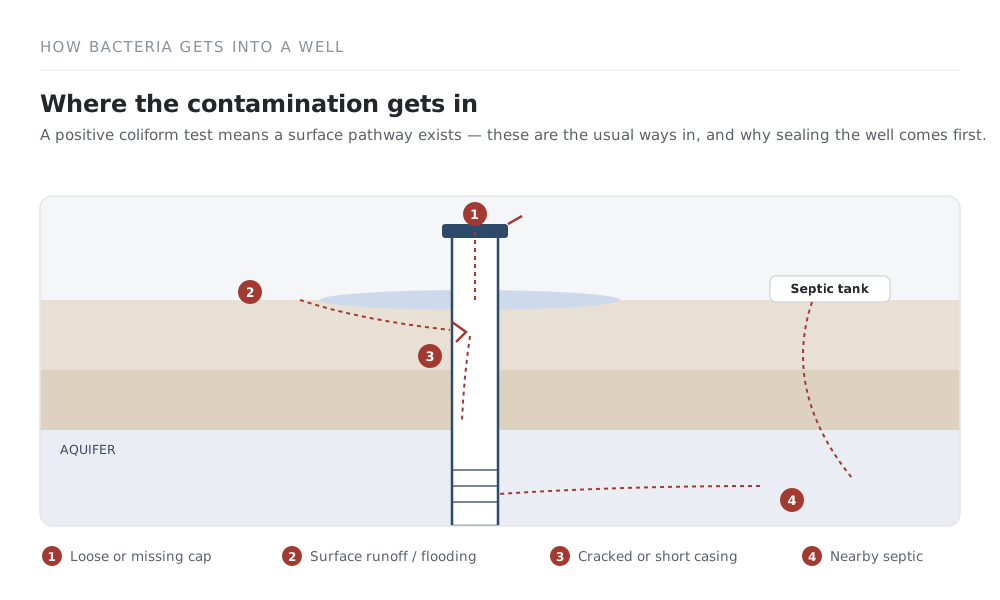
Bacteria gets into a well when surface water gets into a well, so most causes come down to a physical opening.
Common ones include:
- A cracked, corroded, or too-short well casing that lets runoff seep in near the top
- A missing or damaged well cap that leaves the well open to insects, mice, and rain
- A shallow or older dug well that sits close to the surface
- Flooding or heavy spring runoff that pushes surface water into the wellhead
- A failing septic system, barnyard, or manure too close to the well
Because the cause is usually mechanical, the fix is usually mechanical too: seal the opening, then disinfect what got in.
That’s also why bacteria can show up suddenly in a well that tested clean for years, after a flood, a pump repair, or a wet season. (NH DES)
Is it dangerous, and what do you do right now?
That depends on which result you got, and this is where bacteria differs sharply from a contaminant like arsenic.
Arsenic is a slow, chronic risk that gives you weeks to plan a fix.
E. coli is acute: it can make you sick quickly, with stomach cramps, vomiting, fever, or diarrhea, and the risk is highest for infants, older adults, pregnant women, and anyone with a weakened immune system. (NY State Dept. of Health)
So if your test confirms E. coli or fecal coliform, treat it as a “don’t drink it” situation until the well is disinfected and retests clean.
Until then, use bottled water, or boil first.
The CDC’s guidance is to bring water to a rolling boil for one minute, then let it cool, before drinking, cooking, making ice, brushing teeth, or washing produce. (CDC)
If your result is total coliform only, with no E. coli, you don’t need to panic tonight.
You still want to fix it promptly, but you have room to retest and plan rather than rush.
How to get rid of bacteria in well water
There’s a specific order here, and skipping steps is why some wells keep testing positive.
Step 1: Shock chlorinate the well and fix the physical cause.
Shock chlorination is a one-time strong dose of chlorine that disinfects the entire well and plumbing. (MSU Extension)
At the same time, repair the actual opening: a new well cap, a sound casing, or more distance from a failing septic system.
Shock chlorination alone rarely holds if the door that let bacteria in is still open.
Here’s the procedure Virginia Cooperative Extension lays out, in short:
- Set aside clean water first. Store a 12-to-24-hour supply of unchlorinated water for drinking and cooking, because you can’t use the tap during treatment. (Virginia Cooperative Extension)
- Measure the water in the well. Subtract the static water level from the total well depth to get the depth of water, then use that with the well’s diameter and the extension’s dosing table to find how much bleach you need.
- Add the chlorine. Mix the table amount of unscented household bleach (5.25–8.25% sodium hypochlorite, no scents or additives) into a clean 5-gallon bucket of water and pour it in.
- Circulate it everywhere. Run a hose from the nearest outside faucet back into the well to rinse the casing, then open every tap and fixture, indoors and out, until you smell chlorine at each one.
- Hold 12 to 24 hours. Leave the chlorinated water sitting in the pipes. Don’t run water or flush toilets during this window.
- Flush it out. Send the outdoor faucets to a gravel or bare area, not into the septic system or a stream, pond, or garden, until the chlorine smell is gone.
- Retest in one to two weeks. After the chlorine clears, retest for total coliform and E. coli to confirm the well is clean and stays clean. (Virginia Cooperative Extension)
Concentrated chlorine is caustic, so wear goggles and gloves, cut power to the pump before you open the wellhead, and never mix bleach with other cleaners.
Step 2: Retest after the chlorine clears.
Wait until the chlorine has fully cleared (about one to two weeks), then retest for coliform and E. coli. (MSU Extension)
If it comes back clean and stays clean on a follow-up test, the repair worked.
Step 3: If bacteria keeps coming back, install continuous disinfection.
Some wells test positive again and again because the source can’t be fully sealed, or because surface water keeps finding a way in.
For those wells, a continuous disinfection system treats every drop as it enters the house.
UV disinfection is the standard whole-house choice: an ultraviolet lamp kills bacteria and viruses as water flows past it, with no chemicals and no taste. (MSU Extension)
Continuous chlorine injection is the main alternative, and it adds a residual that keeps working downstream in your plumbing, which UV doesn’t do.
Here’s how the three situations map to a fix:
| Your situation | The fix | What to expect |
|---|---|---|
| One positive test after a flood, repair, or new well | Shock chlorination + fix the opening, then retest | Often a permanent fix on its own if the entry point is sealed; cost is low (bleach + your time, or a well pro) |
| Bacteria returns after shock chlorination | Whole-house UV disinfection (after sediment/iron pre-filtration) | Continuous protection, ~$400–1,200 installed, plus a bulb change about once a year |
| Bacteria plus heavy iron or sulfur, or you want a residual in the plumbing | Continuous chlorine injection (or a peroxide-injection system for iron/sulfur wells) | Handles cloudy or iron-heavy water UV can’t; needs a contact tank and periodic chemical top-ups |
| Only worried about drinking water, well otherwise clean | Point-of-use isn’t a substitute for whole-house disinfection | A reverse osmosis unit protects one tap, but leaves bathing, brushing, and every other tap on untreated water |
For the UV pick on a bacteria-prone well, we route to US Water Systems, the contaminant specialist in our product map, and for iron- or sulfur-heavy wells that also grow bacteria, their peroxide-injection systems handle both at once.
Why UV disinfection needs clear water first
UV only works if the light can actually reach the bacteria, and dirty water blocks it.
Sediment, iron, and manganese create particles that cast tiny shadows, and a microbe hiding behind a particle survives the lamp. (wellwaterwise)
Turbidity above about 5 NTU can cut UV effectiveness by half or more, which is why UV goes last, after the water is filtered clear.
Typical feed-water limits for a UV system are turbidity under 5 NTU, iron under 0.3 ppm, manganese under 0.1 ppm, and hardness under about 10 grains. (wellwaterwise)
If your well is over those, you pre-filter for sediment and iron first, then send the clean water through the UV lamp.
Two more things to know before you buy UV:
It needs power, so a UV lamp offers no protection during an outage, and the water should be re-disinfected after the power comes back.
And it kills living organisms only, so UV does nothing for arsenic, nitrate, PFAS, or any dissolved chemical. (wellwaterwise)
If you have a chemical contaminant too, that’s a separate fix on top of disinfection.
One certification note: for water that is actually microbiologically unsafe, look for a system certified to NSF/ANSI 55 Class A, which delivers a UV dose of at least 40 mJ/cm² and is built to disinfect unsafe water. (Know Your H2O)
Class B systems (16 mJ/cm²) are only meant to polish water that’s already safe, so they’re the wrong tool for a well with confirmed bacteria.
What UV disinfection costs
A whole-house UV system commonly runs $400–1,200 installed, which makes it one of the cheaper whole-house treatments for a well. (wellwaterwise)
The lamp loses intensity over time even while it still glows, so plan on replacing it about once a year, which runs roughly $80–150 for the bulb. (wellwaterwise)
Budget for the pre-treatment too if your water isn’t already clear.
A sediment filter is cheap, but if you have iron or manganese, an iron filter ahead of the UV can add several hundred to a couple thousand dollars, and it’s what keeps the UV working.
So the honest all-in number for a bacteria-prone, iron-heavy well is higher than the UV lamp alone, because the pre-filter is doing half the job.
Frequently asked questions
Is bacteria in well water dangerous?
It depends on the type.
Total coliform on its own is a warning that surface water has reached your well, and it may not make you sick.
E. coli means fecal contamination, and it can cause acute illness quickly, so a confirmed E. coli result means you should stop drinking the water and boil it until the well is disinfected and retests clean.
What’s the difference between coliform and E. coli in well water?
Total coliform is a broad group of bacteria used as an indicator: finding it means a path for contamination exists.
E. coli is a specific coliform that comes from feces, so it’s direct evidence that waste has reached your water and is the more serious result.
My well tested positive for coliform. What should I do first?
Retest carefully, since a positive can come from a contaminated sample rather than the well.
Sanitize the tap, remove the aerator, follow the lab’s collection steps, and ask them to test specifically for E. coli so you know which result you’re dealing with.
Does boiling well water kill bacteria?
Yes.
Bringing water to a rolling boil for one minute kills bacteria, and it’s the right short-term step while you disinfect the well.
Boiling is a stopgap, not a fix, because it doesn’t stop new bacteria from entering the well.
Does UV disinfection remove bacteria from well water?
Yes, UV inactivates bacteria and viruses as water passes the lamp.
It only works on clear water, so you filter out sediment and iron first, and it does not remove chemical contaminants like arsenic or nitrate.
Will a reverse osmosis system fix bacteria in well water?
Not for the whole house.
An under-sink reverse osmosis unit protects one drinking tap, but it leaves every other tap, plus bathing and brushing, on untreated water, so it isn’t a substitute for whole-house UV or chlorination when a well has bacteria.
How much does it cost to get rid of bacteria in well water?
Shock chlorination can cost little more than bleach and your time if you seal the opening yourself.
A whole-house UV system commonly runs $400–1,200 installed, plus about $80–150 a year for a replacement bulb, with extra for pre-filtration if your water isn’t clear.
Haven’t tested yet, or need to confirm the E. coli result? Start with well water testing and use a certified lab, since bacteria is a core reason to test in the first place.
Comparing kits? See the best well water test kits — for bacteria, choose one that reports total coliform and E. coli separately.
Building out whole-house treatment around the UV stage? See the best whole-house filter for well water and the full well water filtration system guide.
How we researched this
We built this guide from CDC well-testing guidance, the EPA’s total coliform standard, Montana State University Extension’s coliform and E. coli fact sheet, New Hampshire DES guidance on bacteria in wells, Virginia Cooperative Extension’s shock-chlorination procedure, and manufacturer and NSF/ANSI 55 specifications for UV disinfection.
We don’t test these systems in-house yet, so we don’t claim to.
Every figure here traces to a cited source.
Well owners describe the coliform-positive scare in almost identical terms on community forums (“well tested positive for coliform, now what”), and the questions they ask (retest first, total coliform vs E. coli, is it safe to shower) shaped the sections above; we paraphrase that pattern rather than quote individuals, since we couldn’t verify specific posters in this pass.
We may earn a commission if you buy through a link on the pages this one links to, at no cost to you.
Sources
- CDC — Guidelines for Testing Well Water
- EPA — Revised Total Coliform Rule and Total Coliform Rule (MCLG zero)
- Montana State University Extension — Total Coliform and E. coli Bacteria
- NH DES — Coliform Bacteria: An Indicator of Your Well’s Health
- NY State Dept. of Health — Coliform Bacteria in Drinking Water Supplies
- Purdue Extension — Interpreting Water Test Results (WQ-15)
- Virginia Cooperative Extension — Shock Chlorination: Disinfecting Private Household Water Supply Systems (442-663)
- Know Your H2O — NSF/ANSI 55 UV Class A vs Class B
- wellwaterwise — UV Water Treatment for Well Water