SpringWell SS1 review: a strong softener, if hard water is your only problem
The SpringWell SS1 is a salt-based water softener built for one job, and it does that job well: it takes the calcium and magnesium out of hard water so you stop fighting scale, spots, and stiff laundry.
For a home with 1 to 3 bathrooms and real hardness, it is an easy system to recommend. You get genuine ion exchange, a smart metered head that saves salt, and a lifetime warranty on the tanks and valve.
But here is the honest verdict most reviews bury: the SS1 softens, and that is all it does. It does not remove iron, it does not remove sulfur smell, and it does not clean up sediment or make your drinking water safer. If your water problem is anything other than hardness, this is the wrong first purchase.
We have not tested the SS1 in a lab. This review is built from SpringWell’s published specs, the NSF/ANSI standards that apply to softeners, real-owner reports, and cost math you can check yourself.
Buy it if your test shows hard water and little or no iron, you want truly soft water rather than scale control, and you are sizing it correctly for your household.
Skip it if your test flags iron, sulfur, or sediment (treat those first), you are on a septic system and watching sodium, or you only care about better-tasting drinking water.
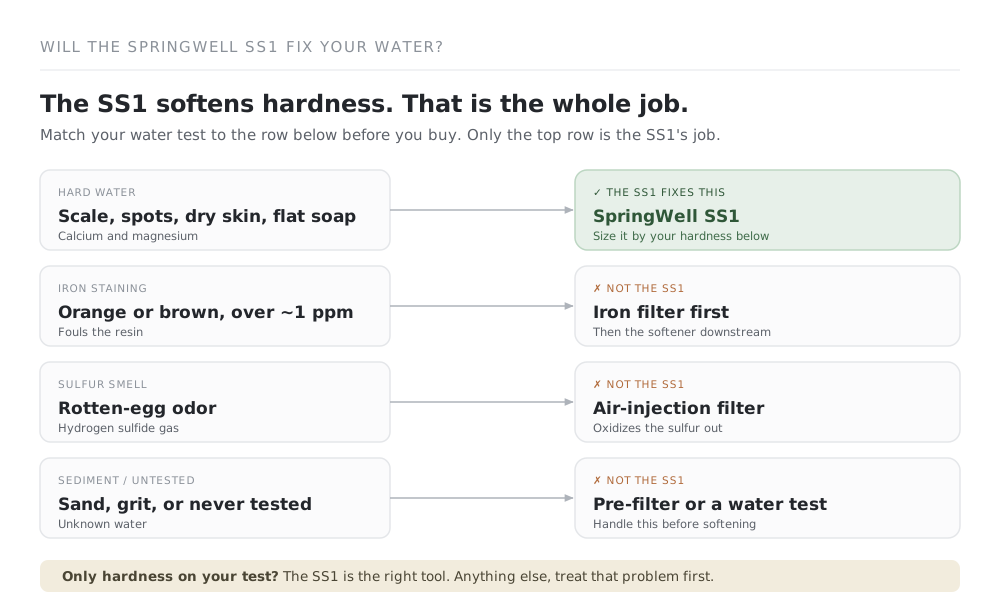
First, the one thing that trips up most buyers
A softener trades hardness minerals for sodium. That is the entire mechanism, and it explains everything the SS1 can and cannot do.
Water flows over a bed of resin beads that hold sodium and grab the calcium and magnesium as the water passes. When the beads fill up, the system rinses them with brine from the salt tank and starts over.
That rinse is called regeneration.
So the SS1 removes what ion exchange can grab: calcium and magnesium, the two minerals that make water hard. It also holds back a small amount of dissolved iron and manganese, because those swap onto the resin the same way.
It cannot remove the things that need a different kind of treatment. Iron above a trace amount fouls the resin instead of rinsing off, sulfur gas needs oxidation, and sediment needs a screen.
None of that is a knock on the SS1. It is a softener doing a softener’s job.
This matters because the most common regret we found, across BBB complaints and Reddit threads, comes from people who bought a softener to fix a well problem it was never built to solve. One owner put it bluntly after the water turned brown: the softener was never going to touch the iron.
Does the SS1 fix your water? Check here before you buy
| Your water problem | Does the SS1 fix it? | What you actually need |
|---|---|---|
| Hard water: scale, spotting, dry skin, soap won’t lather | Yes. This is exactly its job | The SS1, sized with the chart below |
| Iron staining (orange or brown), above ~1 ppm | No (trace only) | An iron filter before the softener, or a well combo |
| Rotten-egg or sulfur smell | No | An air-injection oxidizing filter |
| Cloudy water, sand, grit | No | A sediment pre-filter |
| Chlorine taste, PFAS, cleaner drinking water | No | Whole-house carbon and/or under-sink reverse osmosis |
| Bacteria, or a well you have never tested | No | Test first; UV if needed |
If your only checked box is the first row, read on. If you checked any other row, treat that problem first.
A softener bought to fix iron or sulfur is a return waiting to happen, and returns here are expensive (more on that below).
The specs that matter
SpringWell sells the salt-based softener in three sizes. They share the same head, resin, and warranty, and differ only in tank size and flow.
| Spec | SS1 | SS4 | SS+ |
|---|---|---|---|
| Grain capacity | 32,000 | 48,000 | 80,000 |
| Service flow rate | 11 GPM | 13 GPM | 20 GPM |
| Suggested home | 1–3 baths | 4–6 baths | 7+ baths |
| Softener tank | ~9″ × 48″ (57″ with head) | ~52″ tall | Larger (not published) |
| Brine tank | ~18″ × 33″ | Same class | Same class |
| Port size | 1″ | 1″ | 1″ |
| Removes | Hardness (calcium, magnesium) | Same | Same |
| Head | Bluetooth metered control | Same | Same |
| Warranty | Lifetime on tanks and valve | Same | Same |
A few specs are worth calling out because they change how the system lives in your house.
It is a metered (“smart”) softener. The head measures how much water you use and only regenerates when the resin is nearly spent. That is the setup that saves salt, and it is what NSF/ANSI 44 requires before any softener can carry an efficiency rating. A timer-based unit regenerates on a schedule whether you need it or not; the SS1 does not.
It needs power and a drain. The digital head runs on a low-voltage transformer, and regeneration sends rinse water to a drain line (a 50-foot line is included in the kit). Plan for an outlet and a drain within reach of where it goes.
The operating envelope is normal-house friendly: 25–80 PSI, water 36–120°F, feed pH 6.5–10. If your pressure or pH sits outside that, fix it upstream first.
One number SpringWell does not publish is a salt efficiency figure: the grains of hardness removed per pound of salt.
Metered regeneration is the mechanism that makes a softener efficient, but without a rated number you cannot compare it head to head with an NSF-efficiency-rated unit.
Which size do you need? SS1, SS4, or SS+
Bathroom count is a rough proxy. The real driver is how many grains of hardness your household burns through in a day, which is your water use times your hardness.
The math is simple:
Grains per day ≈ people × 75 gallons × hardness in gpg
Get your hardness number from a water test (in grains per gallon), multiply it out, and match it to the chart. We sized each cell so the unit regenerates about weekly, which is the efficient sweet spot.
| Household | 10 gpg (moderate) | 20 gpg (hard) | 30 gpg (very hard) |
|---|---|---|---|
| 1–2 people (1–2 bath) | SS1 | SS1 | SS1 |
| 3–4 people (2–3 bath) | SS1 | SS4 | SS4 |
| 5–6 people (4–5 bath) | SS4 | SS4 | SS+ |
| 7+ people (6+ bath) | SS4 | SS+ | SS+ |
Two rules keep you out of trouble:
- Do not under-buy on hard water. A big family on 20+ gpg water will run an SS1 into daily regeneration, which burns salt and wears the resin faster. Move up a size.
- Add a margin for iron. If your test shows even 1 to 3 ppm of clear-water iron, size up, because iron eats into the resin’s working capacity. Above roughly 3 ppm, you want an iron filter ahead of the softener regardless of size.
What it really costs over 10 years
The sticker price is the smallest part of the story. Here is the realistic ten-year cost of ownership for an SS1, using mid-range assumptions you can adjust for your own water.
| Cost | Estimate | Over 10 years |
|---|---|---|
| SS1 unit | ~$1,600 once | $1,600 |
| Salt | ~$80/year (varies with hardness and household) | ~$800 |
| Regeneration water | ~$20/year | ~$200 |
| Electricity | ~$8/year | ~$80 |
| All in | ~$2,680 |
A few honest notes on that table. Salt is the biggest running cost, and it swings the most: a two-person home on moderate water might spend $50 a year, while a large family on very hard water can pass $150.
The resin itself is rated to last a decade or more, so we did not build in a media change inside the ten-year window.
And there is no cartridge to replace, which is the SS1’s real running-cost advantage over a filter-based system.
Compared with a rented softener or a service contract, buying outright is usually cheaper across a decade. Compared with a $600-to-800 Fleck or Whirlpool unit, you are paying a premium for the Bluetooth head, the lifetime warranty, and the direct-to-consumer support (which cuts both ways, as the next section shows).
The certification question SpringWell doesn’t answer
Here is the part that takes an honest reviewer to say plainly.
SpringWell publishes no NSF/ANSI certification number for the SS softener. Independent reviewers who went looking, including WaterFilterGuru, found no public NSF certification or third-party test data for the system. A handful of affiliate pages claim it is “NSF/ANSI 44 certified,” but that claim is not confirmed on NSF’s public database, and we will not repeat it.
What would certification mean if it were there? NSF/ANSI 44 verifies a softener’s hardness-removal performance and its salt efficiency, and NSF/ANSI 372 covers lead-free materials.
Individual parts of the SS1, like the valve and resin, may be built to certifiable standards, but the system as a whole is not listed.
For most buyers this is a trade-off to weigh rather than a dealbreaker. Plenty of good softeners skip full-system certification because it is expensive and the ion-exchange process is well understood.
But if an independent performance and efficiency guarantee is important to you, the SS1 does not have one, and a competitor like the Whirlpool WHES40E does. Verify any certification claim yourself on the NSF and WQA databases before you let it sway the decision.
Installing it, and living with it
The SS1 is designed as a DIY install, and a homeowner comfortable with basic plumbing can usually do it in a half-day. The kit ships with the head, brine tank, bypass valve, drain line, and 1-inch adapters.
The reality from owners is more mixed. The media tank arrives heavy because the resin is pre-loaded, so it is a two-person lift into place.
You plumb it into the main line after any sediment or iron pre-treatment, wire in the bypass, run the drain line, and set the hardness on the app.
If you are not confident soldering or working with your main line, budget for a plumber; owners report installation quotes of $500 to $850, which changes the total cost meaningfully.
Day to day, it is low-effort. You refill the brine tank with salt every few weeks, and the metered head handles the rest.
The app lets you check salt level and water use, which owners either love or ignore. If you do not want a phone app in the loop, that is a fair reason to look at a simpler valve.
The return policy you should know before you buy
SpringWell markets a 6-month money-back guarantee, and that trial is real. But using it is costly, and the fine print is where owners get surprised.
Returns carry a 25% restocking fee plus return shipping. On a full system, owners on Reddit and BBB report that working out to $1,400 to $1,500 out of pocket. Think of it as a trial with a real exit cost, and factor that in before you commit.
Support gets mixed reviews too. Some owners praise knowledgeable US-based phone reps, while others describe an email-only model, slow replies, and shipping delays past the promised window.
More than one buyer said a BBB complaint was what finally moved a stuck refund.
SpringWell is a younger company (founded 2018, based in Daytona Beach, Florida) and is not BBB accredited, with 21 complaints logged over three years.
That is context for setting your expectations. The hardware itself earns good marks from owners once it is up and running.
If the SS1 isn’t the right buy
A good review names the times you should buy something else. Here are the three most common.
Your water has iron or sulfur → a well combo, not a bare softener. If your test shows real iron or a rotten-egg smell, you need treatment ahead of the softener. Look at SpringWell’s own well combo (filter plus softener) or a contaminant-specialist system from US Water Systems. Our guide to softening iron-bearing well water walks through the treatment order.
You are on septic or watching sodium → a salt-free conditioner. A salt-free unit like the Aquasana Rhino does not soften. It conditions, so scale sticks less but the water stays technically hard.
It adds no sodium and needs no drain or salt, which makes it the right pick for the “no salt, no waste water” buyer who can accept scale control instead of truly soft water. See our salt-free softener guide.
You want the basics for less → a Fleck or Whirlpool valve. If the Bluetooth head does not sell you, a metered Fleck 5600SXT (around $765) or an NSF-certified Whirlpool WHES40E (around $600) delivers the same soft water for less money. You give up the app and the lifetime warranty, and the Whirlpool even carries the NSF certification the SS1 lacks.
For the full field, see our roundup of the best water softeners and the well-water-specific picks.
Is the SpringWell SS1 worth it?
Yes, with one condition: your problem is hardness, and you size it right.
For a 1-to-3-bathroom home with hard water and little iron, the SS1 gives you real soft water, an efficient metered head, and a lifetime warranty, backed by a company that (support wobbles aside) makes hardware owners keep. The premium over a bare Fleck valve buys the app, the warranty, and a packaged install kit.
Walk away if your water needs more than softening, if you cannot live with the return fee, or if a missing NSF number bothers you. In those cases the money is better spent on the right tool first.
Check price at SpringWell(opens on SpringWell, external site)Frequently asked questions
Does the SpringWell SS1 remove iron?
Only a trace. Ion exchange can hold back small amounts of dissolved iron, but anything above roughly 1 to 3 ppm fouls the resin. For real iron staining, install an iron filter ahead of the softener, or buy a well combo instead.
Does the SS1 get rid of a sulfur or rotten-egg smell?
No. Sulfur gas needs oxidation, which a softener does not do. You need an air-injection or oxidizing filter for that.
What size SpringWell do I need: SS1, SS4, or SS+?
Size by your hardness times your household, not by bathrooms alone. Multiply people × 75 gallons × your hardness in grains per gallon to get grains per day, then use the chart above. Most 1-to-3-bathroom homes fit the SS1; larger families or very hard water move up to the SS4 or SS+.
How much salt does the SS1 use, and what does it cost?
Most homes refill the brine tank every few weeks and spend roughly $50 to $150 a year on salt, depending on hardness and household size. The metered head keeps that lower than a timer-based softener would.
Is the SpringWell SS1 NSF certified?
There is no published NSF/ANSI certification number for the SS softener. Independent reviewers found no public certification or third-party test data. If a third-party performance guarantee matters to you, that is a real gap.
Can I install the SS1 myself?
Yes, if you are comfortable with basic plumbing; a half-day is typical. The tank is heavy and needs a two-person lift, and it must go in after any sediment or iron pre-treatment. If you would rather hire it out, expect $500 to $850 for installation.
Is the 6-month money-back guarantee really free?
No. Returns carry a 25% restocking fee plus return shipping, which owners report costing $1,400 to $1,500 on a full system. Treat it as a trial you can exit, not a no-cost one.
SpringWell salt-based vs salt-free: which one actually softens?
Only the salt-based SS. The salt-free unit is a conditioner: it reduces scale but does not remove hardness, so your water stays technically hard. If you want soft water for your skin and your appliances, you need the salt-based model.