Hard water in well water
Spotty glasses, crusty faucets, soap that won’t lather: that’s hardness. Here’s what causes it, whether it’s actually a problem, how to confirm it, and what removes it.
The fast answer. If glasses spot and scale builds on fixtures but the water looks and smells fine, you have hardness: dissolved calcium and magnesium. The fix is a softener (real removal) or a conditioner (scale control, no salt). Jump to the pick →
What causes it
Hard water is groundwater that has dissolved calcium and magnesium from limestone and other minerals on its way to your well. It’s extremely common: most private wells carry some hardness, and it travels with iron and manganese often enough that treating one means checking for the others.
Hardness is measured in grains per gallon (gpg) or mg/L. Anything above about 7 gpg is generally considered hard, and above ~10 gpg you’ll see scale and spotting clearly.
How hard water shows up
Hardness is safe to drink. The EPA doesn’t regulate it as a contaminant, so this is about your skin, your laundry, your appliances, and what it quietly costs you every month.
Skin and hair
Skin and hair are where most people first notice hard water, often right after a move.
The minerals react with soap and leave a fine film that rinsing doesn’t fully lift, so skin can feel tight or itchy after a shower and hair turns dull and harder to manage.
Curly and color-treated hair shows it first, since the film builds on the cuticle. It clears once the water is softened.
Laundry and cleaning
Laundry takes the same hit. Minerals bind the detergent before it can grab the dirt, so clothes come out stiff or greyed and towels lose their fluff over a few dozen washes.
You end up dosing more detergent to get the same clean, which is part of what hardness costs you. Softened water usually lets you cut detergent by a third to a half.
Appliances and pipes
Inside the plumbing, hardness turns into scale: a chalky crust that coats pipes, showerheads, and the valves inside dishwashers and washing machines.
Scale is worst in the water heater, where it coats the tank and makes it work harder to heat the same water, so energy use creeps up and the tank wears out sooner.
What it costs over a year
Add it up and hard water is a slow tax on the house: more energy at the water heater, faster wear on appliances, and extra soap, shampoo, and detergent month after month.
Independent testing commissioned by the Water Quality Association found that softened water kept water heaters and appliances running near their rated efficiency, while scale steadily dragged the hard-water units down over their service life.
That’s why a softener often pays back over the years you own it, especially on very hard water. If you want the head-to-head, see hard water vs soft water.
Is your area hard?
Whether your water is hard comes down to the rock it moves through, so it varies by region and even from one well to the next.
Wells drilled into limestone or chalk country tend to run hard; ground over granite often runs soft. City water is treated to a target, so neighbors on the same main get the same hardness.
A private well is its own case. The USGS publishes a national hardness map that gives you a rough expectation for your area, but your actual number depends on your specific aquifer, so a hardness test is the only way to know.
How to confirm it
A hardness test strip or a lab panel gives you the number in grains per gallon (gpg). That figure is what sizes a softener: roughly 3 to 7 gpg is moderately hard, 7 to 10 is hard, and above ~10 gpg you’ll see scale and spotting plainly.
Get the gpg before you shop, since capacity is sized to your hardness and how much water the household uses. Guess it, and the unit either regenerates constantly or runs short.
Hardness rarely travels alone on a well, so run a broader panel that also covers iron, manganese, and pH. Those results decide whether you need treatment stages ahead of the softener; see well water testing for how.
Quick self-check. Match what you’re seeing to the gpg range it usually points to.
- Spotting on glasses and dishes only → moderate, roughly 3 to 7 gpg.
- Visible crust on faucets and showerheads → hard, roughly 7 to 10 gpg.
- Soap won’t lather and skin feels filmy after a shower → hard to very hard, 10+ gpg.
A test strip or lab panel still gives you the real number; this just tells you what to expect.
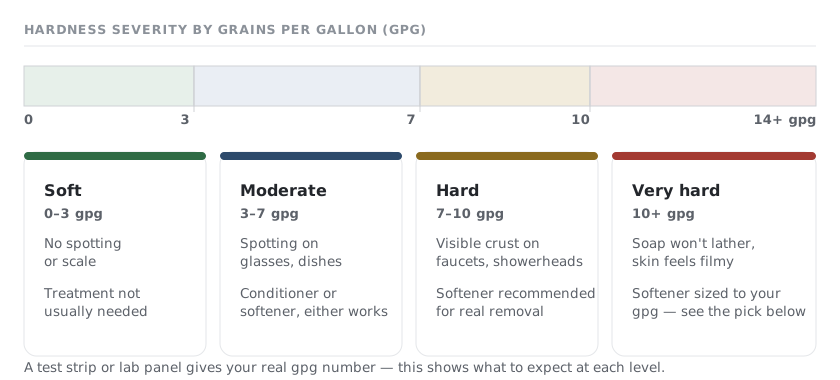
These are the same rounded gpg bands softener manufacturers use for sizing guidance, cross-checked against the self-check symptoms above so what you see at the tap and what the number says line up.
Treatment options
The three ways to deal with hardness, and the catch on each.
| Approach | Good for | Watch out |
|---|---|---|
| Salt-based softener | Any real hardness | Adds sodium; needs a drain |
| Salt-free conditioner | Scale control, no salt | Doesn’t truly soften |
| Template-assisted (TAC) | Low-maintenance scale control | Not for very hard water |
The real choice is softening versus scale control. A salt-based softener removes the calcium and magnesium through ion exchange, which is what gives you slippery-soft water and longer appliance life; how a softener works walks through the resin, brine tank, and regeneration cycle.
A conditioner leaves the minerals in and only stops them sticking as scale. Pick it when scale is your one complaint, you want no salt, or you can’t run a drain line — the salt-free options cover which ones hold up.
One to skip: magnetic and electronic “descalers.” These clamp onto a pipe and run a field through the water. They leave the calcium and magnesium in place, so your gpg number doesn’t move, and they’re a different thing from the TAC conditioners above. A peer-reviewed review of the field found the evidence for scale prevention mixed and hard to reproduce (Lin et al., npj Clean Water, 2020).
Order matters: if your test also shows iron or sulfur, treat those before the softener, or raw iron will foul the resin.
Ready to shop? Compare picks by type in best water softeners, or go straight to the well-water shortlist if you’re on a private well.
Worked example: sizing a softener. Softener capacity is rated in grains, and the number you need is just hardness times daily water use. Take a family of four running 300 gallons a day on a well that tests at 15 gpg:
- Daily grain load: 300 gal × 15 gpg = 4,500 grains/day.
- Most owners regenerate every 6 to 7 days rather than nightly, so multiply out: 4,500 × 7 = 31,500 grains between cycles.
- Softeners are sold in standard capacities (24,000 / 32,000 / 48,000 grains). A 31,500-grain week-long draw calls for the 32,000-grain unit, not the 24,000. Undersizing means it regenerates on day four or five instead of on schedule, burning through more salt and water over a year.
Run your own gpg and household gallons-per-day (roughly 70 to 100 gal per person, more with irrigation or a large tub) through the same math before you buy. The manufacturer’s sizing chart is doing exactly this calculation.
Our recommendation
For hardness, the pick is the SpringWell SS1: a salt-based ion-exchange softener that removes the calcium and magnesium behind spotting and scale, with smart metered regeneration and a lifetime warranty. It’s DIY-friendly for most.
Skip it if your test also shows iron or sulfur: those need a filter ahead of the softener, since raw iron fouls the resin. No drain, or a sodium-restricted setup? Look at a salt-free conditioner instead.
Check price at SpringWell(opens on SpringWell, external site)Keep reading
Where to go next, depending on what you need to do about your hard water.
- Water hardness test kits — get your gpg number before you shop.
- Hard water vs soft water — the difference and how to tell which you have.
- How a water softener works — sizing, cost, and the regeneration cycle.
- Best salt-free water softeners — scale control without salt or a drain.
- Best water softeners — top picks compared by type.
- Best softeners for well water — the private-well shortlist.
- Well water filtration guide — where whole-house well treatment starts.
Frequently asked questions
Will a whole-house filter fix hard water?
Not on its own. Sediment, carbon, and iron filters do not remove hardness. Hardness is calcium and magnesium in solution, so you need ion-exchange softening (or a conditioner for scale only).
Is softened water safe to drink?
For most people, yes. Ion-exchange softening adds a small amount of sodium proportional to the hardness removed. If you are on a sodium-restricted diet, use potassium chloride instead, or keep an unsoftened tap for drinking.