What is a water conditioner? Softener vs conditioner vs salt-free, untangled
In home water treatment, a water conditioner is almost always a salt-free system that controls scale: it changes how the hardness minerals behave so they stop sticking to your pipes and water heater.
It does not remove those minerals, it does not soften your water, and it won’t give you the slippery soft-water feel or fix iron or a rotten-egg smell.
That one distinction is behind a lot of buyer’s remorse: people install a “conditioner” expecting soft water, then find their glasses still spot and their skin still feels the same.
Part of the confusion is the word itself, because “water conditioner” is used for four different things.
This guide sorts out all four, shows exactly how a conditioner differs from a water softener, and points you to the right fix for your water.
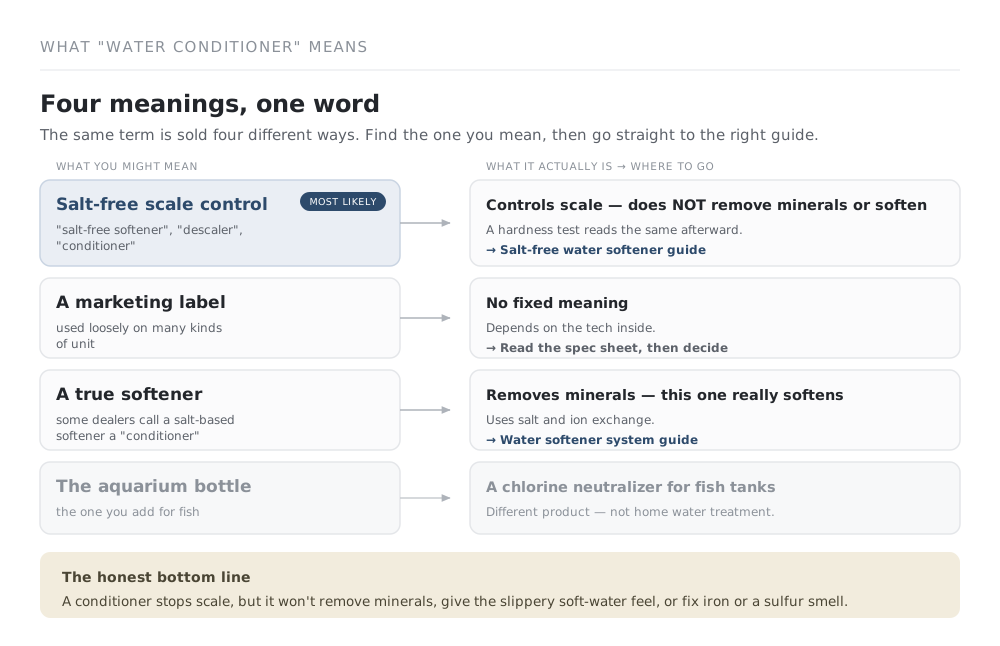
The four things “water conditioner” can mean
Before you compare products, figure out which of these you’re actually looking at, because the word covers all four.
| What people mean | What it actually is | Removes hardness minerals? | The right page |
|---|---|---|---|
| Salt-free scale control (also sold as “salt-free softener,” “descaler,” “conditioner”) | Media that reshapes dissolved calcium and magnesium into crystals that don’t stick as scale. Scale control, not softening. | No — a hardness test reads the same afterward | best salt-free water softener |
| A generic marketing label | Brands put “conditioner” on salt-free units, on all-in-one softener-plus-filter combos, and sometimes on true softeners. The word has no fixed technical meaning. | Depends on the tech inside — read the spec sheet | decode by mechanism, then pick |
| An aquarium dechlorinator | A bottle you add to a fish tank to neutralize chlorine. Nothing to do with hardness or whole-house treatment. | Not applicable — different job | not a home-water product |
| A true softener, called a “conditioner” | Some dealers and older usage call a salt-based ion-exchange softener a “conditioner.” | Yes — this one really softens | water softener system |
Most people who type “water conditioner” mean the first one: a salt-free scale-control system.
So that’s the meaning this guide spends the most time on, and the one behind nearly every “vs softener” question.
Water conditioner vs water softener: the real difference
A softener removes the hardness minerals; a conditioner leaves them in and just stops them from sticking.
A water softener runs your water through a bed of resin that pulls calcium and magnesium out and releases a little sodium in their place, so the water tests soft and feels slippery. (UNL Extension)
A salt-free conditioner runs your water through media that turns those same minerals into tiny crystals, which float away instead of sticking to your plumbing. (UNL Extension)
The minerals stay in the water, so a hardness test reads the same before and after a conditioner. (UNL Extension)
Here is the full side-by-side.
| Water softener (salt-based ion exchange) | Salt-free conditioner (TAC) | |
|---|---|---|
| Removes calcium and magnesium? | Yes — hardness drops to near zero | No — the minerals stay in the water |
| Changes a hardness test? | Yes, down to about 0 gpg | No, it reads the same |
| Feel of the water | Slippery, soft, easier lather | Feels like your original water |
| Scale protection | Eliminates it — no scale-forming minerals left | Cuts it by more than 88% |
| Sodium added | About 8 mg/L per grain of hardness removed | None |
| Salt refills | A 40-lb bag every 1–2 months | None |
| Electricity | Low (metered valve) | None |
| Water waste | Backwashes brine to the drain | None |
| Maintenance | Add salt; occasional resin service | Near zero; replace media every few years |
| Handles iron or sulfur? | Modest iron only (about 5–10 ppm); not sulfur | No — neither |
| Rough installed cost | About $1,200–$3,800 | About $1,500–$4,500 |
The hardness, sodium, and iron figures come from University of Nebraska–Lincoln Extension guides; the 88% scale-reduction figure is from independent testing covered in the next section. (UNL Extension)
If you want the deeper comparison of what “hard” and “soft” actually mean for your house, the hard water vs soft water guide walks through it.
How ion exchange works, and why a softener is an “ion exchange filter”
A water softener is an ion-exchange filter, which is why the two terms describe the same box.
Ion exchange means water flows through a bed of resin beads, and the beads trade an ion they’re holding for an ion in the water they grab more tightly. (UNL Extension)
Softening (cation exchange). The beads hold sodium and grab the positively charged hardness minerals, calcium and magnesium.
When the beads fill up, a salt brine rinses them clean and reloads them with fresh sodium, a step called regeneration. (NDSU Extension)
Contaminant removal (anion exchange). A different resin holds chloride and grabs the negative ions instead.
Anion exchange is a standard treatment for nitrate and arsenic, which carry a negative charge.
The resin swaps them for a harmless chloride ion. (Nova Scotia Environment)
This is the “ion exchange water filter” people mean when they aren’t talking about hardness.
One catch: other stuff like sulfate competes for space on the resin, and the treated water can turn slightly acidic. (Nova Scotia Environment)
So test the source water first, and it may need a corrosion-control step after.
Here’s the point that settles the conditioner question: a salt-free conditioner is not ion exchange.
It doesn’t swap or remove any ions, which is exactly why it can’t change your hardness number.
What a water conditioner does not do
A conditioner protects your plumbing from scale, and that is the whole of its job.
But people often expect it to do more than that, so here is what it won’t do.
- It doesn’t remove minerals. The calcium and magnesium stay dissolved in your water. (UNL Extension)
- It doesn’t change your hardness test. Send a before-and-after sample and the number is the same; that’s expected, not a defect.
- It doesn’t give the slippery soft-water feel. That feel comes from removing the minerals, and a conditioner leaves them in, so lather and rinse feel like your original water.
- It doesn’t remove iron or the rotten-egg sulfur smell. Those need oxidation or a dedicated iron filter, not scale control.
- It doesn’t filter out contaminants. A conditioner isn’t a purifier; for lead, nitrate, or PFAS you need a filter or reverse osmosis.
There’s a naming trap buried in all of this: a “salt-free water softener” isn’t a softener at all.
Extension guides call salt-free units descaling devices, not softeners, so if a product is salt-free, it’s a conditioner. (UNL Extension)
Do salt-free conditioners actually work?
For scale protection, yes, and there’s independent testing to back it.
Most quality conditioners use template-assisted crystallization, or TAC, where treated media seeds the hardness minerals into stable crystals that pass through without sticking. (UNL Extension)
Arizona State University researchers tested TAC on a German scale-test standard, the DVGW W512.
They ran water through a simulated water heater and measured more than 88% less scale. (WateReuse Research Foundation)
That’s a real, measurable result, and it’s why a conditioner is a solid choice when scale is your main worry.
Two limits are worth knowing before you buy.
TAC loses effectiveness on very hard water, and some vendors won’t sell it above a certain hardness, so once you’re past roughly 15–25 grains per gallon a salt-based softener is the safer bet.
And it does nothing for iron, so if your fixtures show reddish-brown staining, scale control isn’t your problem to solve first.
One more category to treat with caution: magnetic and electronic “conditioners” that clamp onto a pipe with no media inside.
The research that validated TAC set out to find credible salt-free options, and standardized testing for these magnet-and-electronic devices isn’t established. (UNL Extension)
So treat their scale claims with caution.
Do you need soft water, or just scale control?
This is the decision the whole page comes down to, and it splits cleanly.
You want a softener if you want the slippery soft-water feel, better lather and spot-free glasses, your water is very hard (above about 15 gpg), or your water carries iron.
Start with the water softener system guide for how it works and sizing, or jump to the best water softeners to compare units.
You want a salt-free conditioner if your main goal is protecting pipes and appliances from scale, and one of these is true: salt-discharge softeners are restricted where you live, you have no drain or space for a softener, or you simply don’t want salt, sodium, or the upkeep.
The best salt-free water softener guide covers which conditioners actually work and who should buy one.
Either way, get a hardness number first, because it decides which side of this fork you’re on and whether a conditioner will hold up.
Is a “water conditioner” the same as the bottle for my fish tank?
No — that’s a completely different product that happens to share the name.
The aquarium version is a small bottle you add to tap water to remove the chlorine so it’s safe for fish. (Wikipedia)
It has nothing to do with hardness, scale, or whole-house treatment, so if that’s what you were looking for, this isn’t the guide for it.
Is conditioned water safe to drink?
Yes. A conditioner removes nothing from your water, so it doesn’t add or take away anything that changes drinking it.
Softened water is also safe for most people, though it carries a little added sodium; the hard water vs soft water guide covers the sodium question in detail.
Keep in mind that neither one purifies your water.
If your goal is removing contaminants like lead, nitrate, or PFAS rather than controlling scale, that’s a job for a filter or reverse osmosis, not a softener or a conditioner.
Frequently asked questions
What is the difference between a water conditioner and a water softener?
A softener removes the hardness minerals through ion exchange and swaps in a little sodium, so your water tests soft and feels slippery.
A conditioner leaves the minerals in the water and only changes how they crystallize, so it stops scale but doesn’t soften your water.
Does a water conditioner remove hardness minerals?
No. The calcium and magnesium stay dissolved in the water, which is why a hardness test reads the same before and after.
It reduces the scale those minerals leave behind, without taking them out.
Does a water conditioner make water feel soft and slippery?
No. That slippery feel comes from removing the minerals, and a conditioner leaves them in place.
Water through one feels the same as your untreated water.
Is a salt-free water softener a real softener?
No. If a system is salt-free, it’s a conditioner, because softening by definition removes the hardness minerals and salt-free systems don’t.
Extension guides classify salt-free units as descaling devices rather than hardness-removing devices.
Does a water conditioner remove iron or the rotten-egg sulfur smell?
No. Iron and hydrogen sulfide need oxidation or a dedicated iron filter, and a conditioner does nothing for either.
If your fixtures stain reddish-brown, treat the iron before you worry about scale.
Do salt-free conditioners actually work?
For scale protection, yes. Independent testing on the DVGW W512 protocol measured more than 88% scale reduction from TAC media.
They lose effectiveness on very hard water above roughly 15–25 grains per gallon, where a softener is the safer choice.
Is a water softener an ion-exchange filter?
Yes. A softener works by ion exchange: resin beads trade sodium for the calcium and magnesium in your water, then recharge with a salt brine.
The same technology with a different resin removes contaminants like nitrate and arsenic.
Is conditioned water safe to drink?
Yes. It removes nothing, so it doesn’t change how safe your water is to drink.
For removing contaminants, though, you need a filter or reverse osmosis, not a conditioner.
Want the slippery soft-water feel or dealing with very hard water? See the water softener system guide or compare the best water softeners.
Mainly want scale protection with no salt? See the best salt-free water softeners.
Still sorting out hard versus soft? Read hard water vs soft water.
How we researched this
We built this guide from public water-science and university-extension sources.
The Nebraska (UNL) and NDSU extensions explain how ion exchange and salt-free conditioning work.
Nova Scotia Environment covers anion exchange for removing arsenic.
The scale-reduction figure comes from an Arizona State University study, reported through the WateReuse Research Foundation.
We don’t test these systems in-house yet, so we don’t claim to.
Sources
- Nebraska Extension (UNL) — Water Softening by Ion Exchange, G1491
- Nebraska Extension (UNL) — Salt-Free “Softener” Options, G2275
- NDSU Extension — Water Softening by Ion Exchange
- Nova Scotia Environment — Anion Exchange to Remove Arsenic from Drinking Water
- WateReuse Research Foundation (WRF-08-06) — Alternatives to Ion Exchange Softeners
- Wikipedia — Water conditioner