Best sediment filter for well water: spin-down vs Big Blue vs backwashing
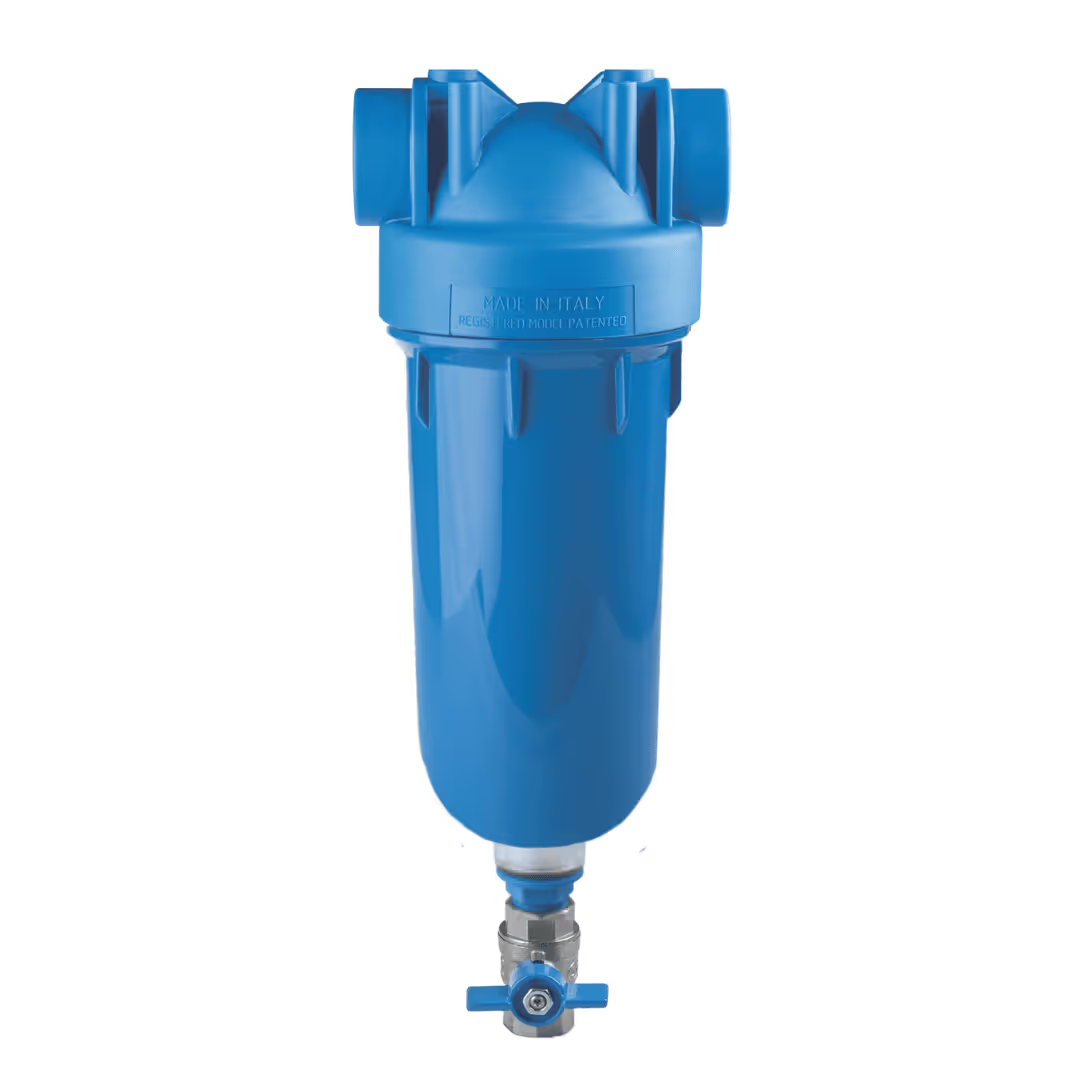
- A 90-micron reusable stainless screen catches sand, grit, and coarse rust flakes.
- Handles up to 26.4 GPM with almost no pressure drop, so it never starves the house.
- Flushes clean from a valve; there is no cartridge to buy, ever.
- Costs about $110, carries a lifetime warranty, and needs no drain or power.
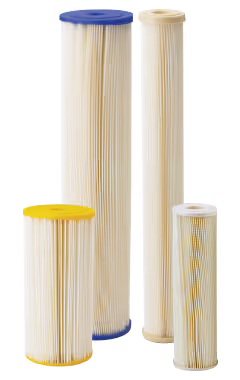
- A pleated 5-micron cartridge with 36 square feet of surface area, so it holds a lot of dirt before it clogs.
- Fits any standard 20-inch by 4.5-inch “Big Blue” housing, sold separately for roughly $60 to $100.
- Flows up to 20 GPM with under 1 psi of pressure drop when it is clean.
- Costs about $40 a cartridge, replaced every 6 to 9 months depending on your water.
- A tank of filtration media (such as Turbidex or Filter-Ag Plus) on an automatic valve.
- Filters down to roughly 5 microns, in the range of a fine cartridge, but self-cleaning.
- Backwashes the collected sediment to drain on a schedule, so there is no cartridge to change.
- Needs a drain connection and electrical power, and is the most expensive of the three up front.
Sand in your aerators, grit at the bottom of the toilet tank, or water that turns cloudy after a hard rain almost always means sediment in your well.
The right filter depends on how coarse that sediment is, and it comes down to one number: the micron rating.
For visible sand and grit, a spin-down pre-filter like the SpringWell Spin-Down catches it at the main line with a reusable screen and no cartridge to buy.
For finer silt, or to protect a softener or reverse-osmosis system downstream, a 5-micron Big Blue cartridge does the polishing.
For heavy, constant sediment that would clog a cartridge every few weeks, a backwashing media filter cleans itself.
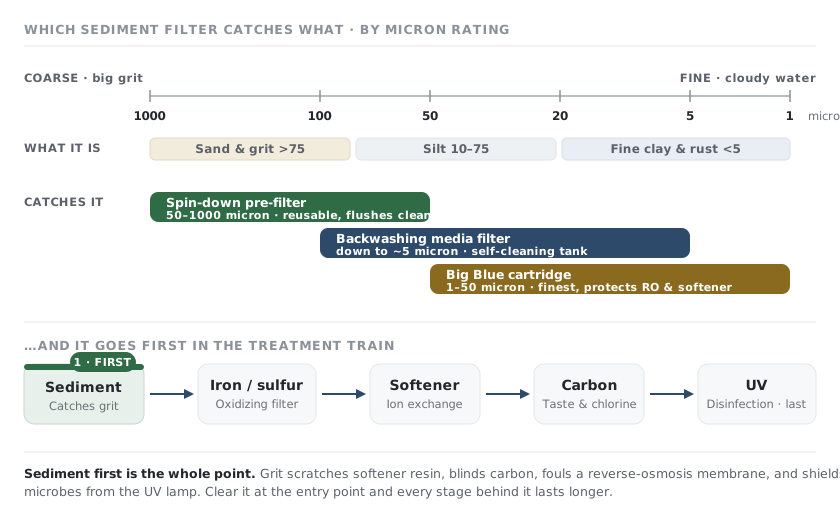
Whichever you pick, one rule decides where it goes: sediment is treated first, before the iron filter, softener, carbon, and UV, because grit ruins every one of them.
Why sediment goes first (the one rule that saves your other filters)
Sediment is the suspended solids in your water: sand, silt, clay, and rust flakes, the material that makes water look cloudy. (USGS)
On its own it is a nuisance rather than a health risk. But it damages everything you install to treat the real problems.
Grit scratches and channels a softener’s resin bed, so the softener stops trading hardness for sodium evenly.
It blinds a carbon filter, using up its surface area on dirt instead of chlorine and taste.
It fouls a reverse-osmosis membrane, and a membrane that should last about two years can clog in months without a proper pre-filter. (Global Filter)
And it undermines a UV lamp directly: the particles physically shelter bacteria from the light, so the water passes through “disinfected” while microbes ride through in the shade of a speck of clay. (USGS; Minnesota Dept. of Health)
That is why a sediment filter sits at the entry point, ahead of the whole train.
Penn State Extension puts it plainly: a whole-house sediment filter improves water clarity and reduces maintenance for any treatment that follows it. (Penn State Extension)
The full well order runs: sediment → iron/sulfur filter → softener → carbon → UV. UV goes last because it needs the clearest water to work.
If you are also treating iron or hardness, the well water treatment-order guide has a diagram of how those stages line up, with the softener always downstream of the filter that removes iron.
Which micron rating do you need?
A micron rating is the size of particle a filter is built to catch. A lower number means a finer filter.
For scale: a grain of fine sand is roughly 100 microns, the naked eye stops seeing individual particles around 40 microns, and clay that keeps water cloudy is under 5 microns.
Sediment filters run from coarse screens around 1000 microns down to fine cartridges at 1 micron.
Here is the decision, and the mistake almost everyone makes with it.
Start coarse, then go finer
The single most common sediment-filter complaint is “my filter clogs immediately.”
It happens when someone buys a 1-micron cartridge and points sandy well water straight at it. The cartridge loads up with grit in days, pressure drops, and they are back to changing filters every week.
The fix is staging: a coarse filter first to pull out the sand, then a finer one to catch what is left.
A spin-down at 50 to 100 microns ahead of a 5-micron cartridge lets each filter do the job it is sized for, and the fine cartridge lasts many times longer.
Nominal vs absolute ratings
Two filters can both say “5 micron” and perform differently.
A nominal rating means the filter catches most particles that size, typically around 85 percent. Most whole-house sediment filters are nominal.
An absolute rating means it catches essentially all of them at that size. Absolute filters cost more and restrict flow more, and you mostly see them protecting a reverse-osmosis membrane.
For a whole-house sediment filter, a nominal rating is fine. For the pre-filter directly ahead of an RO membrane, an absolute rating buys real protection.
Match the micron to what it protects
| What is downstream | Micron target | Why |
|---|---|---|
| A softener | Spin-down or 5–20 micron | Keeps sand out of the resin bed so it channels evenly |
| A carbon filter | 5 micron | Saves the carbon for taste and chlorine, not dirt |
| A reverse-osmosis membrane | 5 micron (1 micron absolute is better) | A fouled membrane fails years early |
| A UV lamp | 5 micron or finer | Clear water lets the light reach every microbe |
If you have not measured your water yet, test your well so you know whether you are dealing with coarse sand or fine silt before you buy.
The picks
SpringWell Spin-Down Sediment Filter
| Spec | Value |
|---|---|
| Type | Reusable spin-down / centrifugal |
| Micron rating | 90 micron |
| Max flow rate | 26.4 GPM |
| Maintenance | Flush the valve; rinse the screen |
| Cartridge cost | None (reusable screen) |
| Price | ≈ $110 |
| Warranty | Lifetime |
It works by spinning the water inside a clear housing.
The heavier grit is thrown to the outside and drops to the bottom, where it collects until you open the flush valve and rinse it out.
Because the screen is reusable, the running cost is essentially zero: no cartridge, no filter waste, no schedule to keep.
It stops sand and grit, but fine silt and clay pass straight through, so on cloudy water it is only a first stage.
That is fine sediment, and you need a cartridge or media filter below to catch it.
Check price at SpringWell(opens on SpringWell, external site)Why it scores 8.5i
Each sub-score is our assessment, weighted into the overall. It reflects published specifications, certification listings and warranty terms — not systems we ran ourselves. How we score
- Performance8/10
- A 90-micron reusable screen that catches sand and grit at up to 26.4 gpm with almost no pressure drop — exactly the job a whole-flow pre-filter is for. Held short of the top because 90 microns is coarse: it passes fine silt and clay, so it protects the rest of the train rather than polishing the water on its own. Source ↗
- Value9/10
- About $110 for a filter with no cartridge to buy, ever: you flush the collected grit down a valve and reuse the same stainless screen. The cheapest running cost of any sediment approach. Source ↗
- Ownership9/10
- Open the flush valve now and then and the grit washes to a drain or a hose; no cartridge swap, no drain line, no power. It mounts on the main line ahead of everything else. Source ↗
- Trust8/10
- A lifetime warranty and a published micron and flow rating, backed by a 6-month money-back window. No NSF/ANSI particulate certification is published for the spin-down line. Source ↗
Pentek ECP5-20BB Big Blue cartridge
| Spec | Value |
|---|---|
| Type | Pleated cartridge, 20” × 4.5” Big Blue |
| Micron rating | 5 micron (nominal) |
| Max flow rate | 20 GPM |
| Surface area | 36 sq ft |
| Maintenance | Swap cartridge every ~6–9 months |
| Cartridge cost | ≈ $40 |
| Housing | Bought separately (~$60–100) |
The pleats are the point.
Folding the media into 36 square feet gives it far more dirt-holding capacity than a plain wound cartridge, which is why it can run 5 microns at whole-house flow without choking.
If your sediment is heavy, pair it behind the spin-down above.
The graded-density version of this cartridge, the Pentek DGD-5005-20, catches 50 microns down to 5 in a single cartridge, which is staging inside one filter.
You would be changing cartridges every few weeks, and the backwashing filter below is built for that load.
Check price at Amazon(opens on Amazon, external site)Why it scores 7.7i
Each sub-score is our assessment, weighted into the overall. It reflects published specifications, certification listings and warranty terms — not systems we ran ourselves. How we score
- Performance8/10
- Pleated to 36 square feet of surface area, it holds a 5-micron nominal rating at up to 20 gpm with under 1 psi of pressure drop — fine enough to protect softener resin and a reverse-osmosis membrane. It clogs fast if it is the only stage on sandy water, which is why it belongs behind a coarse pre-filter. Source ↗
- Value8/10
- Roughly $40 a cartridge and it drops into any standard 20-inch Big Blue housing, so you are not locked into a proprietary part. Cheap to buy; the cost is the recurring swap, not the sticker. Source ↗
- Ownership7/10
- Anyone can change it with the housing wrench, and it needs no drain or power — but that is a job roughly twice a year, more on heavy sediment, versus a reusable screen you just rinse. Source ↗
- Trust7/10
- Pentair is a long-standing filtration maker that publishes the cartridge's micron rating, surface area, and flow. The 5-micron figure is nominal, and no NSF/ANSI particulate certification is listed for this cartridge. Source ↗
a backwashing media filter
This is the heavy-duty option.
Instead of trapping sediment in a screen or cartridge, it runs the water through a bed of media, then periodically reverses the flow to wash the trapped dirt down a drain.
There is no cartridge cost and no weekly maintenance, which is what makes it worth the higher price on a well that pumps a lot of sediment.
The tradeoff is real, though: it costs several times what a spin-down or Big Blue setup does, it needs a drain line and a power outlet, and it needs enough well flow to backwash properly.
For most homes with occasional or moderate sediment, it is more filter than the water calls for.
One case sits beyond all three: colloidal clay so fine it slips through even a 5-micron cartridge and leaves water hazy. That is the job for an ultrafiltration membrane, which is a different (and pricier) piece of equipment worth a conversation with a local water dealer.
We do not have a direct buying relationship for the backwashing systems we would point you to, so we are not linking one here; treat this as the approach to price out with a local water dealer if your sediment is genuinely heavy.
How the three approaches compare
| Spin-down pre-filter | Big Blue cartridge | Backwashing media | |
|---|---|---|---|
| Best for | Sand and grit | Fine silt, RO/softener protection | Heavy, constant sediment |
| Micron range | 50–1000 | 1–50 | ~5 and up |
| Maintenance | Flush a valve | Swap cartridge ~6–9 mo | Self-cleaning |
| Cartridge cost | None | ~$40 each | None |
| Needs drain + power | No | No | Yes |
| Upfront cost | ~$110 | ~$100–150 with housing | Highest |
| Sees full flow | Yes | Yes | Yes |
Many well owners end up running two of these: a spin-down first for the sand, then a Big Blue cartridge for the fine silt.
That pairing costs a little over $200 all in and covers coarse and fine sediment together, which is why it is the setup we point most people to.
Is it the filter, or is it the well?
A quick gut-check before you buy anything.
If your well has always run a little gritty, a sediment filter is the right fix.
But if the sand started suddenly, or is getting worse, that can signal a problem with the well itself: a worn well screen, a cracked casing, or a pump set too low and pulling sand off the bottom.
A filter treats that water, but it does not fix the well, and you may be masking a problem worth a call to a licensed well contractor.
The tell is a change: steady sediment is a filtration job, while a sudden onset of sand is worth diagnosing at the source first.
Are sediment filters NSF-certified?
Mostly, no, and that is worth understanding before you compare micron numbers.
There is a standard for it. NSF/ANSI 42 covers particulate reduction, sorting filters into classes by the particle size they remove, from the finest sub-micron class down to a class for 50 microns and coarser. (NSF)
In practice, though, most consumer sediment filters, spin-down screens and generic Big Blue cartridges included, are not third-party certified. They carry the manufacturer’s own micron rating instead.
That is simply how the category works. It means the “5 micron” on a cartridge is a nominal, manufacturer-stated figure rather than an independently listed one.
Read the rating as a useful guide to sizing, and stage your filters so the number matters less: a coarse pre-filter ahead of a fine cartridge protects you whether or not the fine one hits its rating exactly.
What it costs
Sediment filtration is the cheapest stage in a well setup, which is part of why skipping it to protect a $2,000 softener makes no sense.
A spin-down pre-filter runs about $110, with no ongoing cost beyond flushing it.
A Big Blue cartridge setup runs roughly $100 to $150 for the housing, plus about $40 per cartridge every 6 to 9 months, so figure $60 to $80 a year in cartridges.
A backwashing media filter is the outlier, costing several times as much up front, but with no cartridge cost after that.
The most common well setup, a spin-down feeding a Big Blue cartridge, lands a little over $200 to buy and under $100 a year to run.
Against the cost of a softener or an RO system it protects, that is inexpensive insurance.
Frequently asked questions
What micron sediment filter do I need for well water?
Start coarse, then finer. A 50-to-100-micron spin-down catches sand, and a 5-micron cartridge behind it catches fine silt and protects a softener or RO membrane.
Running a single 1-micron filter on sandy water clogs it in days, so stage two filters instead.
Why does my sediment filter clog so fast?
Usually because it is too fine for the first stage, with no coarse pre-filter ahead of it.
Add a spin-down to pull out the sand first. If the sediment appeared suddenly, also check the well itself, since a worn screen or a low-set pump can pump sand.
Does a sediment filter go before or after the water softener?
Before. Sediment goes first in the whole train, ahead of the iron filter, softener, carbon, and UV.
Grit scratches and channels softener resin, so a sediment filter protects it and keeps it working evenly.
Do I need a sediment filter before a UV light or RO system?
Yes, and it matters most for those two. Particles shield microbes from UV light, and they foul an RO membrane years early.
A 5-micron pre-filter is the standard protection for both.
How often do I change a sediment cartridge?
Commonly every 6 to 9 months, but it depends entirely on your water.
Heavy sediment can mean monthly changes, which is the sign you should add a spin-down ahead of it or move to a backwashing filter.
Will a sediment filter remove sand and cloudy water?
A spin-down removes sand and grit. Cloudy water is finer sediment, so it needs a 5-micron cartridge or a media filter to clear.
Match the micron rating to how fine the sediment is.
Spin-down, cartridge, or backwashing: which is best?
For sand, a spin-down. For fine silt or to protect a softener or RO, a 5-micron Big Blue cartridge. For heavy, continuous sediment, a self-cleaning backwashing filter.
Many wells use the first two together.
Not sure what is in your water yet? Start with well water testing to get real numbers before you buy.
Dealing with rust stains or a metallic taste too? That is iron, and it is treated in its own stage: see the best iron filter for well water.
Ready to build the whole treatment train? See the best whole-house filters for well water and how a full well water filtration system fits together.
How we researched this
We built this guide from USGS and Penn State Extension guidance on sediment and turbidity, Minnesota Department of Health guidance on UV disinfection, and manufacturer spec sheets for the specific filters.
We don’t test these systems in-house yet, so we don’t claim to.
Every figure here traces to a cited source, and where a micron rating is the manufacturer’s own nominal number rather than a third-party certification, we say so.
We may earn a commission if you buy through a link here, at no cost to you.
Sources
- USGS — Sediment and Suspended Sediment
- USGS — Turbidity and Water
- Minnesota Dept. of Health — Disinfection and Disinfection Byproducts
- Penn State Extension — Maintenance and Treatment of Residential Water
- Global Filter — Reverse Osmosis Prefiltration
- NSF — NSF/ANSI 42, 53, and 401: Filtration Systems Standards
- SpringWell — Spin-Down Sediment Filter