Tannins in well water: why it’s yellow and how to remove it
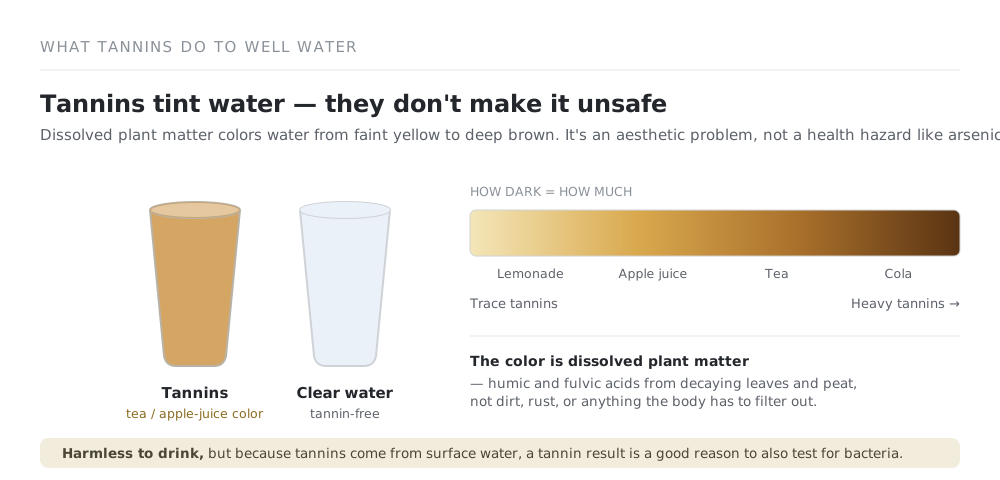
Tannins in well water are harmless organic compounds from decaying plants, so the yellow or tea-colored water they cause is an aesthetic problem, not a health hazard.
If your water looks like weak tea or apple juice but a lab test rules out iron, tannins are the usual answer.
They don’t belong in the same category as arsenic or nitrate, which are real health risks you can’t see or taste.
Tannins you can see, and the fix is a well-understood one: a whole-house resin tank built to grab them, or an under-sink filter if you only care about drinking water.
Why your well water looks like weak tea
Tannins are natural organic compounds, mainly humic and fulvic acids, that leach out of decaying leaves, bark, roots, and peaty soil.
They’re the same family of compounds that gives tea, coffee, and red wine their color and their dry, tart edge.
When rain filters down through leaf litter and peat, it picks up these compounds and carries them into shallow groundwater.
So the color in your glass is dissolved plant matter, not dirt or rust.
Depending on how much is present, the water can look faintly yellow like diluted lemonade, amber like apple juice, or deep brown like tea or cola.
You may also notice a musty, earthy smell or a slightly tart, tangy taste.
Over time, tannins can leave a faint yellow or tan tint on white laundry and a light stain in sinks, tubs, and toilets.
The EPA lists color as a secondary (aesthetic) standard with a guideline of 15 color units, and tannins are a common reason a well fails it. (EPA)
Where tannins in well water come from
Tannins are a surface-and-shallow-water problem, so where your well sits matters more than your local bedrock.
They’re most common in wells that are shallow, or drilled near wetlands, swamps, marshes, and peat bogs.
Low-lying wooded ground and many coastal and lowland areas are classic tannin country, because decaying vegetation is always feeding the groundwater.
A deep well in dry, rocky terrain rarely has them.
Because the source is surface organic matter, tannin levels can rise after heavy rain or snowmelt and ease off in drier stretches.
That seasonal swing is a useful clue: water that turns more yellow every spring points toward tannins rather than a mineral in the rock. (PrivateWellClass.org)
Are tannins in well water dangerous?
No, not in the way arsenic or nitrate are.
Tannins are not a recognized health risk at the levels found in wells, and the EPA classes them as a secondary contaminant, meaning the concern is how the water looks, tastes, and smells. (PrivateWellClass.org)
You can drink lightly tannic water without a health worry, which is why this page stays calm where our arsenic guide does not.
There are two honest caveats, though, and both point to testing rather than panic.
First, tannins react with chlorine.
If you chlorinate your well or add a chlorine feed, the tannins can combine with it to form disinfection byproducts such as trihalomethanes, a class of compounds the EPA regulates in public water because long-term exposure is linked to higher cancer risk. (ScienceDirect)
Second, because tannins come from surface organic matter, their presence can be a sign that surface water is reaching your well.
That last point is our inference, not an EPA finding: the same shallow path that lets leaf-stained water in can also let bacteria in, so a tannin result is a sensible reason to also run a coliform bacteria test. (Tap Score)
So the takeaway is measured: tannins themselves won’t hurt you, but they’re worth testing around.
If you haven’t tested yet, start with well water testing or the best well water test kits.
Tannins or iron? How to tell them apart
Tannins and iron both discolor water, so they get confused all the time, but they’re different problems with different fixes.
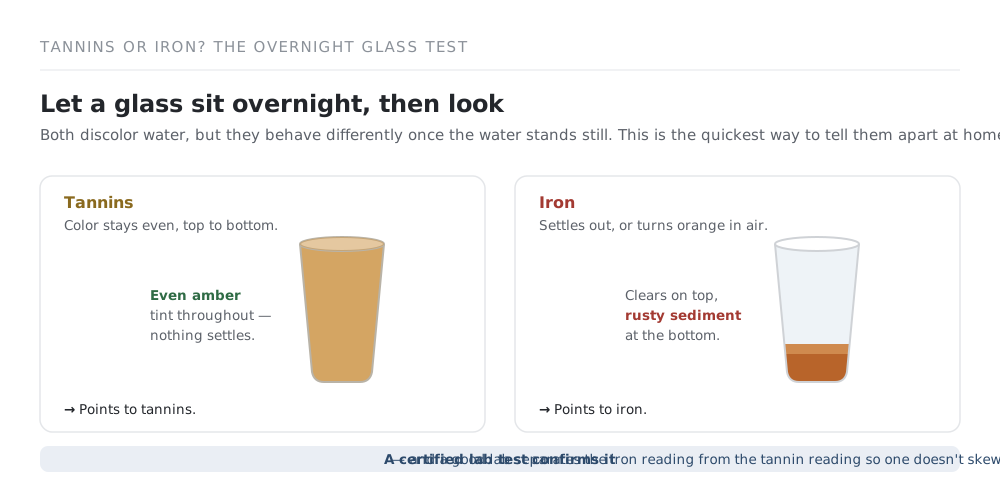
The quickest home check is the overnight glass test.
Fill a clear glass, let it sit overnight, and look at it in the morning.
If the water stays evenly tinted top to bottom, that points to tannins.
If the color drops to the bottom as sediment, or the water turns more orange as it meets the air, that points to iron. (Tap Score)
Here’s how the two usually show up:
| Sign | Tannins | Iron |
|---|---|---|
| Color | Yellow to brown, like tea or apple juice | Rusty orange or red |
| After sitting overnight | Stays evenly colored | Settles to the bottom or turns orange |
| Staining | Faint yellow-tan on laundry and fixtures | Rusty orange stains on sinks, tubs, and toilets |
| Taste | Musty, earthy, or tart | Metallic |
| Where it’s common | Shallow wells near wetlands and peat | Wells drawing iron-bearing rock or soil |
One catch worth knowing: iron can throw off a tannin lab result, so a good lab measures iron separately and subtracts its effect to report a true tannin number.
To confirm before you spend money, order a tannins water test from a certified lab. The lab reports tannins as milligrams per liter of tannic acid, using a standard color-based method. (Hach) That gives you a real number instead of a guess, and well-water labs like Tap Score sell a dedicated tannins test kit for it. (Tap Score)
The quick decision path
Start with the overnight glass test, then confirm the result at a certified lab before you buy anything.
- Water stays evenly yellow-brown overnight, no rust stains: likely tannins, so a whole-house tannin resin tank (or under-sink reverse osmosis for drinking water only).
- Color settles to the bottom, or the water turns orange as it sits, with rusty stains on fixtures: likely iron, so an iron filter.
- You see both signs, or the lab reports both: treat both, with the iron filter or softener plumbed first, then the tannin tank behind it.
A tannin resin won’t fix iron, and an iron filter won’t fix tannins, so getting this branch right is what saves you from buying the wrong tank.
Plenty of wells have both, and then you treat both.
What actually removes tannins
The proven whole-house fix is a tannin-selective anion exchange resin, sometimes just called a tannin filter.
Tannin molecules carry a negative charge, so a bed of positively charged anion resin grabs them as the water flows through, then flushes them out and recharges with ordinary salt.
Here’s how to match the fix to your situation:
| Your situation | The fix | What to expect |
|---|---|---|
| Whole house, water is soft and low in iron | Tannin-selective anion exchange tank | $1,500–3,000 installed; regenerates with salt every few days; cuts tannins by roughly 90–99% |
| Whole house, water is also hard or has iron | Water softener (or iron filter) ahead of the tannin tank | Protects the tannin resin from fouling; two tanks in series, higher upfront cost |
| Drinking and cooking water only | Under-sink reverse osmosis | $200–600; the reverse osmosis membrane blocks the large tannin molecules; treats one tap, not the whole house |
| Haven’t confirmed it’s tannins | Lab test, plus the overnight glass test | Rules out iron, which can mimic and skew a tannin reading |
A few specifics behind the table.
Whole-house tannin resin: the main event
An anion exchange tannin tank looks a lot like a water softener and works on the same swap-and-regenerate principle, just tuned for tannins instead of hardness.
Expect to refill the brine tank with salt, and expect it to regenerate more often than a softener, which means more salt and more backwash water over the year.
The resin itself lasts several years before it needs replacing.
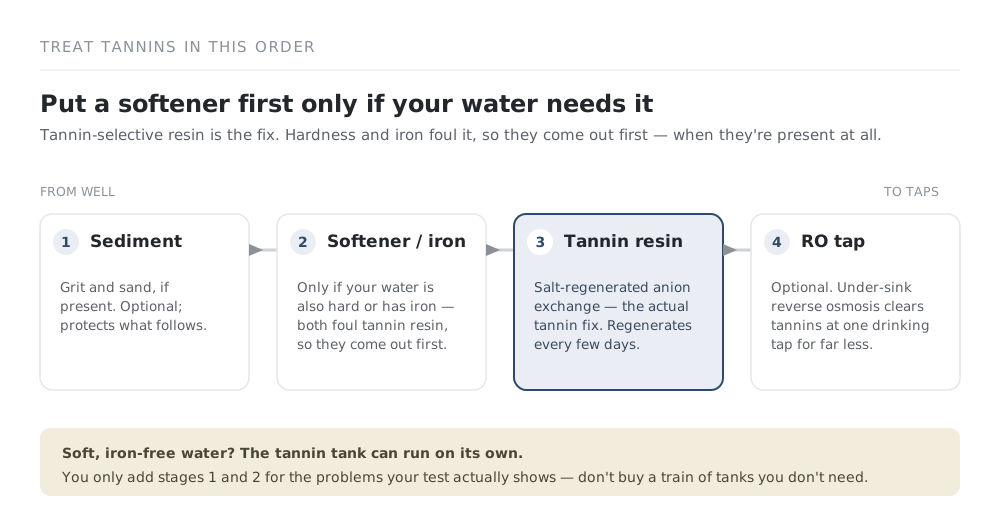
Put a softener first if your water is hard or has iron
Hardness minerals and iron can coat and foul tannin resin, which shortens its life and cuts its performance.
If your test shows hard water or iron alongside tannins, the standard build is a softener or iron filter first, then the tannin tank second. (US Water Systems)
For the hardware that handles hardness across the house, see the best whole-house filter for well water.
Carbon helps a little; reverse osmosis handles the drinking tap
A plain activated carbon filter removes only light tannin staining and clogs quickly, so it’s not a whole-house answer on its own.
Reverse osmosis is different: the tannin molecule is large, so a reverse osmosis membrane rejects it well, which makes an under-sink reverse osmosis unit a low-cost way to get clear, good-tasting water at the kitchen tap.
Reverse osmosis only treats the tap it’s plumbed to, so it fixes your drinking water without touching the yellow tint in your shower or laundry.
Our pick for the whole-house route
For a dedicated whole-house tannin system, US Water Systems is the specialist we point readers to, since contaminant-specific media is their core catalog.
Their Matrixx tannin system runs about $2,195–3,658 depending on size, uses a salt-regenerated anion resin, and is built to sit behind a softener when hardness is also in play. (US Water Systems)
The honest downsides: it’s a salt-hungry system that regenerates every few days, it adds some chloride to your water, and it’s overkill if you only care about drinking water, where an under-sink reverse osmosis does the job for a fraction of the price.
If you’d rather have a broad-catalog option with a filter-cartridge angle, Crystal Quest also sells whole-house tannin systems, though we’d start with the specialist above for a well that mainly needs tannins handled.
What it costs
A whole-house tannin anion exchange system commonly runs $1,500–3,000 installed, with specialist units like the US Water Matrixx sitting around $2,195–3,658 before install. (US Water Systems)
On top of that, budget a few hundred dollars a year in salt, plus the water used on frequent regeneration cycles.
The resin bed typically lasts several years before replacement.
An under-sink reverse osmosis unit is far cheaper at $200–600, plus filter changes, but it only cleans the one tap it’s connected to.
If your water is also hard or iron-laden, add the cost of a softener or iron filter ahead of the tannin tank, which pushes a full build toward the top of that range.
The trade-off in one line
Whole-house treatment clears the color everywhere, including your laundry and fixtures, and costs the most.
Under-sink reverse osmosis clears only your drinking water for a fraction of the price.
Since tannins are aesthetic, either is a valid choice, and it comes down to whether the yellow tint bothers you at every tap or only in your glass.
Frequently asked questions
Are tannins in well water harmful to drink?
No.
Tannins are not a recognized health risk at the levels found in wells, and the EPA treats them as an aesthetic (secondary) contaminant, not a health-based one.
The one caveat is that tannins can react with chlorine to form disinfection byproducts, so if you chlorinate your well, that’s worth accounting for.
Why is my well water yellow or brown?
The most common cause is tannins, dissolved organic compounds from decaying leaves and peat that stain water like weak tea.
The other common cause is iron, which shows up as rusty orange and settles or oxidizes as the water sits.
An overnight glass test and a lab test tell them apart.
How do I know if it’s tannins or iron?
Fill a clear glass and let it sit overnight.
Tannin water stays evenly colored; iron settles to the bottom or turns more orange as it hits the air.
A certified lab test confirms it, and a good lab separates the iron reading from the tannin reading so one doesn’t skew the other.
What removes tannins from well water?
For the whole house, a tannin-selective anion exchange resin tank that regenerates with salt.
For drinking water only, an under-sink reverse osmosis unit.
Plain carbon filters handle only light staining and clog fast, so they aren’t a standalone fix.
Do I need a water softener too?
Only if your water is also hard or high in iron.
Hardness and iron foul tannin resin, so the standard setup puts a softener or iron filter ahead of the tannin tank to protect it.
If your water is soft and iron-free, the tannin tank can run on its own.
How much does it cost to remove tannins from well water?
A whole-house tannin system commonly runs $1,500–3,000 installed, plus a few hundred dollars a year in salt.
An under-sink reverse osmosis unit runs about $200–600 and treats a single tap.
Does boiling remove tannins?
No.
Boiling doesn’t remove tannins, and reducing the water can concentrate the color instead.
Filter the water or use reverse osmosis instead of boiling.
Not sure it’s tannins? Start with well water testing or compare well water test kits, and run the overnight glass test to rule out iron.
Seeing rusty orange stains and a metallic taste instead? That’s an iron problem, which needs a different filter (many wells have both tannins and iron).
For the full test-to-installed-system framework, see well water filtration system.
How we researched this
We built this guide from EPA secondary drinking-water standards, PrivateWellClass.org (an EPA-supported private-well education program), peer-reviewed research on tannin-derived disinfection byproducts, and technical write-ups from water-treatment suppliers on tannin resin and the tannin-versus-iron distinction.
We don’t test these systems in-house yet, so we don’t claim to.
Every figure and claim here traces to a cited source.
We were not able to pull raw well-owner quotes from Reddit or forum threads in this research pass, so the color and taste descriptions here are paraphrased from water-treatment references rather than presented as first-hand quotes.
We may earn a commission if you buy through a link on the pages this one links to, at no cost to you.
Sources
- EPA — Secondary Drinking Water Standards: Guidance for Nuisance Chemicals
- PrivateWellClass.org — What are tannins, and how do they affect well water?
- Tap Score — Coliform bacteria in well water
- ScienceDirect — Novel chlorinated disinfection byproducts from tannic acid
- Tap Score — The complete guide to discolored tap water
- Tap Score — Tannins water test kit
- Hach — Tannin-Lignin Reagent Set (Method 8193, reported as tannic acid)
- US Water Systems — Tannin removal filters & systems