Alkaline water machines: what they do, and whether you actually need one
An alkaline water machine, sold as a water ionizer, runs an electric current through your tap water to raise its pH, usually to somewhere around 8 to 9.5.
For most people it’s an expensive answer to a question their water isn’t really asking.
The machines cost roughly $3,000 to $4,000 for the popular Kangen brand, and the health story behind them, that alkaline water changes your body’s pH and wards off disease, isn’t supported by strong evidence. (Frontiers in Medicine, 2026)
There’s one narrow exception worth knowing about, and there’s a much cheaper path if what you actually want is clean, good-tasting water.
What is alkaline water?
Alkaline water is simply water with a pH above the neutral value of 7.
The pH scale runs from 0 to 14, where 7 is neutral, lower numbers are acidic, and higher numbers are alkaline (also called basic).
Ordinary tap and bottled water usually sits close to neutral, around pH 6.7 to 7.4. (Koufman & Johnston, 2012)
The alkaline water people buy to drink is typically in the pH 8 to 9.5 range, whether it comes from a bottle or a machine.
Water can be alkaline naturally, when it picks up minerals like calcium and magnesium from rock, or it can be made alkaline by a machine.
A quick word on two terms the marketing leans on, because they get mixed up with pH.
ORP, or oxidation-reduction potential, is a separate measurement that ionizer sellers quote as a negative number (like −300 millivolts) and call an “antioxidant” marker; it isn’t a validated health metric.
Total dissolved solids, or TDS, measures the mineral content of your water, which is a different thing again from pH.
What an alkaline water machine actually does
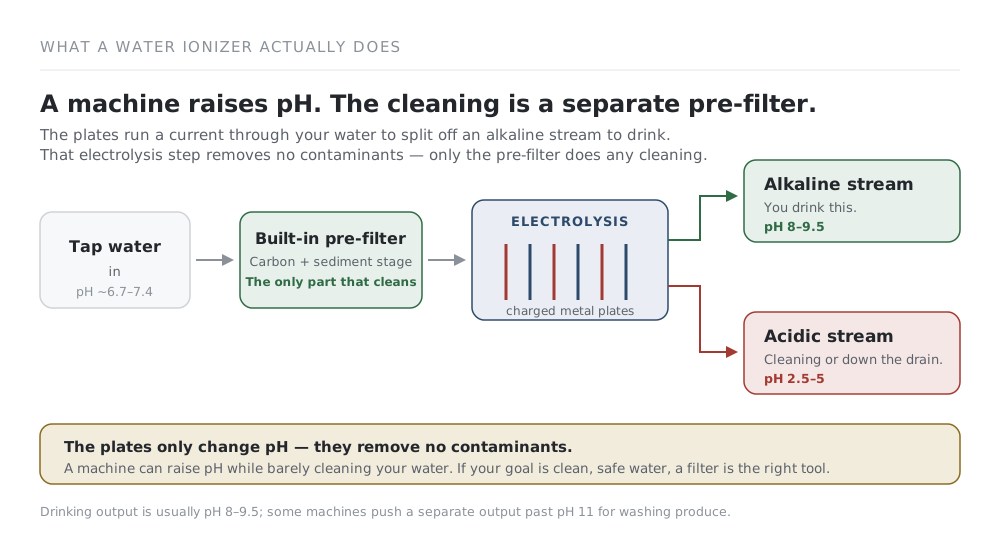
A water ionizer is really an electrolyzer.
It passes an electric current through water across a set of metal plates, commonly platinum-coated titanium, with entry models using around 5 plates and higher-output models using 7, 9, 11, or 13.
That current splits the incoming water into two streams: a more alkaline stream you drink, and a more acidic stream that goes down the drain or gets used for cleaning.
The drinking stream is usually pH 8 to 9.5, and many machines can push a separate output past pH 11 for washing produce, plus an acidic output down around pH 2.5 to 5 for cleaning and skincare.
One detail rarely makes it onto the sales pages.
The electrolysis step removes no contaminants at all.
Any cleaning an ionizer does comes from a separate pre-filter built into the unit, the same kind of carbon stage you’d find in a basic pitcher, which handles chlorine, sediment, and some metals.
So a machine can raise your water’s pH while doing little to clean it, and a good filter can leave the pH untouched while removing far more.
That single distinction, pH change versus contaminant removal, is the one to hold onto for the rest of this page.
Is alkaline water good for you?
For a healthy adult, drinking alkaline water is safe, but the big health claims attached to it don’t hold up.
A 2026 review in Frontiers in Medicine looked at the research and found the evidence “limited, inconsistent, and largely from small or preclinical studies.” (Frontiers in Medicine, 2026)
Here’s how the main claims actually stack up against that evidence.
| Claim | What the evidence shows |
|---|---|
| Changes your body’s or blood’s pH | No. Your body holds blood at pH 7.35 to 7.45 on its own, and alkaline water doesn’t move it. |
| Prevents disease, boosts immunity, slows aging | Not supported by robust clinical evidence; the review flags these as marketing rather than fact. |
| Fights cancer | No. Only preclinical (animal) signals exist, and cancer organizations have rejected the claim. |
| Better hydration for athletes | A small, transient effect in some studies, not sustained “alkalizing.” |
| Stronger bones | Weak and inconsistent; one study found no meaningful change versus regular water. |
| Helps acid reflux | A real but narrow local effect at pH 8.8 (see below), not a whole-body benefit. |
The first row is the one that matters most.
Your kidneys and lungs hold your blood pH in a tight band, 7.35 to 7.45, and they do that job no matter what you drink. (Frontiers in Medicine, 2026)
On top of that, any alkaline water you swallow meets your stomach acid and is neutralized on the spot.
So the idea that you can “alkalize your body” by drinking high-pH water runs into two walls: your stomach, then your kidneys.
A few related sub-claims are worth naming so you can spot them.
“Micro-clustered” or “hexagonal” water, the idea that ionizers rearrange water into smaller clusters your cells absorb better, is dismissed by chemists as inaccurate.
And “antioxidant water,” based on that negative ORP reading, doesn’t have the clinical backing the marketing implies.
Does alkaline water help acid reflux?
This is the one place the science gives alkaline water real, if narrow, credit.
A 2012 study found that water at pH 8.8 permanently deactivates pepsin, the stomach enzyme that drives much of the tissue damage in reflux, and that it buffers acid well. (Koufman & Johnston, 2012)
Small clinical work has since linked high-pH water to fewer heartburn episodes for some people.
But read the limits carefully, because they matter.
The effect is local, acting in the throat and esophagus as the water passes through, and it does nothing to your systemic or blood pH.
It applies mainly to reflux that reaches the throat, and the researchers were clear it “should not replace treatment for reflux disease.”
You also don’t need a machine to get pH 8.8 water.
Bottled high-pH water works, and so does a pinch of baking soda stirred into a glass, both for a tiny fraction of an ionizer’s price.
If reflux is your reason for looking at alkaline water, treat it as a possible add-on and talk to a clinician rather than buying a countertop machine for it.
Alkaline water machine vs filter: which do you actually need?
Most people searching for an alkaline water machine actually want clean, safe, better-tasting water, and for that a filter is the right tool.
An ionizer adjusts pH; a filter removes contaminants, and those are different jobs.
If your tap water has lead, PFAS, chlorine taste, or well-water problems like iron or sulfur, raising the pH does nothing about any of it, while a proper filter is built for exactly that.
Match the tool to what you’re really after.
| What you actually want | The right tool | What to expect |
|---|---|---|
| Clean, safe water to drink | A filter, not an ionizer | A good pitcher, under-sink, or reverse osmosis system, roughly $30 to $400, removes contaminants an ionizer ignores |
| Help with acid reflux | Bottled pH 8.8 water or a clinician’s plan | Cheap to try as an adjunct; not a cure, and not worth a machine |
| To “raise your pH” or “detox” | Nothing to buy | Your kidneys and lungs already hold blood at 7.35 to 7.45 |
| Higher-pH water purely for taste | An ionizer, bought on specs | Similar pH and ORP to Kangen for about $1,000 to $2,600 from other brands |
If contaminants are the concern, start with the best drinking water filtration system guide, which compares the setups that actually remove them.
For the lowest-contaminant water at the tap, a reverse osmosis system is the workhorse, and you can add a remineralization stage to nudge its pH and taste back up if you like a rounder flavor.
Is a Kangen water machine worth the money?
Kangen, made by Enagic, is the brand most people mean when they ask about alkaline water machines, and its machines run about $3,000 to $4,000 or more.
The popular K8 model lists around $3,980, and the entry SD501-class units land in the low-to-mid $3,000s, going by current manufacturer and retail listings.
Competing ionizers from brands like Tyent, Life Ionizers, AlkaViva, and Chanson reach comparable or higher pH and ORP for a good deal less, often in the $1,000 to $2,600 range.
That’s a gap of well over a thousand dollars for water the specs say is much the same.
Kangen’s premium is widely tied to how it’s sold, through a multi-level sales network, where a chunk of the price funds the seller chain rather than better hardware.
There’s a telling detail here.
Enagic’s own U.S. website lists the benefits of its machines as pleasant taste, better-flavored food and drink, and longer-lasting plants, not the disease-prevention claims its independent sellers often make.
Regulators have noticed the gap too: in 2016 Malaysia’s Health Ministry moved against sellers promoting Kangen water with near-miraculous disease claims, which Enagic’s local arm denied making. (Malay Mail, 2016)
If you still want an ionizer after all that, judge it on measurable specs, pH range, ORP, number of plates, and the quality of its filter, and don’t pay a premium for a health story the maker itself won’t put in writing.
Who should actually consider a machine
An alkaline water machine makes sense for a small group, and it’s worth being honest about who that is.
If you simply prefer the taste of higher-pH water and have the budget for a countertop novelty, an ionizer is a fine preference purchase.
If that’s you, buy on specs and price rather than health claims, and skip the MLM markup.
For nearly everyone else, the money goes further elsewhere.
If you want safe, clean water, buy a filter.
If you want it to taste rounder, a reverse osmosis system with a remineralization stage gives you low-contaminant water with a gentle mineral lift, for far less than an ionizer.
And if a health worry is driving the search, the honest answer is that clean water and a normal diet do more for you than any pH number on a jug.
How to decide
Here’s the whole page in one short fork.
- You want clean, safe water to drink: buy a filter, not an ionizer. A pitcher, under-sink, or RO system removes the contaminants that actually matter, and an ionizer doesn’t.
- You have acid reflux and read alkaline water helps: it may help a little, locally, at pH 8.8; try cheap bottled high-pH water and see a clinician instead of buying a machine.
- You want to “raise your body’s pH” or “detox”: save your money, because your kidneys and lungs already handle that.
- You just like the taste of alkaline water and have the budget: an ionizer is a reasonable preference buy, judged on pH, ORP, plates, and filter, without overpaying for a brand name.
Still weighing what to drink day to day? The best water to drink guide lays out tap, filtered, bottled, and every specialty water side by side.
Frequently asked questions
What is alkaline water?
Alkaline water is water with a pH above the neutral 7, usually around pH 8 to 9.5 for the kind sold for drinking. It can be alkaline naturally from dissolved minerals, or made alkaline by a machine.
Is alkaline water good for you?
It’s safe for healthy adults to drink, but the major health claims aren’t backed by strong evidence. A 2026 review found the research limited and inconsistent, and drinking it does not change your blood’s pH.
Does an alkaline water machine actually do anything?
It raises your water’s pH by running a current through it, and it separates a more alkaline stream from an acidic one. What it does not do is remove contaminants, since that’s the job of the separate pre-filter, not the electrolysis.
Is an alkaline water machine the same as a water filter?
No. An ionizer changes pH, while a filter removes contaminants like lead, PFAS, or chlorine. If your goal is clean, safe water, a filter is the right tool and an ionizer isn’t.
Is a Kangen water machine worth the money?
For most people, no. Kangen machines cost about $3,000 to $4,000, and competing ionizers reach similar pH and ORP for roughly $1,000 to $2,600, with much of Kangen’s premium going to its multi-level sales model rather than better hardware.
Does alkaline water help acid reflux?
It can help a little, in a narrow way. Water at pH 8.8 deactivates pepsin and buffers acid in the throat and esophagus, which may reduce heartburn for some people, but it works locally, doesn’t change your body’s pH, and shouldn’t replace prescribed reflux treatment.
Does alkaline water change your body’s pH?
No. Your body holds your blood at pH 7.35 to 7.45 through your kidneys and lungs, and stomach acid neutralizes alkaline water as soon as you drink it, so it can’t “alkalize” you.
What pH should drinking water be?
Ordinary drinking water sits around pH 6.7 to 7.4, and that’s perfectly fine. There’s no proven health reason to push it higher, so pH is mostly a matter of taste.
Are there side effects to drinking alkaline water?
Moderate amounts are generally safe for healthy adults. Very high intake from unregulated machines is best avoided, especially for people with kidney disease or other conditions that affect how the body handles minerals and acid-base balance.
Trying to pick a daily drinking water? The best water to drink guide compares tap, filtered, bottled, and specialty waters in one place.
Want clean, better-tasting water for a fraction of an ionizer’s price? See the best drinking water filtration system guide or the reverse osmosis system guide.
How we researched this
We built this guide from peer-reviewed research and public health sources.
The health-claim section draws on a 2026 review of alkaline water in Frontiers in Medicine and, for the reflux question, a 2012 clinical study on pH 8.8 water and pepsin.
Prices reflect current manufacturer and retail listings for Kangen and competing ionizer brands, and the regulatory note comes from Malaysian Health Ministry reporting.
We don’t lab-test water machines in-house, so we don’t claim to; the mechanism and specs come from how ionizers are built and what the makers publish.