Whole house reverse osmosis: do you actually need it?
Almost nobody does.
Whole-house reverse osmosis is a $3,000–$8,000 specialist system. For most homes it solves a problem you don’t have. It also creates two problems you didn’t ask for: a water bill that can double, and water acidic enough to corrode your pipes.
It earns its place in a narrow set of cases. Maybe a well with very high total dissolved solids, brackish, or salt-affected water. Or a dissolved contaminant like arsenic or nitrate that you’ve decided to remove at every tap.
For everyone else, the right answer is smaller and far cheaper. Use a point-of-use under-sink reverse osmosis at the kitchen tap for the water you drink and cook with. Add a softener or carbon filter for everything else.
Here’s the mistake that costs people thousands: you don’t drink from the shower or the toilet. Paying to purify every gallon in the house is money and water down the drain.
Do you actually need whole-house reverse osmosis?
Start with what’s in your water, because that decides everything.
Whole-house reverse osmosis is the right tool only when your source water is bad enough that you need it treated everywhere, not just where you drink.
That’s a short list.
| Your situation | Whole-house reverse osmosis? | Better first move |
|---|---|---|
| Very high-TDS well, or brackish / salt-affected water | Yes — reverse osmosis is one of the only things that lowers TDS at scale | Confirm TDS with a lab test, then size for it |
| Well-wide arsenic, nitrate, uranium, or confirmed PFAS you want gone at every tap | Maybe — only if you truly need it beyond the kitchen | Try under-sink reverse osmosis at the kitchen tap first; you only drink a few gallons |
| City water at normal TDS | No — overkill | A whole-house carbon filter, plus a softener if it’s hard |
| Only a chlorine taste or smell | No | A carbon filter, whole-house or under-sink |
| Only hard water (spots, scale) | No | A water softener — cheaper, wastes nothing |
| You just want clean drinking water | No | An under-sink reverse osmosis at the kitchen sink |
Notice how many rows point somewhere other than whole-house reverse osmosis.
That’s the honest picture, and even companies that sell these systems say the same thing.
One whole-house reverse osmosis vendor puts it plainly. Most of the water in a home goes to flushing toilets and bathing, so treating all of it to drinking-water purity is “typically not necessary.”
So before you price a point-of-entry system, get a water test or read your utility’s annual report. See whether your problem actually lives at every tap, or just in your drinking glass.
What most homes should buy instead
If you mainly want clean, safe water to drink and cook with, you don’t need to treat the whole house.
An under-sink reverse osmosis at the kitchen tap gives you the same purified water reverse osmosis is known for. It costs a few hundred dollars instead of several thousand.
It reduces the same dissolved contaminants a whole-house unit would: lead, arsenic, nitrate, fluoride, PFAS, and TDS.
It fits in the cabinet, and most people install it themselves. It also wastes far less water, because it only treats the gallons you actually drink.
Then handle everything else at its own scale.
If your water is hard, a softener stops the scale and spots without wasting a drop.
If the issue is a chlorine taste or smell, a whole-house carbon filter clears it at every tap for far less than reverse osmosis.
This pairing gives most homes the same glass of water for a fraction of the lifetime cost: a whole-house softener or carbon filter, plus a small under-sink reverse osmosis for drinking.
Even SpringWell, a major whole-house brand, builds it this way. A carbon tank for the house, and a separate under-sink reverse osmosis for the kitchen, instead of one point-of-entry reverse osmosis for everything. (SpringWell)
How whole-house reverse osmosis actually works
A whole-house reverse osmosis system isn’t a single filter you screw onto the main line.
The membrane makes water slowly and at low pressure. It physically can’t feed a house on demand. So the real install is a chain of equipment.
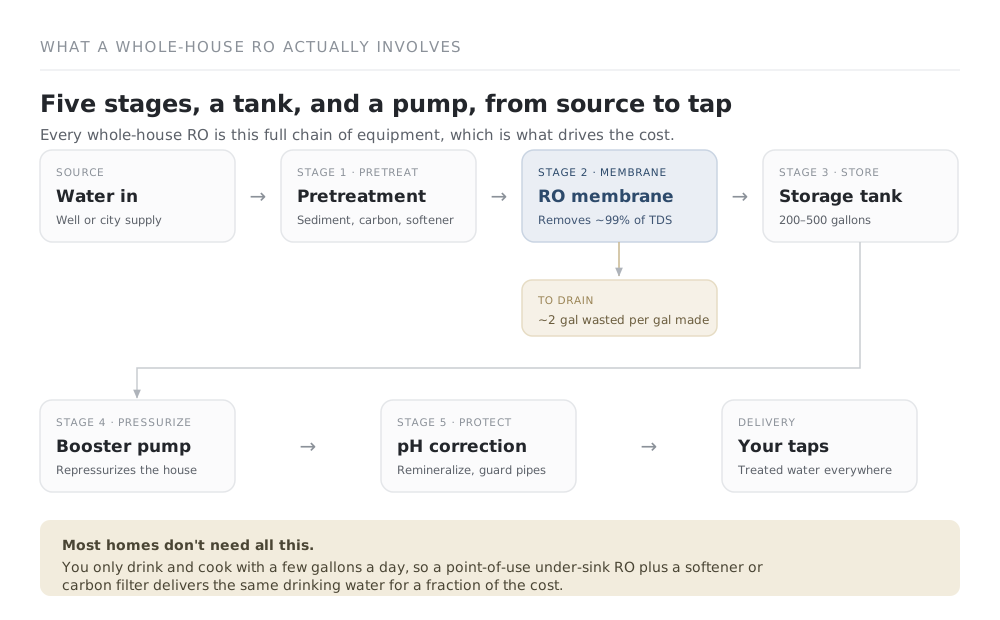
Here is the full train, in order:
Pretreatment comes first, and it’s mandatory. Raw water hits sediment, carbon, and usually a softener before it reaches the membrane. Iron, hardness, and chlorine destroy reverse osmosis membranes if it doesn’t.
The reverse osmosis membrane bank does the real work. It removes up to around 98–99% of TDS. It also targets dissolved contaminants like arsenic, nitrate, sulfates, and PFAS, while flushing a large reject stream to the drain.
A storage tank holds the output. The membrane can’t keep up with a running shower and a dishwasher at once. So the treated water collects in a 200–500 gallon atmospheric tank.
A repressurization pump sends it to the house. Water sitting in an open tank has no pressure. A booster pump pushes it back up to normal household pressure on demand.
A pH-correction stage protects your plumbing. This last step is the one most sales pages skip. It matters more than any other, so it gets its own section below.
That’s five stages and two big pieces of hardware, a tank and a pump, before a drop reaches your faucet.
The stack is why the price and the maintenance are what they are.
The corrosive-water problem nobody mentions
Pure reverse osmosis water is stripped of minerals. It’s slightly acidic and chemically “hungry.”
Left untreated and run through your house, it slowly leaches copper and lead out of your pipes and fittings. Over years, that means pitting and pinhole leaks.
That’s why every proper point-of-entry reverse osmosis install adds a remineralization or acid-neutralizer stage after the membrane. This raises the pH back to a safe range before the water enters your plumbing.
This is the sharp difference between whole-house and under-sink reverse osmosis.
Under the sink, remineralizing is a taste preference, and the water only ever touches a short run of tubing to one faucet.
At the whole-house level, skipping pH correction can quietly damage the entire plumbing system. So every proper install includes it as a standard stage.
The cost is real and worth naming. US Water Systems lists its remineralization add-on for the Defender at about $1,295 on top of the base system. (US Water Systems)
What whole-house reverse osmosis really costs
The sticker price is only the beginning. A whole-house reverse osmosis is a full system: a tank, a pump, pretreatment, and consumables that keep costing after install.
A whole-house reverse osmosis install runs from about $2,000 at the low end. Most homes pay $3,000–$8,000 once you add the tank, pump, pretreatment, pH correction, and professional labor.
Then there’s the running cost, which never stops.
| Cost line | What to expect | Source |
|---|---|---|
| System, installed (tank + pump + pretreat + labor) | ~$2,000 low; $3,000–$8,000 typical | — |
| Wastewater | ~2 gallons drained per gallon made; can roughly double a water bill | — |
| reverse osmosis membrane replacement | Every 2–4 years with pretreatment; as little as 6 months without | — |
| Pre/post filters + tank sanitizing | Filter changes every 6–12 months, plus periodic whole-system sanitizing | — |
| Pump electricity | Runs on demand to pressurize the house (continuous small draw) | manufacturer specs |
| An under-sink reverse osmosis instead | ~$150–$650 one time | Home Depot |
The wastewater line is the one people underestimate.
Because a point-of-entry system treats all your water, that roughly 2-to-1 reject stream runs continuously. One vendor warns it can effectively double your water bill.
That’s a permanent tax on every gallon your house uses, not just the gallons you drink. It’s the core reason point-of-use reverse osmosis wins for most people.
What size (GPD) you’d need
Whole-house reverse osmosis is sized in gallons per day (GPD), and household units are large.
Most homes need somewhere around 500–1,500 GPD, with big families or properties reaching 2,500 GPD or more.
Compare that to a 50–100 GPD tank-style under-sink unit, and you can see the gap. A whole-house system is an order of magnitude bigger. That’s what the tank and booster pump are for.
You also can’t run the membrane flat out, because constant running shortens its life. So the system pairs with a few hundred gallons of storage to buffer demand.
Sizing is a job for the installer, working from your water test and your household’s peak use. Treat these numbers as the ballpark, not a spec to buy from.
If you genuinely need one: what to look at
Suppose your water test does justify it, a very high-TDS or brackish well, or a whole-home contaminant you’ve confirmed.
At that point you want a purpose-built point-of-entry system, with the tank, pump, and pretreatment engineered together. Buy it from a company that treats problem water for a living.
The US Water Systems Defender is the specialist pick here. It’s built in 4,000, 6,000, and 8,000 GPD sizes, with a matched atmospheric tank, a Grundfos delivery pump, and up to 99% TDS reduction, per the manufacturer’s specs. (US Water Systems)
Its base list price runs around $10,000. Add the mandatory remineralization stage at about $1,295 more, and anti-scalant pretreatment at about $749. That’s an honest picture of what a real whole-house reverse osmosis costs installed.
One caution worth stating: no whole-house reverse osmosis system we found publishes an NSF/ANSI 58 certification number, the Defender included. So treat contaminant-reduction figures as manufacturer claims, and match them to your specific water test.
Check price at US Water Systems(opens on US Water Systems, external site)If you’d rather stay with proven equipment at a lower price, look at builds from vendors like reverseosmosis.com. They pair a 300-gallon tank, a variable-speed repressurization pump, an acid neutralizer, and UV in the $6,950 range. Pretreatment is sold separately. (reverseosmosis.com)
And if this is starting to sound like more system than your problem needs, that’s the signal. Go back and price an under-sink reverse osmosis, plus a whole-house softener or carbon filter, instead.
How to keep a whole-house reverse osmosis alive
These systems live or die on maintenance, because a fouled membrane or a neglected tank fails fast.
- Sediment and carbon prefilters: change every 6–12 months, sooner on rough well water.
- reverse osmosis membrane: 2–4 years with proper pretreatment, as little as 6 months without it.
- Storage tank: sanitize on a schedule, since an atmospheric tank is vented to the air.
- Repressurization pump: a mechanical part that runs on demand, so inspect and service it periodically.
- pH / remineralization media: tops up or replaces as it depletes, on a schedule set by your water chemistry.
- Pretreatment softener or iron filter: keeps its own salt and media schedule on top of the reverse osmosis’s.
The pretreatment is the part people skimp on. It’s also the part that protects the most expensive component, the membrane. So it’s the last place to cut corners.
Frequently asked questions
Do I really need a whole-house reverse osmosis system?
Probably not. It’s the right tool only when your source water is genuinely bad at every tap, like a very high-TDS or brackish well, or a confirmed whole-home contaminant. If you mainly want clean drinking water, an under-sink reverse osmosis at the kitchen tap does that job for a few hundred dollars.
Whole-house reverse osmosis or under-sink reverse osmosis, which do I need?
Under-sink reverse osmosis for almost everyone, because you only drink and cook with a few gallons a day. Whole-house reverse osmosis makes sense only when the water needs treating everywhere. That’s a narrow set of source-water problems.
How much does a whole-house reverse osmosis system cost installed?
Roughly $3,000–$8,000 for most homes once you include the storage tank, repressurization pump, pretreatment, pH correction, and labor. Specialist systems like the US Water Systems Defender start around $10,000 before options.
Is whole-house reverse osmosis water safe for my pipes?
Only after pH correction. Untreated reverse osmosis water is acidic, and can slowly leach copper and lead from your plumbing. So a point-of-entry system must add a remineralization or neutralizer stage before the water reaches the house.
Does a whole-house reverse osmosis system need a tank and a pump?
Yes, both. The membrane makes water slowly and at low pressure, so treated water collects in a 200–500 gallon tank. A booster pump then repressurizes it to feed the house on demand.
How much water does whole-house reverse osmosis waste?
About 2 gallons go to the drain for every gallon produced. Because a whole-house system treats all your water, that reject stream is continuous. It can roughly double your water bill.
Does whole-house reverse osmosis remove arsenic, nitrate, and PFAS?
Yes. Reverse osmosis reduces arsenic and nitrate. The EPA reports that high-pressure membranes like reverse osmosis are typically more than 90% effective at removing a wide range of PFAS, along with TDS and other dissolved contaminants. (EPA) For most homes, an under-sink reverse osmosis removes the same things in your drinking water for far less.
What pretreatment does the membrane need, and how long does it last?
Sediment, carbon, and usually a softener ahead of the membrane. With that pretreatment a membrane lasts 2–4 years; without it, fouling can kill it in as little as 6 months.
Do I have to remineralize whole-house reverse osmosis water?
For a whole-house system, yes, effectively. Untreated reverse osmosis water is corrosive to plumbing. Under the sink it’s a taste preference; at the whole-house level pH correction is a required safety stage.
What size whole-house reverse osmosis do I need?
Most homes land around 500–1,500 GPD, with large households needing 2,500 GPD or more, paired with a few hundred gallons of storage. Size it with an installer from your water test and peak use, not from a chart.
Can I just filter my drinking water instead of the whole house?
Yes, and for most people that’s the smarter move. An under-sink reverse osmosis handles the water you ingest. A softener or carbon filter takes care of scale, chlorine, and taste at every tap, for a fraction of the cost.
Not sure reverse osmosis is even the right tool for your water? Start with the home water filtration system guide, which routes you by what’s actually in your water.
Ready to treat just your drinking water? See best under-sink reverse osmosis system for the mainstream pick.
Comparing reverse osmosis types in general? The best reverse osmosis system guide covers under-sink, tankless, and whole-house side by side.
How we researched this
We built this guide from EPA drinking-water treatment guidance, and from whole-house reverse osmosis documentation and pricing from specialist vendors (US Water Systems, reverseosmosis.com). We also drew on real-owner reports on cost, wastewater, and pipe corrosion.
We don’t run these systems ourselves yet, so we don’t claim first-hand testing. Every figure here is attributed to its source.
Prices, sizes, and drain ratios in this category move fast, and depend heavily on your water. Treat every number as a starting point, and confirm the current spec before you buy.
When we name a merchant we may earn a commission if you buy through a link here, at no cost to you.