Best fluoride water filter: what actually removes it
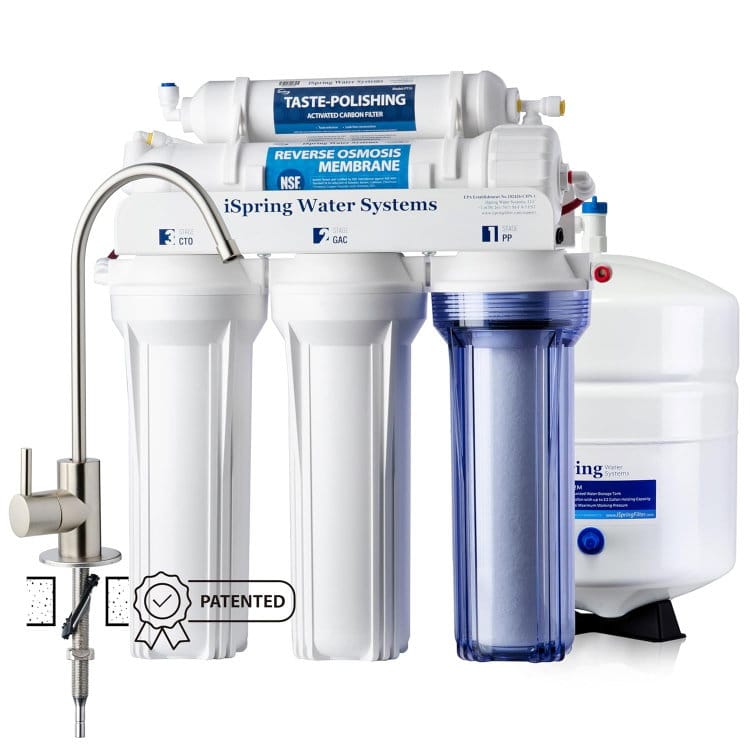
- Certified to NSF/ANSI 58, the reverse osmosis standard, and carries the WQA Gold Seal against it.
- Reverse osmosis reduces fluoride and a broad list of dissolved contaminants in one step.
- About $230, the value benchmark for certified reverse osmosis.
- Filters are common parts, so running costs stay low.
Here’s the part most pages bury: most water filters do not remove fluoride.
Not Brita. Not PUR. Not the standard carbon block in most under-sink and whole-house systems.
Fluoride is a tiny, chemically stable ion, and ordinary carbon filters can’t grab it. Removing it takes a different kind of filter.
A real fluoride water filter uses one of three methods: reverse osmosis, activated alumina, or bone char carbon.
For most homes, the practical answer is reverse osmosis, and our overall pick is the iSpring RCC7, an under-sink system certified to NSF/ANSI 58 for about $230.
If you rent or won’t drill your cabinet, the AquaTru Classic is a countertop reverse osmosis unit that needs no plumbing, for about $449.
First, the fluoride facts you’re buying against
Whether you want to reduce the fluoride in your water is your decision. This page doesn’t take a side on that. It answers a narrower question: if you’ve decided to, what filter actually does it?
To buy well, it helps to know the numbers your water is measured against.
The EPA sets an enforceable limit, called a maximum contaminant level, of 4.0 milligrams per liter (mg/L) for fluoride in public water. That limit was set in 1986 and most recently reviewed in 2024. (EPA)
The EPA also has a second, non-enforceable guideline of 2.0 mg/L, aimed at the cosmetic tooth discoloration (dental fluorosis) that higher long-term exposure can cause in children. (EPA)
Systems that add fluoride aim much lower. Since 2015 the U.S. Public Health Service has recommended an optimal level of 0.7 mg/L in community water that’s fluoridated. (Federal Register)
So a public supply that meets the rules can still contain fluoride, either added at around 0.7 mg/L or naturally present up to the 4.0 mg/L limit.
If you want to know your own number, start with a test. Well owners especially should test, because private wells aren’t regulated and natural fluoride varies a lot by geology.
Why most filters don’t remove fluoride
This is the trap that sends people back to the store.
You’d expect a good carbon filter to handle fluoride the way it handles chlorine. It doesn’t, and the reason is chemistry.
Carbon works by adsorption: contaminants stick to the huge surface area inside the carbon. That works well for chlorine, many organic chemicals, and taste and odor. Fluoride ions are small, and they’re too stable to bind to carbon that way.
So a pitcher or faucet filter can make your water taste better and still leave the fluoride untouched.
The methods that do remove fluoride each work differently:
- Reverse osmosis pushes water through a membrane so fine that dissolved ions, fluoride included, stay behind. A good RO system reduces roughly 85 to 95% or more.
- Activated alumina is a media that fluoride ions chemically stick to. It’s the workhorse of high-fluoride treatment, and it works best when the water is slightly acidic.
- Bone char carbon is carbon made from bone, and its calcium-phosphate structure binds fluoride that ordinary carbon can’t.
- Distillation boils water to steam and condenses it, leaving fluoride behind in the boiling chamber.
For most households, reverse osmosis is the one to reach for. It’s widely available, certified, and it removes fluoride alongside lead, arsenic, nitrate, and PFAS in one step.
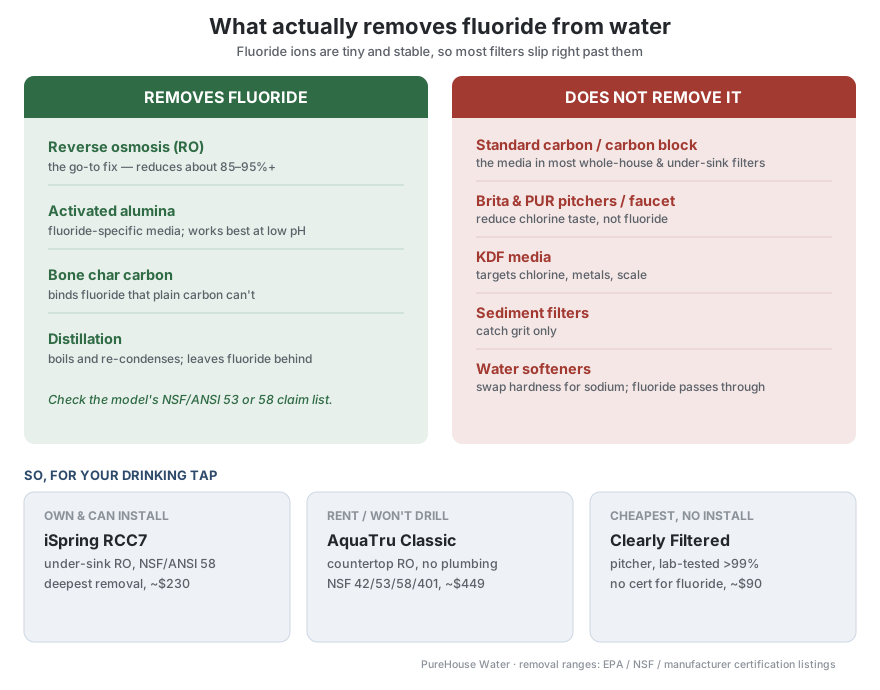
Which filter media remove fluoride
| Filter media | Removes fluoride? |
|---|---|
| Reverse osmosis | Yes, about 85 to 95%+ |
| Activated alumina | Yes, fluoride-specific media |
| Bone char carbon | Yes |
| Distillation | Yes |
| Standard carbon / carbon block | No |
| Brita & PUR pitchers / faucet filters | No |
| KDF media | No |
| Sediment filters | No |
| Water softeners | No |
Keep this table in mind when you read a product page. A filter can be excellent and still do nothing for fluoride, because it was built for a different job.
Buy by the certified claim, not the marketing
“Reduces fluoride” on a box is a marketing claim until an independent lab has checked it.
Two NSF/ANSI standards matter here. NSF/ANSI 53 covers health-related reduction claims and includes a specific fluoride-reduction test. NSF/ANSI 58 is the standard written for reverse osmosis systems. (NSF)
When a model is certified to one of those standards for fluoride, an accredited lab has verified the claim. That’s the strongest proof you can get.
Plenty of good products are lab-tested but not formally certified for fluoride. That’s a step below certification, not a red flag, as long as the testing is done by an accredited third-party lab and the results are published. We’ll flag which is which on each pick.
The picks
iSpring RCC7
| Spec | Value |
|---|---|
| Method | 5-stage reverse osmosis |
| Certification | NSF/ANSI 58 + WQA Gold Seal |
| Output | ~75 gallons per day |
| Install | Under-sink; drain saddle + faucet |
| Price | ~$230 |
The iSpring RCC7 is our overall pick because it treats fluoride at the source that matters, your drinking tap, and it’s certified to the standard written for reverse osmosis. iSpring says it reduces up to 99% of more than 1,000 contaminants, including fluoride, arsenic, and PFAS. (iSpring)
It’s a five-stage tank system: sediment and carbon pre-filters, the reverse osmosis membrane, and a post carbon filter, feeding its own small faucet.
Discount codeuse REFISPRING at checkout to save on this order.
Why it scores 8.5i
Each sub-score is our assessment, weighted into the overall. It reflects published specifications, certification listings and warranty terms — not systems we ran ourselves. How we score
- Performance9/10
- A five-stage membrane that reduces the dissolved contaminants nothing else reliably touches — arsenic, nitrate, lead, fluoride, PFAS and total dissolved solids — at 75 gallons a day. Short of the top because it treats one tap and sends several gallons to the drain for each one it makes. Source ↗
- Value10/10
- About $230 for certified reverse osmosis is the value benchmark of the whole category: nothing else on this site removes as much for as little. The filters are commodity parts rather than proprietary cartridges, so the running cost stays low for the life of it. Source ↗
- Ownership6/10
- The most involved install of any drinking-water pick here: a faucet hole to drill, a drain saddle to tap and a pressurized tank to find room for. Then filters every six to twelve months and a membrane every two to three years. Source ↗
- Trust8/10
- Certified to NSF/ANSI 58, the standard written for reverse osmosis, and carrying the WQA Gold Seal against it. Held short of the top because iSpring's "over 1,000 contaminants" headline is broader than the certified claim list underneath it. Source ↗
AquaTru Classic
| Spec | Value |
|---|---|
| Method | 4-stage countertop reverse osmosis |
| Certification | IAPMO to NSF/ANSI 42, 53, 58, 401 |
| Install | None; plug-in, refill by hand |
| Recovery | 4:1 (efficient for the format) |
| Price | ~$449 |
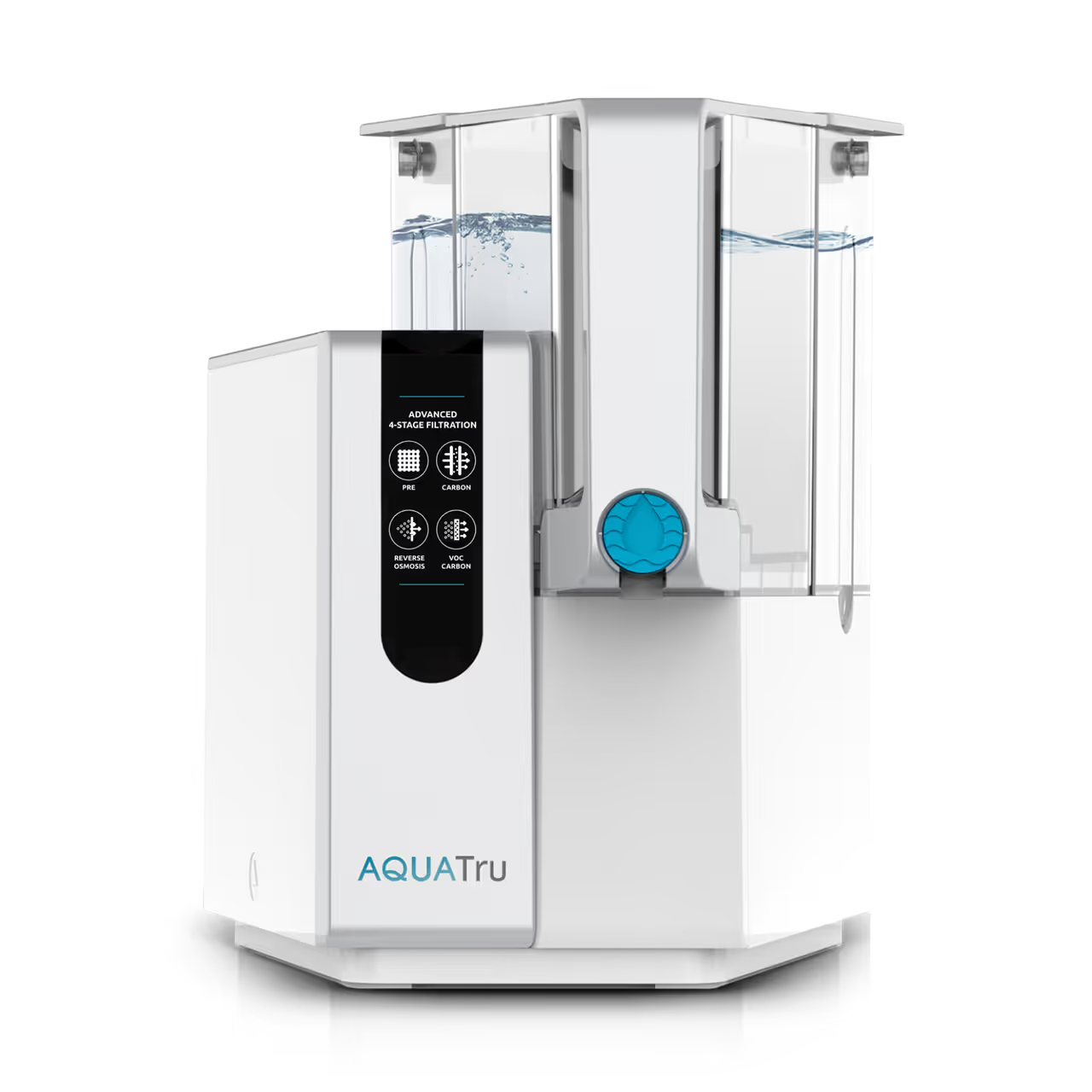
The AquaTru Classic is the pick when you can’t install under the sink. It’s a countertop reverse osmosis unit independently certified by IAPMO to NSF/ANSI 42, 53, 58, and 401 for every contaminant it claims, fluoride among them. (AquaTru)
You fill the tap-water tank, the system purifies it, and clean water collects in a separate tank you pour from. No drilling, no drain line, no landlord conversation.
Why it scores 8.3i
Each sub-score is our assessment, weighted into the overall. It reflects published specifications, certification listings and warranty terms — not systems we ran ourselves. How we score
- Performance9/10
- A genuine reverse osmosis membrane with no plumbing at all — lead, arsenic, fluoride, PFOA and PFOS among more than eighty contaminants, at a 4:1 recovery ratio that is efficient for the format. The ceiling is throughput: 0.75 gallons of clean water per tank fill. Source ↗
- Value7/10
- About $449, plus roughly $60 a year in proprietary filters, is more than a certified under-sink system that does the same job out of sight. That gap is the price of not drilling, which for a renter is the whole point. Source ↗
- Ownership7/10
- Nothing to install, no drain to tap and no faucet hole to cut. Against that, it is a large two-tank appliance holding real counter space, and both tanks are filled and emptied by hand. Source ↗
- Trust10/10
- Independently certified by IAPMO to NSF/ANSI 42, 53, 58 and 401 for every one of the contaminants it claims to reduce. That is the broadest verified claim list of any product on this site, and the reason it stays a safe answer when a test flags something serious. Source ↗
Brita, PUR, and plain carbon filters
Skip them because Brita and PUR pitchers and faucet filters, and the standard carbon or carbon block in most under-sink and whole-house systems, are built to reduce chlorine, taste, and some other contaminants, not fluoride. They’re genuinely good at that job. They just don’t remove fluoride, so if that’s your goal, they’ll disappoint you no matter how well-reviewed they are. For fluoride, you need reverse osmosis, activated alumina, or bone char.
What a fluoride filter costs to own
The sticker price is the start, so budget for filters before you buy.
A reverse osmosis system like the iSpring runs its sediment and carbon filters about every 6 to 12 months, and the membrane every 2 to 3 years. Plan on roughly $50 to $80 a year. (iSpring)
The AquaTru uses proprietary filter sets at about $60 a year. (AquaTru)
There’s a water cost with reverse osmosis too. The membrane sends some water to the drain to work, so a few gallons go down for every gallon of clean water made.
Whole-house or just the drinking tap?
Almost nobody needs to remove fluoride from the whole house.
Fluoride matters for what you drink and cook with, so treating one kitchen tap solves it for far less money. That’s why every pick here is a point-of-use unit.
Whole-house fluoride removal exists, using large activated-alumina or bone-char tanks, but it’s expensive, needs monitoring, and treats water you only bathe in. Unless a lab test shows very high fluoride and a specific reason to treat everything, put your money on the drinking tap.
If your water has other whole-house problems, chlorine, sediment, hardness, a whole-house carbon filter handles those on the main line, and you add a reverse osmosis unit at the kitchen for fluoride. The two do different jobs.
Frequently asked questions
Does reverse osmosis remove fluoride?
Yes. A reverse osmosis system pushes water through a fine membrane that dissolved fluoride can’t pass, reducing roughly 85 to 95% or more. It’s the most practical fluoride filter for most homes because it also removes lead, arsenic, nitrate, and PFAS in the same step.
Does a Brita or PUR filter remove fluoride?
No. Standard Brita and PUR pitchers and faucet filters use carbon, which reduces chlorine and taste but not fluoride. Fluoride ions are too small and stable to bind to carbon. To remove fluoride you need reverse osmosis, activated alumina, or bone char.
What is the best filter to remove fluoride?
For most homes, a certified reverse osmosis system. Our overall pick is the iSpring RCC7 under-sink unit, certified to NSF/ANSI 58, for about $230. Renters who won’t drill can use the countertop AquaTru Classic.
Is fluoride in tap water dangerous?
The EPA’s enforceable limit is 4.0 mg/L, and fluoridated systems aim for about 0.7 mg/L. Whether to reduce fluoride below the legal limit is a personal choice. If you decide to, a fluoride filter is how you do it. If you’re unsure of your level, test your water first.
Does activated carbon remove fluoride?
No, ordinary activated carbon does not remove fluoride. A specialized form called bone char carbon does, because its calcium-phosphate structure binds fluoride. Regular coconut-shell or coal-based carbon block, the kind in most filters, leaves fluoride in the water.
Do I need to remove fluoride from my whole house?
Almost never. Fluoride matters for drinking and cooking water, so a point-of-use unit at the kitchen tap solves it for far less than a whole-house system. Whole-house fluoride removal is expensive and mainly treats water you only bathe in.
Want to know your fluoride level before you buy? A home test or a certified lab tells you what you’re treating, and whether fluoride is even your issue.
Worried about lead too? Many of the same reverse osmosis systems handle it; see our guide to a lead water filter.
Dealing with forever chemicals? Read PFAS water filter, since reverse osmosis covers both.
Ready to compare reverse osmosis systems in depth? Start with under-sink reverse osmosis, or the no-drill countertop reverse osmosis route.
Not sure which filter your water needs at all? The best drinking water filtration system guide routes you by what’s in your water.
How we researched this
We built this guide from the EPA’s fluoride regulations, the U.S. Public Health Service recommendation, the NSF/ANSI standards, and the certification listings and manufacturer testing for each product named (iSpring, AquaTru).
We don’t run these systems ourselves yet, so we don’t claim first-hand testing, and every figure here is attributed to its source.
Prices, certifications, and filter costs change, so treat every number as approximate and confirm the current spec and certification listing on the model before you buy.
When we name a merchant we may earn a commission if you buy through a link here, at no cost to you.
Sources
- EPA — Fluoride in Drinking Water (4.0 mg/L maximum contaminant level; set 1986, reviewed 2024)
- EPA — Secondary Drinking Water Standards (2.0 mg/L guideline, dental fluorosis)
- Federal Register — U.S. Public Health Service recommendation of 0.7 mg/L for fluoridated community water (2015)
- NSF — NSF/ANSI 58: Reverse Osmosis Drinking Water Treatment Systems
- iSpring — RCC7 5-Stage Under-Sink Reverse Osmosis, certified to NSF/ANSI 58, 75 GPD
- AquaTru — Classic Countertop Reverse Osmosis Water Purifier (IAPMO NSF/ANSI 42/53/58/401, filter costs)